
A Perth Curtain Maker’s View: What Is Actually Changing
– Colour, texture and the 2026 shift
Every year there is a list. Fabric houses publish one, magazines publish one, and by March the same six ideas have been repeated far enough that they start to look like facts. I have been making curtains in Perth long enough to have watched several of those lists come and go, and to have seen what happens in a house four years later when someone bought the list rather than the window.
So this is not that. Below are the curtain trends I have genuinely seen change in what people ask for, what has gone quiet, and what is worth acting on. There is also an argument at the end that runs against the whole idea of a trends post, and I think it is the most useful part.
The clearest change in the last two years is colour. Not pattern – solid colour. Green, orange and pink, in flat weaves and unbroken fields, on curtains that are meant to be seen rather than to disappear into the wall.
That is a real shift in what people want a window to do. For most of the last decade the brief was to make the window quiet. Now, in a lot of the Perth homes we work in, the curtain is the colour in the room, and the furniture and the walls are doing the neutral work instead.
It is a better trend than most, because solid colour is a decision about the room rather than a decision about a season. A patterned fabric announces roughly when it was bought. A deep green does not, in the same way that a green sofa from twenty years ago still reads as a green sofa. If you are drawn to it, look at the [curtain fabrics](https://hayinteriors.com.au/curtains-perth/fabrics/) with the rest of the room in front of you, not on a screen, and look at the colour in the actual light the window gets. West-facing rooms in Perth are unforgiving about this, and a colour that reads warm in a showroom in the morning can read quite differently at four in the afternoon.
The other side of the same change: white and grey sheers are being asked for noticeably less than they were.
I want to be careful here, because this is a shift in palette, not a verdict on the product. Sheer curtains still do something nothing else does. They hold privacy through the day while keeping the light and the view, they soften hard glass and hard flooring, and in a room with a lot of window they are the difference between light and glare. None of that has changed and none of it is going to.
What has changed is that the default neutral sheer, the one specified because it was safe, is losing to colour and to texture. Where sheers are still going in, they are more often doing a defined job rather than being the whole answer – layered behind a heavier curtain, or chosen in a tone rather than in white by reflex.
If a room needs a sheer, it needs a sheer. Just choose it because of what it does at that window, not because it is the quiet option.


Texture is the third genuine movement, and it arrives with a word attached: bouclé. It is worth being precise about this one, because it is where I most often have to give an answer nobody wants.
True bouclé is a looped yarn woven into a heavy, deeply textured cloth. It is an upholstery fabric by construction. It is wonderful on a chair, and it is very good on a bedhead, which is why you are seeing so much of it. As a curtain it does not behave. The weight and the loop structure fight the pleat, so it will not fold cleanly or hang the way a drapery fabric hangs, and the loops catch on anything they meet.
What does work is bouclé-look drapery fabric: cloth engineered to read with that same nubbed, tactile surface while being built to hang. You get the texture at the window without asking an upholstery cloth to do a job it was never woven for. If the look is what you are after, that is the honest route to it, and we sew curtains from these fabrics regularly.
Bouclé is not the only way to get texture at a window, and it is not the one I would reach for first. Linen is the fabric doing most of the work in this shift, and unlike bouclé it was woven to hang. The irregularity in the weave, the way it takes light, the softness in the fall — that is texture arriving as part of the cloth rather than as a surface effect applied to it. It comes with its own conditions, because natural linen creases and moves with the weather and not everybody wants that, and there are blends and linen-look polyesters for people who want the texture without the behaviour. Our post on linen curtains sets out the difference and which one you are likely to be.
If it is the true bouclé you love, put it where it belongs. Look at James Dunlop’s bouclé range and you will notice something useful: every fabric in it is catalogued as upholstery. That is the trade telling you what the cloth is for. We stock James Dunlop, so if you have fallen for one of those, we can put it on a chair, a window seat or a bedhead rather than at the window. Our custom upholstery work and our upholstered bedheads are exactly where that fabric earns its place, and you can carry the texture through a room that way without compromising the curtains.
Trend lists describe what is being promoted. Search data describes what people are typing at eleven o’clock at night when they are trying to solve something. The two do not always agree, and where they disagree the search data is usually closer to the truth.
Three things have risen sharply. Floor-to-ceiling curtains have grown enormously as an enquiry, which tracks with how Perth houses are being built and renovated – taller openings, more glass, fewer small punched windows. Acoustic curtains have risen just as fast, driven by smaller blocks, closer neighbours and more people working from home. And interest in motorised curtains keeps climbing, mostly for the windows nobody can comfortably reach.
None of those three is a trend in the decorative sense. They are people describing a problem. That is the useful signal in the data: what is really growing is not a look, it is a set of practical requirements that the room now has and did not have before.
One thing has been coming up repeatedly and I usually argue against it: splitting a single wide window into several separate Roman blinds sitting side by side.
It photographs beautifully. In a room it can read as busy, and it introduces vertical breaks across a view that was continuous. There are windows where separating the blinds is genuinely the right call, and that is a judgement about the specific opening rather than a rule, so it is worth having the conversation before the fabric is cut. Our Roman blinds page goes into how we approach wide windows, and it is the sort of thing best decided with the window measured and the fabric in your hand.
Here is the part I actually care about.
Curtains made properly are a fifteen-year purchase. Often longer. Trends turn over every two or three years. So if you choose curtains from a trend list, you are matching something with a fifteen-year life to something with a three-year one, and you will be living with the mismatch for the remaining twelve.
The other things in the room do not move on that cycle either. Your sofa does not change every two years. Your rugs do not. The way you actually use the room – where the sun comes in, where the television is, which window the neighbours can see through, whether anyone in the house sleeps badly – does not change at all. Those are the fixed points. A trend is not one of them.
So the question is never what is in this year. It is what suits this house, this room, this light and the people living in it. Sometimes the answer happens to be a trend, and that is fine. Green is having a moment and green may well be right for you. But it should be right because of the room, not because of the year.
That is also why the choice of product matters more than the choice of colour. If you are still deciding between the two, our guide to curtains or blinds works through it, and the answer usually comes from the window rather than from fashion.
We are a curtain maker, not a retailer of the season’s look. Everything we sew is made in our Nedlands workroom, and the reason we ask so many questions before quoting is that we are not trying to sell you this year – we are trying to get you something you still like in 2040. That is what custom made curtains should mean.
If you would like to talk it through with the fabric in front of you, we work with clients on curtains and blinds across Perth, and you are welcome to come and see the range.
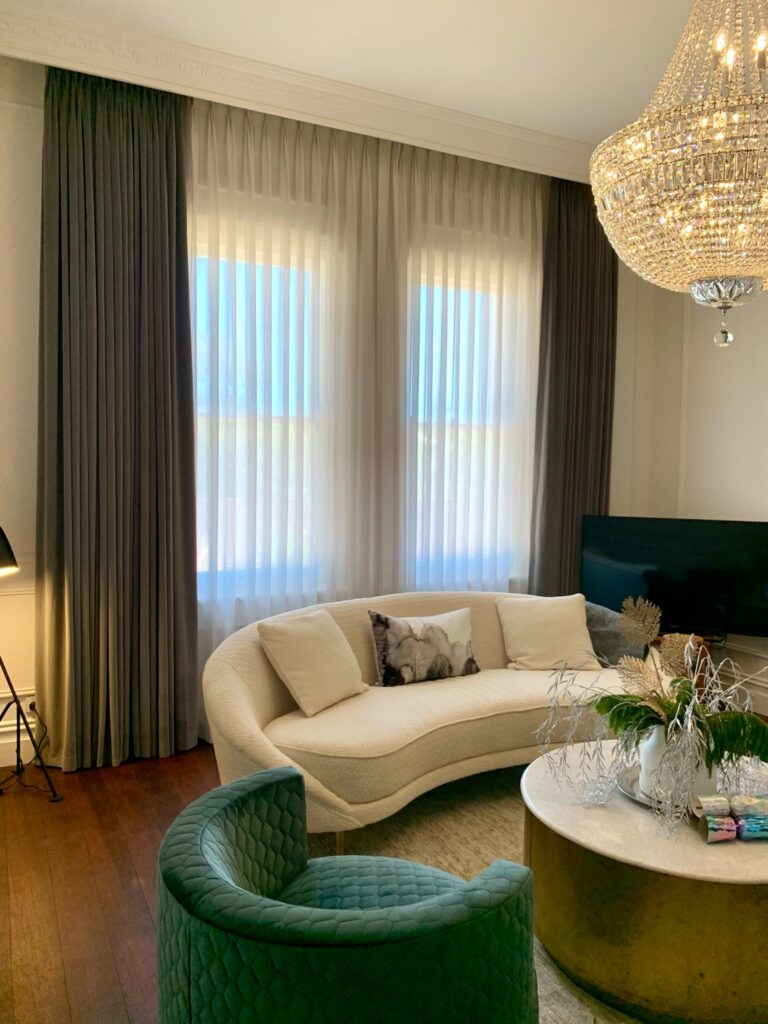
The clearest shift is a return to solid colour, particularly green, orange and pink, rather than pattern. White and grey sheers have gone quieter as a result. Texture is the third movement, arriving mostly as bouclé-look drapery fabric. Alongside those, enquiries for floor-to-ceiling curtains, acoustic curtains and motorised tracks keep rising, though those are practical requirements rather than decorative trends.
Yes. What has changed is the palette, not the product. The default white or grey sheer is being specified less often, but sheers still do something nothing else does: privacy through the day without losing the light or the view. Choose one because of what the window needs, not because it is the safe option.
Not from true bouclé. It is a looped upholstery cloth, and its weight and structure mean it will not hold a pleat or hang the way a drapery fabric does. Bouclé-look drapery fabrics give you the same texture and are built to hang, and we sew curtains from those regularly. True bouclé belongs on a bedhead or a chair.
Made properly and looked after, fifteen years is a reasonable expectation and many last longer. That lifespan is the reason we are cautious about trend-led choices: a look turns over every two or three years, while the curtain does not.
Only where the trend happens to suit the room. Your furniture, rugs and the way you use the space do not change on a two-year cycle, and neither does the light the window gets. Those fixed points should drive the decision, with the trend as a coincidence rather than a reason.
There is no single answer, but there is a rule worth following: judge the colour in the light that window actually gets, at the time of day you use the room. West-facing rooms here are unforgiving, and a tone that reads warm in the morning can look quite different by late afternoon. Always view a decent-sized sample at the window rather than choosing from a screen.