
How the Wave Heading Works, and When It Is the Wrong Choice
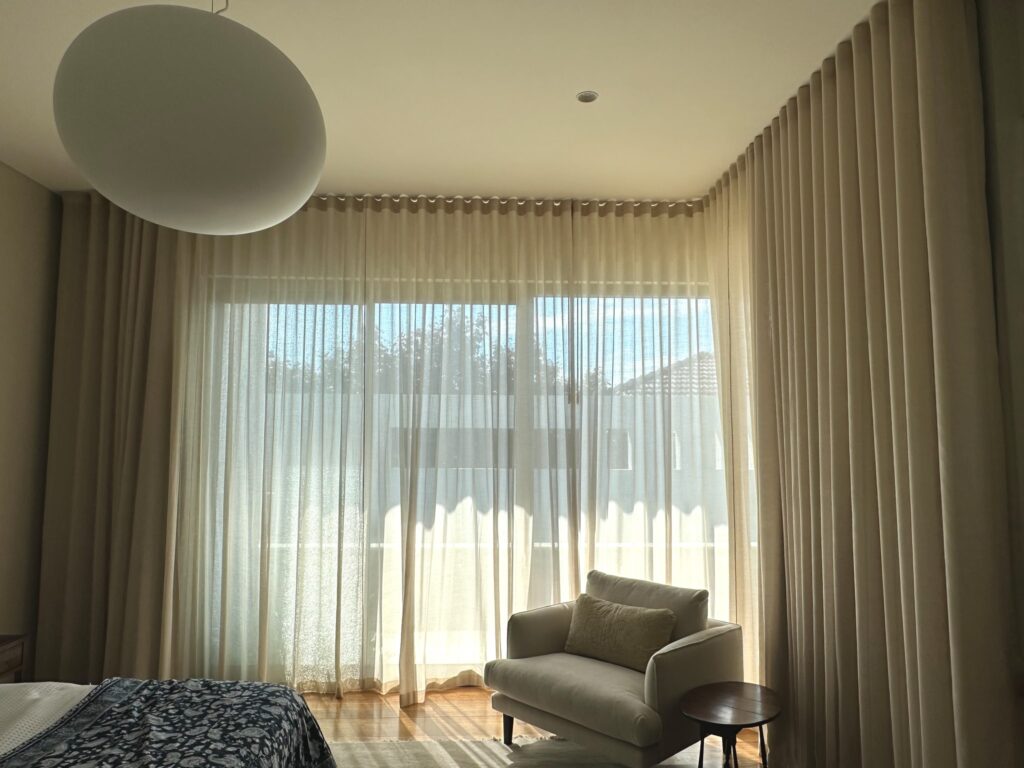
S-wave is the heading that made modern curtains look modern. Instead of gathering fabric into pleats at the top, it holds the fabric in a continuous, even wave from one end of the track to the other, and that wave carries all the way down to the floor. It is the heading you have seen in architectural photography and in apartment towers, and it is the one people most often describe to us without knowing its name – they say they want curtains that ripple rather than pleat.
You will see it written two ways. S-wave and s-fold mean the same thing. Some suppliers and some tracking systems use one, some the other, and there is no difference in the product. We use s-wave as our lead spelling because that is what most people say out loud, but if you have been quoted for s-fold curtains, you are being quoted for this.
This guide covers how the wave is actually built, what it needs in order to look right, and – just as usefully – the three situations where we would suggest a different heading. If you want the full range of heading options side by side rather than one in depth, our guide to curtain headings and heading styles covers the wider set.
The wave is not created by the fabric. It is created by the track.
A specialist wave track carries gliders at a fixed spacing, and a tape sewn into the top of the curtain clips onto those gliders at matching intervals. Because every glider sits the same distance from the next, the fabric between them has no choice but to bow forward and back in a regular rhythm. Pull the curtain closed and the wave holds its shape across the whole run. Pull it open and it stacks back in neat concertina folds.
We specify 60mm glider spacing. That is the interval that produces a wave with enough depth to read as a wave from across the room, without the fabric crowding on itself. Wider spacing flattens the curve out until it looks like a poorly hung flat panel. Narrower spacing makes the folds tight and busy and costs you fabric for no visual gain.
Everything else about the curtain – the fabric, the lining, the hem, the width joins – we make in our Nedlands workroom the same way we would for any other heading. The wave tape and the track are what make it an s-wave. The rest is ordinary good curtain making.
Fullness is the ratio between the width of fabric used and the width of the window it covers. It is the single number that decides whether an s-wave looks like the photograph you had in mind. Wave headings are usually quoted as a percentage where pleated headings are quoted as a multiple. 100% means one metre of extra fabric for every metre of track, so 100% is 2 times the track width, 120% is 2.2, and 80% is 1.8.
We cut s-wave at 2.2 times the track width — what the trade calls 120% fullness. That is the ratio at which the wave is full and even and holds its curve when the curtain is closed. The common standard is 100%, or 2 times, and even go under that. The heading will still function, the curtain will still open and close, and in a quote it will still be described as an s-wave.
Annie has seen curtains made at 80% — 1.8 times the track width. You can tell immediately. At that ratio there is not enough fabric to fill the distance between gliders, so instead of bowing forward the fabric is pulled taut between clips. The wave goes shallow and slack, the curtain reads as thin, and the stack when it is open looks stringy rather than plump. Nothing about it is broken. It simply looks cheap, permanently, and the only way to fix it is to remake the curtain.
This matters when you are comparing quotes, because fullness is rarely the number anyone leads with. Two quotes for s-wave curtains in the same fabric can differ substantially and both be honest, and the difference can be sitting entirely in a ratio nobody mentioned. It is a fair question to ask of anyone quoting you, including us: what fullness is this made to?
Full-height glass. The wave was made for floor-to-ceiling windows and sliding doors, where the eye reads the whole drop at once and any irregularity in the heading shows all the way down. If that is your situation, our guide to floor-to-ceiling curtains covers the drop, the track position and the stacking questions in more detail.
Sheers. An s-wave in a fine fabric is one of the best things you can do to a modern room. The light comes through the curve of each wave differently to the flat of it, so the fabric shows depth rather than reading as a screen. A great many of the sheer curtains we make are s-wave for exactly this reason. The caveat is that the sheer has to have enough body to carry the wave down its full length — not all of them do, and a soft linen sheer is the one most likely to disappoint.
Wide runs. Because the wave is a repeating unit, it holds its rhythm across a very wide window in a way that pleating does not always manage. A six-metre run of s-wave looks intentional. It also pairs naturally with motorised curtains, since the even glide of a wave track suits a motor better than a heavier gathered heading.


The house is not modern. S-wave belongs to a particular architectural language – clean lines, plain surfaces, minimal trim. In a federation home with deep skirtings, picture rails and ornate cornices, the wave fights the room. It does not look contemporary in that setting, it looks out of place. A pinch pleat has the structure to sit inside traditional detailing without arguing with it.
You do not want to see the hardware. This is the one that catches people out, so it is worth being blunt about it. An s-wave heading is always underslung – the curtain hangs beneath the track, not in front of it, because that is the only way the gliders can hold the wave. The track is visible. It is a designed component and modern tracks are made to be looked at, but it is there, and if your instinct is that curtain hardware should be hidden, this is not your heading.
You can have a pelmet over an s-wave, and it will conceal the track. Very few people do. The shape of the heading is the reason they wanted it, and a pelmet cuts the top of the wave off. If concealing the track is genuinely important to you, a pelmet with a pleated heading behind it is a more coherent answer than a pelmet with a wave hiding underneath.
Stack space. When an s-wave is open it stacks wider than a standard pleated curtain. The concertina folds are deeper and they need somewhere to go. On a window with generous wall either side this is a non-issue. On a window that runs close to a corner or a return wall, the open curtain will sit over more of your glass than you expected, and on a view that is the whole point of the room, that is a real cost. Measure the wall you have to stack into before you commit.
Pinch pleat gathers the fabric into fixed groups of folds at the top, held by hand-sewn stitching. It is structured, formal and traditional, it hangs from a track or a rod, and it is the heading that carries a period room. It is also the heading where handwork is most visible, which is why it remains the benchmark for made to measure curtains.
Pencil pleat gathers the whole heading into a continuous narrow ruffle. It is softer than pinch pleat, less formal, and forgiving across a wide range of fabrics and room styles.
S-wave sits apart from both, because it does not gather at all. It is the only one of the three where the top of the curtain is a curve rather than a fold, and that single difference is what makes it read as contemporary. The choice between them is a question about your house before it is a question about your window.
S-wave suits fabrics with enough body to hold a curve and enough drape to fall cleanly – most plain and textured weaves and the better sheers. Very stiff fabrics resist the bow and give you a flattened wave. Very limp fabrics collapse between the gliders. If you are choosing between options, our curtain fabrics page covers weight and drape, and it is worth handling a sample vertically rather than flat on a table.
Linen deserves a caveat here rather than a place on the list. It has the drape but often not the body, and it is the fabric most likely to hold the wave at the top and lose it partway down. The heavier and more tightly woven the linen the better its chances, and a linen blend or a linen-look polyester will generally hold a wave where a soft natural linen will not. Our post on linen curtains covers the differences and which headings each one suits.
Lining changes the wave. A lined curtain has more mass and holds a deeper, heavier curve; an unlined sheer keeps a lighter one. Neither is more correct.
If you are still deciding between curtains and blinds for the room, start there rather than with headings. If you have settled on curtains and want to see how s-wave sits alongside the other headings we make, the headings and styles guide is the place to go. And if you would like to talk it through in person, we make curtains and blinds across Perth from our Nedlands workroom, and the fabric range is on the wall to be handled rather than described.
There is no difference. They are two names for the same heading, and which one you see depends on the supplier and the tracking system rather than on the product. We lead with s-wave because it is what most people say, but a quote for s-fold curtains is a quote for the same thing.
Yes, and it is one of the better pairings. The heading runs on a specialist track with evenly spaced gliders, so the curtain glides consistently across its whole travel, which suits a motor better than a heavier gathered heading that loads unevenly.
Not usually. The wave depends on a continuous run of track holding gliders at a fixed spacing, and a tight return or a sharp angle interrupts that rhythm at exactly the point the eye lands. Gentle curves can sometimes be accommodated. A right-angled bay is generally better served by separate curtains on each face, in a heading that does not depend on an unbroken line.
More than you would need for a pleated curtain. An open s-wave stacks in deep concertina folds that need somewhere to sit, so on a window that runs close to a corner the open curtain will cover more of the glass than you expect. Measure the wall you have to stack into before you decide on the heading, not after.
No. The heading requires a wave track carrying gliders at a set spacing, with a matching tape sewn into the curtain, so a standard track cannot produce the wave. If you are reusing hardware, that points you towards a pleated heading instead.