
Natural, blend or linen-look
— which one you actually want, and the question that settles it
There is a question that decides a linen curtain, and it is not which fabric or which heading. It is whether you want linen, or whether you want how linen looks.
Those turn out to be two different customers, and in our showroom they are almost exactly half and half.
One half wants the texture without any of the behaviour — no movement with the weather, no natural creasing, something that survives children and pets and Perth sun. The other half can spot a polyester at ten paces, wants the creases, and would be disappointed by anything that behaved itself.
Neither is the sophisticated answer and neither is the compromise. But choosing the wrong one is how people end up disappointed by a fabric that was doing exactly what it was always going to do.
Four things, and they are genuinely different.
The technology is moving quickly here. Fabric companies keep releasing polyesters that mimic linen’s texture more closely each season, and because we deal with suppliers across Australia and beyond rather than one range, we see them as they arrive.
Belgian linen is regarded as the best, and it is worth being clear about why.
It is reputation. The same way tartan means Scotland and champagne means France — a place has made something for long enough and well enough that the name carries weight. That is a real thing and it is not nothing, but it is not a technical specification you can hold a fabric to.
So Belgian linen is a good signal, but it is not a substitute for looking at the cloth in front of you.
The honest way to settle it is to notice that on almost every practical measure, the polyester wins.
It costs less. It resists UV better, which matters more here than in most places. It spot cleans and washes. It does not move with the weather. In a sheer it gives you a better view out. If you laid the two side by side and scored them on performance, it would not be close.
And yet half our clients buy natural linen anyway, and are right to.
The reason is that they can see the difference. Most of the time the two are distinguishable — the way natural linen takes light, the irregularity in the weave, the way it falls. Occasionally a manufacturer gets close enough to catch even an experienced eye, but that is the exception rather than the rule. If the two were genuinely interchangeable, nobody would pay more for one of them.
So the question is not which fabric is better. It is whether you are someone who will see it. If you will, the polyester will quietly bother you for years and no amount of practical advantage will fix that. If you will not, buying natural linen means paying more for maintenance you did not want.
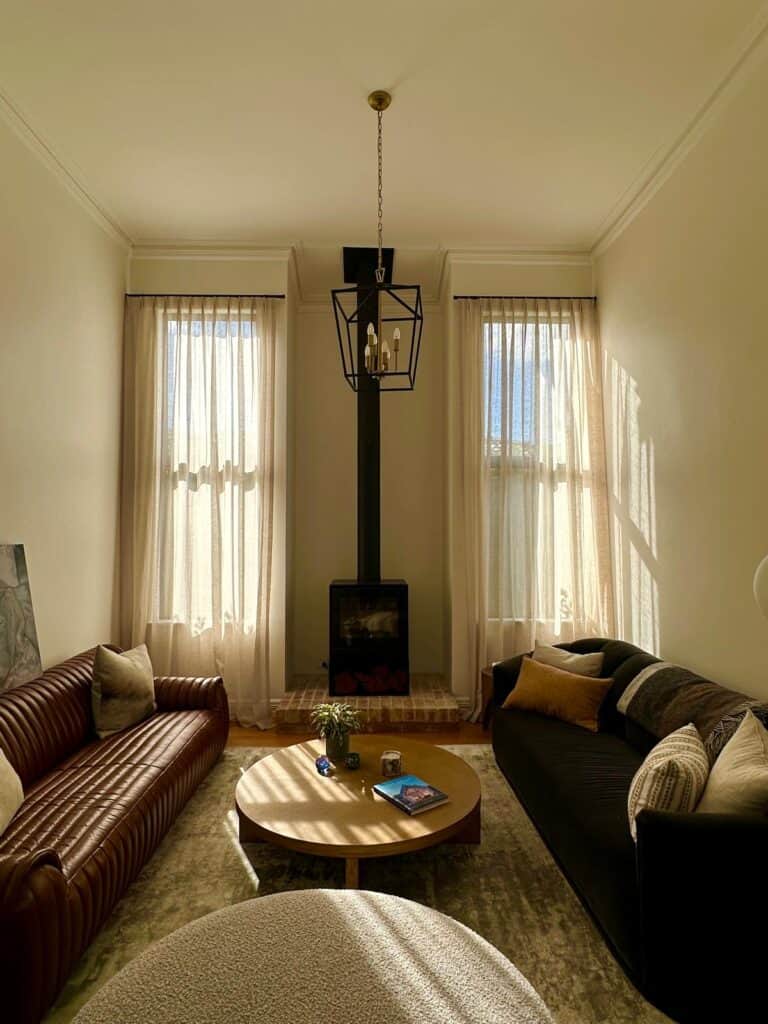

Every heading works on linen — including on blends and linen-look polyester, which behave no differently in this respect.
Box pleat, triple pleat and double pleat are all popular and all sit well. The more linen in the fabric the more natural it looks, and the more it behaves like full linen, but that is a fabric consideration rather than a heading one. Our guide to curtain headings and styles sets out what each one involves.
Wave is the exception, and it is a popular one. A wave heading is created at the top by the track and the fabric has to carry that shape down its full length. Linen does not reliably do it. The wave holds for the first stretch and then goes slack, and what you have is a curtain that looks like it meant to do something. Our post on sheer curtains for living rooms explains why this catches people out on linen sheers in particular, and what to use instead.
That is not an argument against wave. It is an argument for matching the heading to the cloth rather than choosing the heading first.
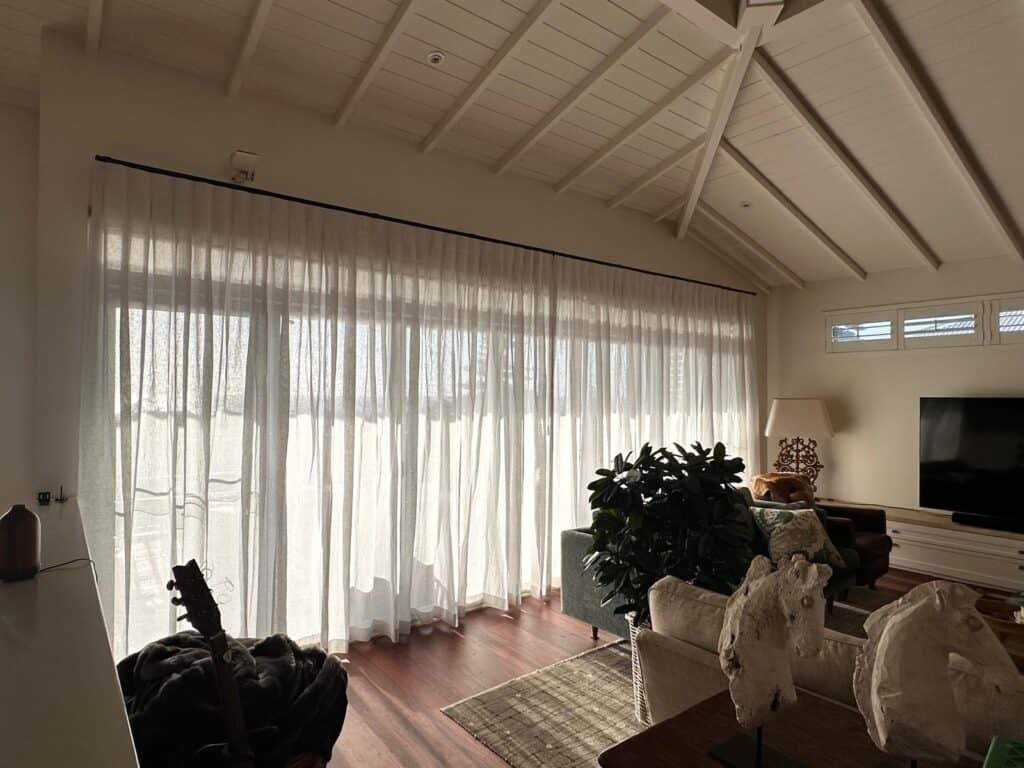
Most linen curtains we make are unlined sheers, and it is worth saying so plainly because the searches suggest a lot of people arrive at linen through the sheer.
A sheer is not lined — being seen through is the entire point, and our post on curtain linings sets out why that is the correct specification rather than an economy.
There is a second pattern that comes up often enough to mention: a linen sheer paired with a blockout curtain behind it. People choose it for privacy and darkness while keeping the linen look at the window, and because a sheer linen costs less than a solid linen and weighs less on the track. If you want linen in the room and darkness in the room, that pairing is usually how it is done.
Linen works well as a Roman, with one clear exception.
Soft Romans are the most popular, and relaxed Romans and London blinds run a close second. Often they look better unlined, which is how we would generally make them. Where privacy or fabric protection matters, a cotton lining is a necessary addition.
A classic Roman is where Annie would say no. The structure of a classic Roman fights the way linen moves — and if the fabric shrinks, which linen does, it twists the lining. The blind stops sitting square and there is no fixing it afterwards. If you want a lined classic Roman, use a different fabric.
Our Roman blinds page covers the styles and how they are made.
Two things are worth knowing before you commit, and neither is a reason to avoid linen.
West-facing windows – Natural fibres deteriorate faster under strong light, and linen is a natural fibre. On a west-facing window it will not last as long as a polyester would. The answer is not to avoid linen — it is to protect it with a good lining, which is a specification decision made at the outset.
Near the water – Closer to the ocean or the river, there is more moisture in the air, and linen responds to moisture. Movement will be more pronounced. Again the answer is not avoidance, it is knowing — and being clear about the relaxed look you are choosing and the movement that comes with it.
Annie will not call linen the wrong product for either situation. What she will do is make sure you know, and put the steps in place to minimise it.
Very little, and this is the part worth understanding.
Annie’s position is direct: nothing goes wrong because of the linen. Linen does what linen does. What can go wrong is the making.
Linen needs extra care in pressing and steaming, and every linen behaves slightly differently, so the fabric has to be studied rather than treated as a category. Folding and storing before installation is handled differently too, so the process does not add creases the client will then be looking at.
The movement itself is genuinely unpredictable, and anyone telling you otherwise is guessing. We have seen a drop happen immediately because of moisture in the air on the day, and we have seen fabrics barely move over years. Annie allows for it as well as it can be allowed for, usually by making the curtain longer than she otherwise would. But nobody can tell you when, or how much.
One practical consequence: do not wash a linen curtain. It will shrink. Stone-washed linen is the exception, having already been shrunk, and is more tolerant of it.
Composition is not normally stated on a curtain quote, and on linen that matters more than on any other fabric.
The reason is the range hiding behind one word. Natural linen, a linen-cotton blend, a linen-cotton-polyester blend and a full polyester linen-look can all reasonably be described as linen curtains on a quote, and they are quite different products at quite different prices. Occasionally the imitation is close enough to surprise even someone who handles fabric daily.
So unless two quotes name the identical fabric, they are not comparable. This is the same argument our post on what drives the cost of made-to-measure curtains makes about fabric generally, and linen is where it bites hardest.
Ask what the composition is. A supplier who knows will tell you.
Work out which half you are in first, because everything follows from it. If you will notice the difference, buy natural linen and accept the creasing and the movement as the price of what you wanted. If you will not, a blend or a linen-look polyester will give you the texture with none of the maintenance, and there is no snobbery in that choice.
Then match the heading to the fabric rather than the other way round, protect it if the window faces west, and expect more movement near the water.
Annie will show you natural linen and its imitations side by side in the showroom, which is the only reliable way to find out which one you are. We make linen curtains and Roman blinds in our Nedlands workroom, and have done since 1969.
Linen is a natural fibre that creases, moves with humidity and deteriorates faster in strong sun. Linen-look polyester mimics the texture without any of that — it is cheaper, washes and spot cleans, holds up better under UV, and in a sheer it is more see-through, which gives a better view out. Around half our clients choose each. The difference is usually visible, which is precisely why the people who want linen buy linen.
Linen moves with the moisture in the air, both dropping and shrinking, and it continues to do so for the life of the curtain. It is unpredictable — sometimes immediately, sometimes barely at all over years. We allow for it in the making, usually by cutting longer. Do not wash a linen curtain, as it will shrink; stone-washed linen has already been shrunk and is more tolerant.
You can, but linen does not reliably hold the wave down the full drop. The shape is created at the track and the fabric has to carry it, and linen tends to go slack partway down. A pleated heading holds its shape regardless of what the fabric does, which is why we would usually suggest one on linen.
Linen from Belgium, which has a long-standing reputation as the best — in the same way tartan means Scotland. It is a genuine signal of quality, but it is a reputation rather than a technical specification, so it is not a substitute for assessing the actual cloth.
Soft and relaxed Romans in linen work well and look best unlined, with a cotton lining available where privacy or protection matters. A classic lined Roman is the one we would advise against — the lining fights linen’s movement, and if the fabric shrinks it twists the lining out of square.