
Heritage and period homes deserve window treatments designed with genuine understanding of their architecture. Federation, Victorian, Edwardian and Art Deco homes have proportions, mouldings, picture rails and original windows that modern, off-the-shelf solutions rarely flatter. Done sympathetically, curtains and blinds enhance a period home’s character; done carelessly, they undermine it.
At Hay Interiors, heritage work is one of Annie’s great strengths. She trained as a curtain maker in Southampton, England, where her work included heritage houses and museums — exactly the settings where traditional technique, correct proportion and period-appropriate detail matter most. That background, combined with our in-house workroom, makes us one of the few Perth makers genuinely equipped for sympathetic period work.
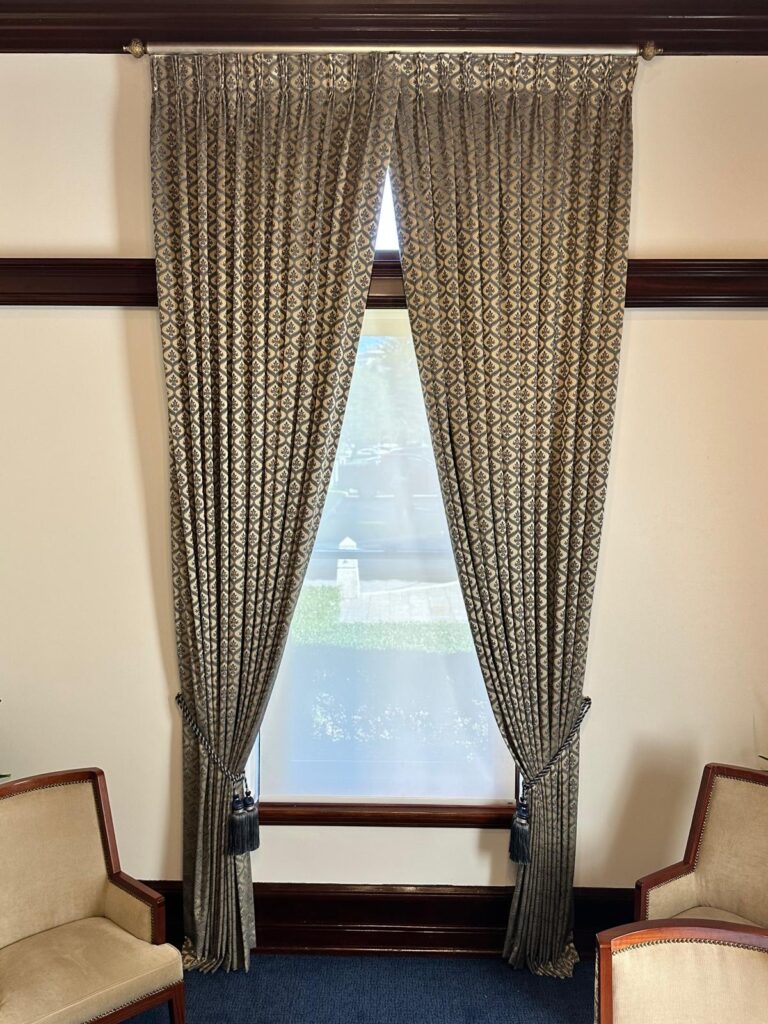
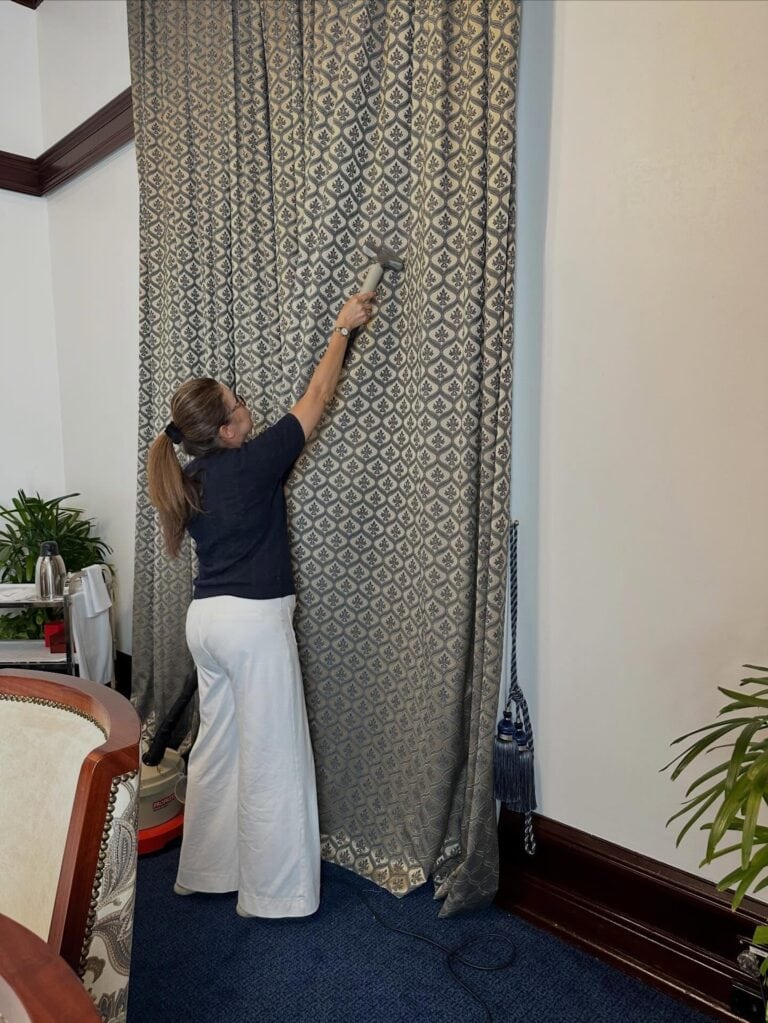
The curtains at the top of this page are ours. Earlier this year Hay Interiors was invited to propose window dressings for a suite at Parliament House in Perth, against a brief asking for a design that would make the rooms feel lighter, brighter, more inviting and more cohesive, while respecting the heritage architecture. Annie submitted a proposal and design, and it was accepted.
Those two requirements pull against each other, which is what made it interesting. The conventional heritage answer for a window of that height is a pelmet, or swags and tails – handsome, formal, and weighted across the top of the opening. Annie proposed neither. The curtains hang from a hand painted rod, which leaves the head of the window open and lets the full height of the glass do its work. The room reads lighter because nothing sits across the top of it.
What she did not compromise on was the curtain itself. The heading is a triple pinch pleat, the most generous of the traditional headings at two and a half times the track width, and the heading depth was made deeper than standard because the curtains are tall. A heading sized for an ordinary drop looks undersized on a high window – the pleats read mean against the length, and the eye notices before the mind does. Scaling the heading to the height of the curtain is a proportion judgement, and it is the kind of decision that comes from having made a great many of them.
That is what sympathetic heritage work usually looks like in practice. Not more decoration, but knowing which traditional elements a room genuinely needs and which it is better without.
Perth has beautiful pockets of period housing — the Federation and Art Deco homes of Mount Lawley, the character streets of Subiaco, Shenton Park and East Fremantle, and grand older residences throughout the western suburbs. Each era brings its own considerations:
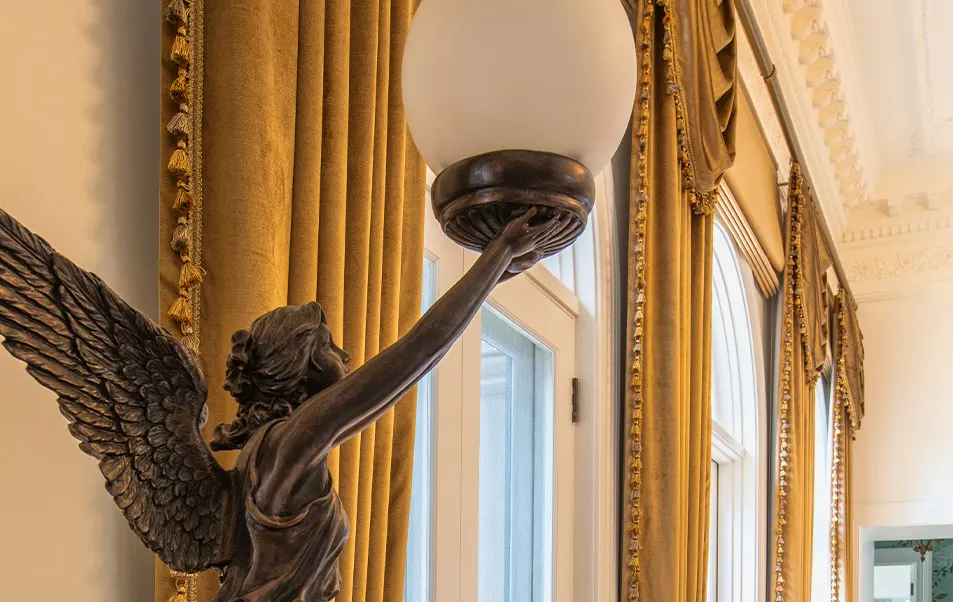
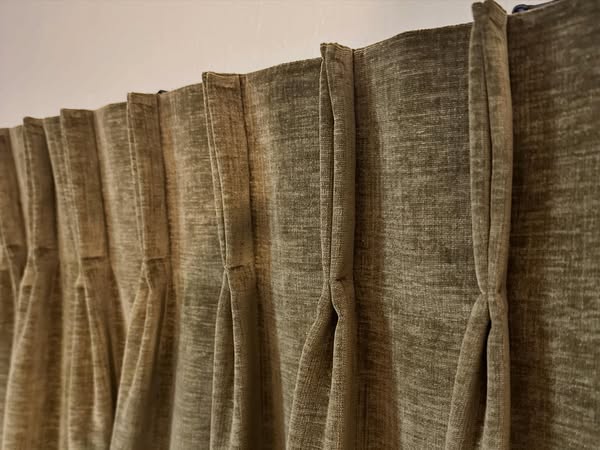
Heritage interiors are where our traditional skills come into their own. We make proper, sewn curtains and the decorative blind styles few Perth makers still offer — London Blinds, Austrian Blinds and Festoon Blinds — along with swags and tails, goblet and pinch-pleat headings and tailored pelmets. Each is made in our Nedlands workroom with attention to the proportion and detailing a period room demands. See our curtain headings and styles for the full range.
Authentic heritage work depends as much on sourcing as on sewing. Annie draws on specialist suppliers for period-appropriate fabrics — including classic Victorian-style prints from Slender Morris, a well-priced source of traditional designs — alongside the wider curtain fabrics library of damasks, linens, velvets and trimmings suited to older homes. The right fabric, in the right colour and weight, is what makes a treatment feel true to the period rather than merely traditional-looking.
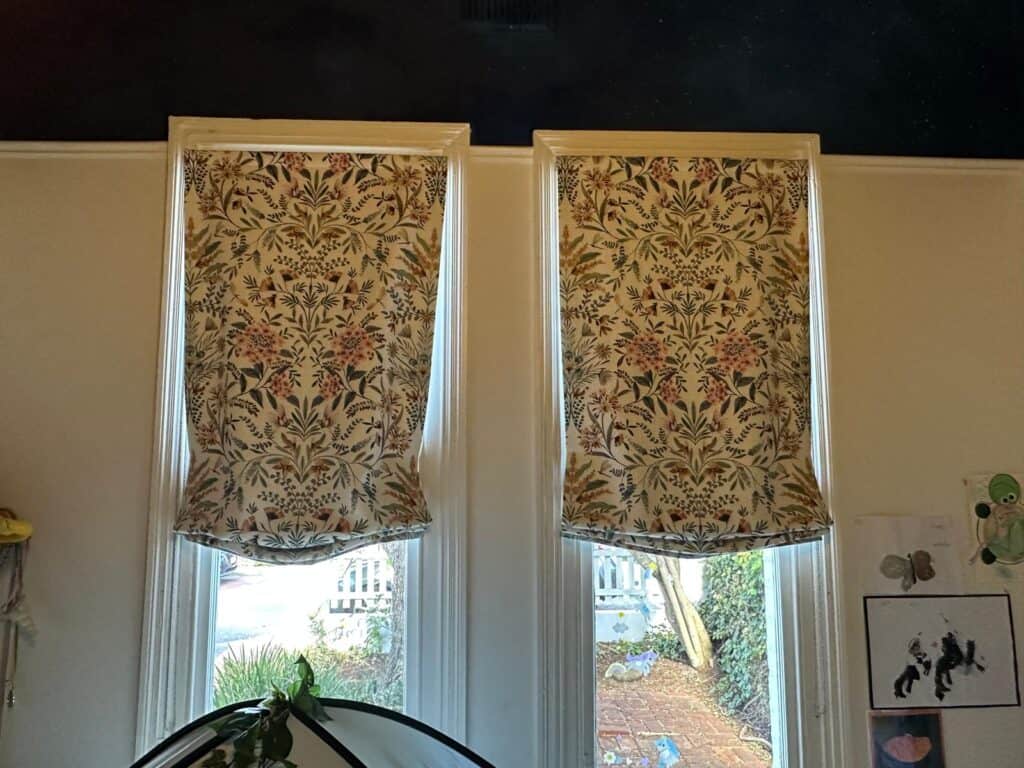
In a North Perth heritage home this year we made a pair of blockout-lined soft Roman blinds in Slender Morris curtain fabric for a child’s bedroom. Two windows sitting close together, each with its original moulded frame – a curtain spanning both would have covered the joinery that gives the room its character. Separate blinds keep the frames visible and let the pattern read flat rather than gathered.
Annie consults personally, considering the era and architecture of your home, the original windows, how each room is used, and how to balance authenticity with modern comfort — such as discreet lining for insulation or subtle motorised curtains for tall, hard-to-reach windows. Many owners of Perth’s finest period homes, and the interior designers who work on them, come to her precisely because she respects the building and understands what it needs.
Hoover House sits above the old Sons of Gwalia mine, built in the 1890s as the mine manager’s residence — a post held briefly by a young Herbert Hoover, three decades before he became President of the United States. It is now run as a museum and guesthouse, and the interiors are maintained to reflect the period.
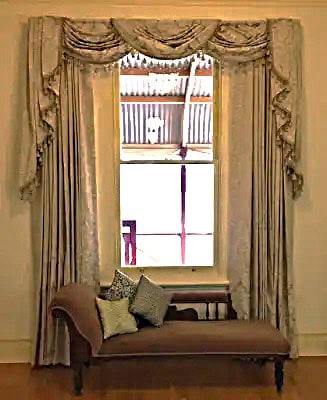
Annie made the window furnishings: a Roman blind beneath drapes with a padded pelmet, and a traditional swag and tails treatment. Period-accurate work in a building where getting it wrong would have been obvious to every visitor who walked through.

Allora House is an 1890s heritage-listed guesthouse built by Sir James Connolly. Its owners, Allison and Carl, had a problem familiar to anyone who owns a period home: the windows were not standard sizes, and they could not find a curtain maker willing to work outside a catalogue.
So they asked the museums. The Gwalia Museum referred them to us, on the strength of the Hoover House work.
What followed was the kind of job that does not fit a normal process. Hours on the telephone. Guidance on how to measure windows unlike anything in a modern house. Fabric samples posted six hundred kilometres. Carl drew diagrams and sent them through. They settled on a silk in a colour that nods to the red landscape around Kalgoorlie — a decision that would have been easy to get wrong from Perth, and was not.
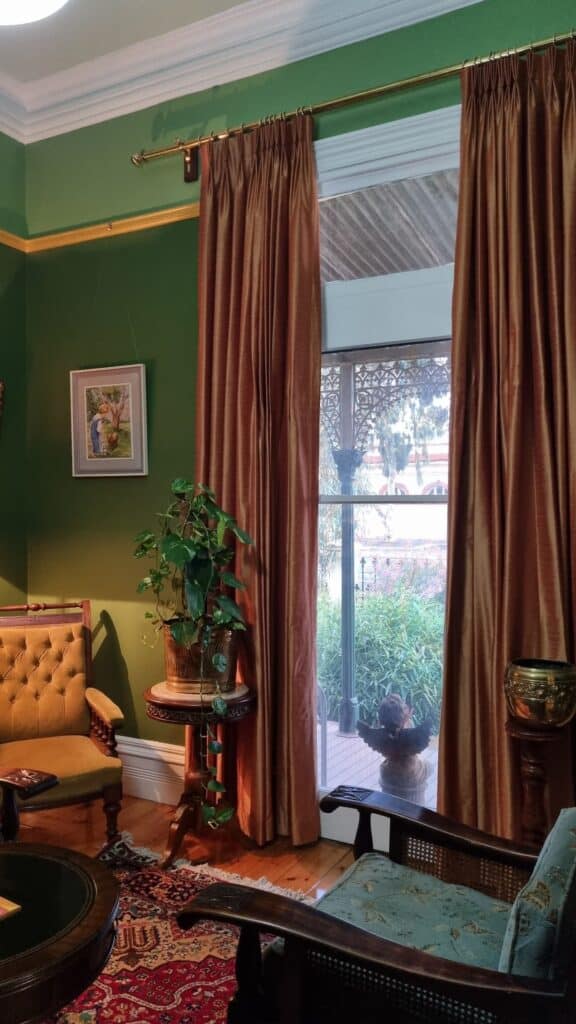
Most of our heritage work is not in the goldfields. It is a Federation house in Peppermint Grove, a character home in Claremont, a 1920s bungalow in Dalkeith — houses where the windows have their own proportions, where the cornices and picture rails have to be worked around, and where a standard curtain will look wrong in a way the owner cannot quite name.
The skill is the same one the museums came looking for: making to the building rather than to a catalogue. Measuring windows that are not square, matching a fabric to a period without turning the room into a reproduction, and knowing which treatments belong to which decade.
If a heritage museum trusts us with a listed property, a period home in Perth is well within familiar territory.
The best way to begin is to visit our showroom in Nedlands. You can explore hundreds of fabric samples in natural light, see finished examples, and often watch work happening in the attached workroom. Annie or a member of the team is always happy to talk through possibilities and answer questions.
Alternatively, we can arrange an in-home consultation at a time that suits you. This has the advantage of enabling us to consider your actual windows and provide advice on the best window dressings for your space.
Either way, you will receive honest, expert guidance focused entirely on what is right for your windows and your home.
We look forward to helping you create window furnishings you will love for many years to come.
It depends on the room, the era and what the room needs to do. Traditional pinch pleat or goblet pleat headings, tailored pelmets, and decorative styles such as swags and tails or Austrian blinds suit many period homes beautifully. But sympathetic does not always mean more – at Parliament House the brief asked for lighter and brighter, and the right answer was a hand painted rod rather than a pelmet, with the traditional heading kept where it earned its place. Annie advises in your home, where the architecture can guide the choice.
Yes — Annie sources traditional designs including classic Victorian-style prints through specialist suppliers such as Slender Morris, alongside period-suited damasks, linens and trimmings, so the result feels authentic to your home’s era.
Annie trained in England in settings that included heritage houses and museums, and we make traditional styles by hand in our own workroom — a combination of period knowledge and genuine making capability that is rare in Perth.