
How to dress tall windows and big glass
— full-height curtains, s-fold tracks and the details that make them look effortless.
Walk into any room that stops people mid-sentence and there’s a fair chance the curtains run floor to ceiling. It’s the single most transformative thing you can do to a window — and, curiously, it often has little to do with the window itself. Full-height curtains dress the wall, not the glass: they draw the eye up, make ceilings feel higher, and give even a modest window the presence of a grand one. They’re also the fastest-growing request in our workroom. Here’s how to get them right — the tracks, the fabrics, the measurements, and the handful of details that separate effortless from almost.
The trick is proportion. A curtain hung just above the window frame chops the wall into horizontal slices and makes the ceiling feel exactly as high as it is. Run the same fabric from ceiling to floor and the vertical line does the opposite — the wall reads as one tall plane, the ceiling lifts, and the room gains a calm, architectural order that no other single change delivers.
There’s a practical dividend too. Full-drop fabric means full coverage: better insulation across the whole wall of glass, better blockout in bedrooms, and softer acoustics in big hard-surfaced rooms. And because the curtain no longer has to “match” the window, awkward glass — offset windows, mixed heights, a door beside a pane — disappears behind one clean sweep of fabric.
Most floor-to-ceiling curtains today hang as an s-fold (also called s-wave or wave fold): a heading style where the fabric ripples in soft, uniform waves along a discreet ceiling-mounted track. It earned its dominance honestly — the waves stack tight and travel smoothly across very wide spans, which is exactly what walls of glass and sliding doors demand, and the look is clean without being flat.
It isn’t the only heading that suits full height — pinch pleats bring a tailored, classic structure, and other styles each cast the fabric differently. The heading decision deserves its own consideration, and our curtain headings and styles guide lists some of the more popular options we sew. For this guide, the short version: for wide modern glass, s-fold is the default for good reason; for traditional rooms, don’t rule out a pinch pleat.
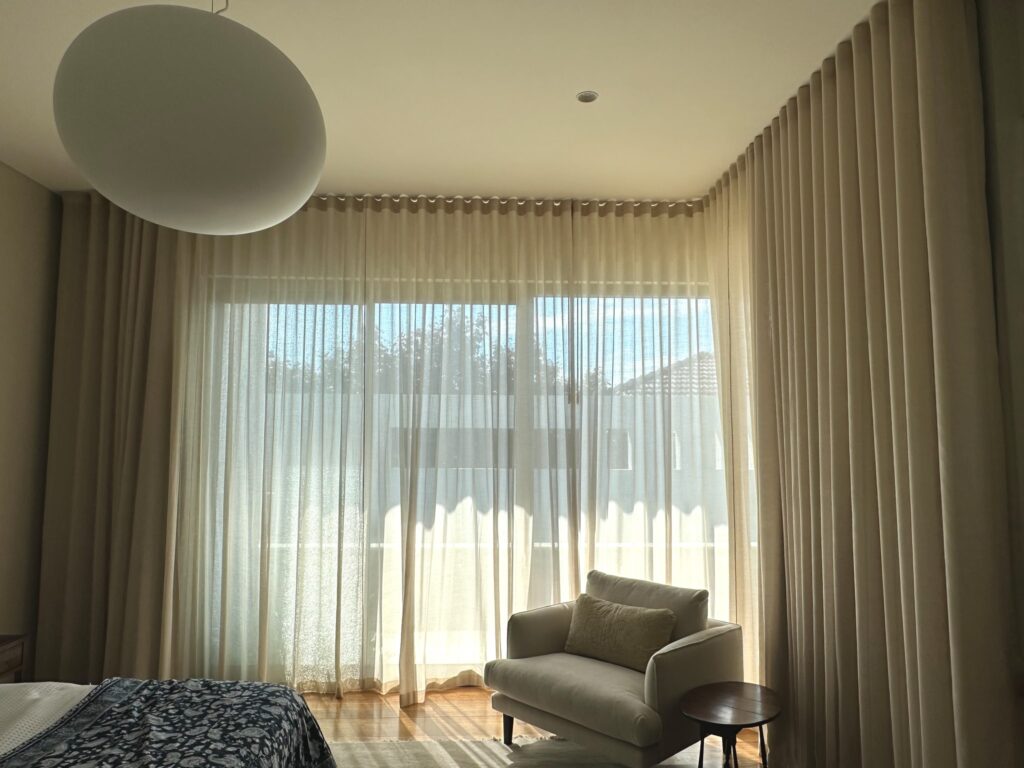
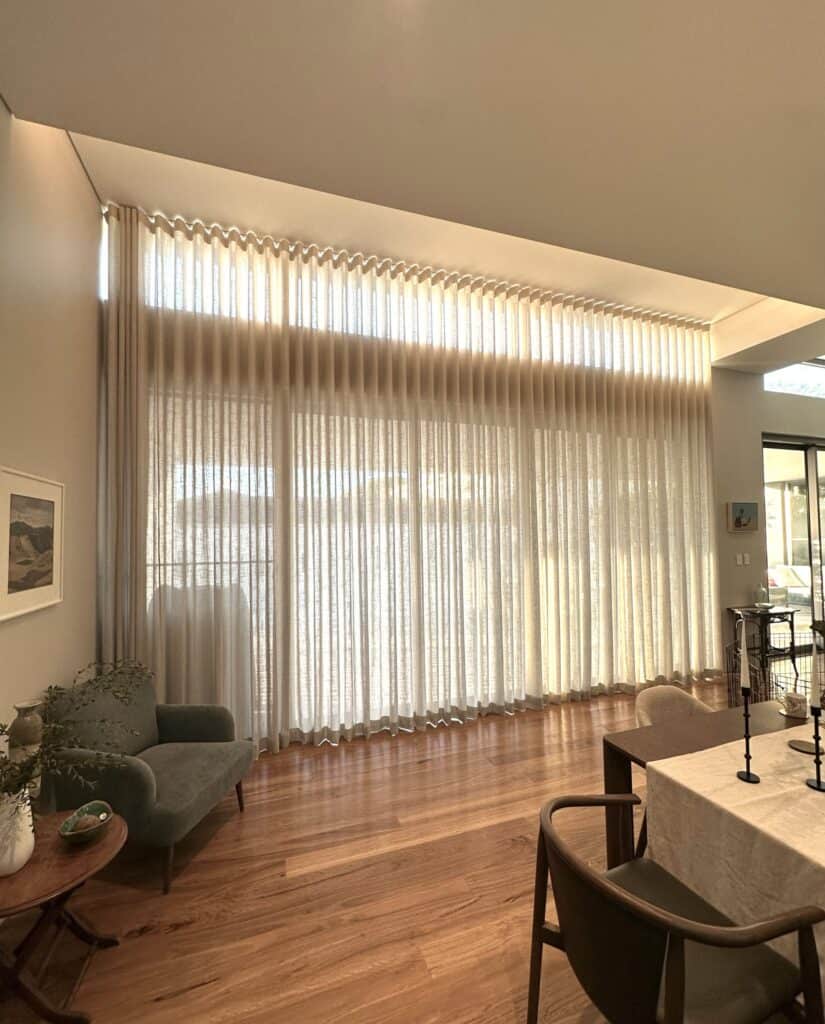
Full-height treatments really come alive layered. The modern signature is a full-drop sheer curtain that filters Perth’s hard light into something luminous all day — with a second layer behind or in front doing the heavy work at night. In living spaces that’s often a discreet blind at the glass; in bedrooms, a blockout curtain on a second track gives total darkness without sacrificing the daytime softness.
One-layer rooms work too. A single heavier drape in linen or wool reads warm and substantial; a lone sheer reads airy and coastal. The curtain fabric carries more of the room’s character at full height than in any other treatment — there’s simply more of it — so choose like you’re choosing a wall colour, because visually, you are.
The whole effect depends on the track sitting at (or recessed into) the ceiling. On new builds and renovations, ask about recessed track channels early — a track hidden in a shadow line is the most finished look there is. That said, Where the track goes is not always a free choice. Ceiling mounting gives the tallest curtain and the cleanest line, but a cornice you would rather not cover, a ceiling that will not carry the weight, or a bulkhead can each decide it for you – and a flush recessed track, where the curtain appears to emerge from the plaster itself, has to be installed during construction and cannot be retrofitted. Our page on curtain tracks and rods covers the mounting options and what rules each one out.
Full-height curtains should just touch, or float a few millimetres above. Too short reads as a mistake; heavy puddles gather dust and drag on opening. Precision here is why made-to-measure exists — every ceiling wobbles more than you think, and we measure for it.
Fabric has to go somewhere when open. Wide glass needs wall allowance beside it for the stacked curtain — or a track run long enough that the stack clears the glass entirely. This is a plan-stage conversation on big openings.
Once a curtain runs the width of a living room, hand-drawing it twice a day gets old. Motorised curtains glide the full span at a button-press or on schedule, and big glass is exactly where they earn their keep.
The signature application. One track, one sweep of sheer, and a hard-edged room turns soft. Where multiple blinds across wide glass would mean gaps and clutter, a single traveling curtain does the whole span cleanly — the same logic we set out in curtains or blinds, where big glass is the ground curtains win most decisively.
Full-height layering — sheer plus blockout — is the most refined bedroom treatment we make. The scale brings hotel-suite calm; the blockout layer brings sleep.
Floor-to-ceiling is barely a choice here — the door already runs near-full height. A ceiling track carrying the curtain past the door’s full travel keeps the opening completely usable.
The quiet secret: full-height curtains don’t need a full-height window. Run fabric ceiling to floor across a standard window and the wall gains the same vertical lift — the glass behind is nobody’s business but yours.
Annie’s shortcut after decades of big windows: take the track to the ceiling, take the fabric to the floor, and buy the fullness — a full-height curtain skimped on fabric width looks like a bedsheet, and a generous one looks like architecture.
Full-height curtains live or die on precision — the track position, the true ceiling height, the stack-back, the exact drop. That’s measured at your windows, not guessed from a chart. Annie measures for Perth curtains and blinds from the western suburbs across to Mount Lawley and South Perth, and on a full-height window she checks the floor as carefully as the drop — very few Perth floors are as flat as they look. Book a free in-home consultation and she’ll look at your glass, your ceilings and your light, and tell you straight what full-height would do for the room, and how to get every detail right the first time.
Yes — chiefly taller. The unbroken vertical line draws the eye up and makes ceilings feel higher, while dressing the whole wall in one plane makes the room read calmer and larger than treatments that stop at the window frame.
Absolutely — it’s one of the best tricks in the book. The curtain dresses the wall rather than the glass, so a standard window gains the same height and presence as a much larger one. The fabric simply conceals the wall above and beside the frame.
A heading style where fabric hangs in soft, continuous waves from a discreet track — the modern standard for full-height curtains and wide glass, because the waves stack neatly and travel smoothly across long spans. It’s one of several headings we sew; each suits different rooms.
They should just touch the floor or float a few millimetres above it. A visible gap looks accidental, while heavy puddling gathers dust and drags — precise measurement to your actual floor and ceiling is what made-to-measure is for.