
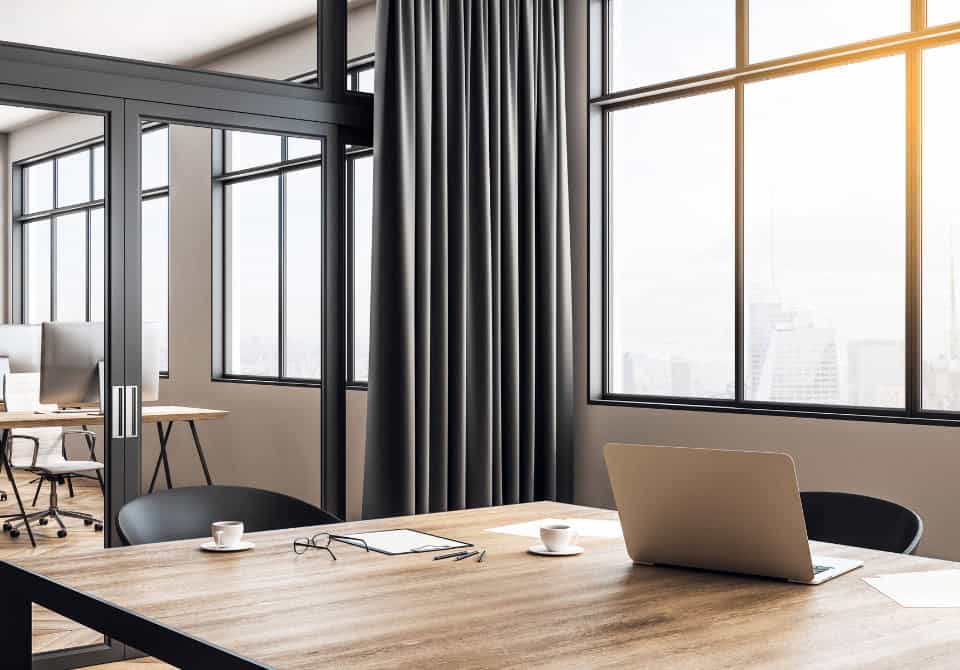
Sound has a powerful effect on how a home feels. Traffic, neighbours, open-plan living, home offices and media rooms can all make a space less restful. Well-designed acoustic curtains are a beautiful, practical way to reduce noise while adding warmth, texture and comfort to a room.
At Hay Interiors we are the exclusive Western Australian partner of Acoustic Blinds and Curtains, Australia’s leading specialist acoustic fabric supplier. This gives us access to the highest-performing acoustic fabrics available in Australia — combined with Annie’s deep, hands-on understanding of how different fabrics, linings and hanging methods affect sound in real homes. It’s a combination no other Perth curtain shop can offer.
Acoustic performance is measured, not guessed — and the measurements come from independent laboratories, not from us.
Sound absorption is rated as a Noise Reduction Coefficient (NRC), running from 0 for no absorption to 1 for complete absorption. Our acoustic face fabrics are rated up to 0.90, tested at the University of Sydney in accordance with ISO 354, on a curtain hung at 1.8x fullness with lining. An NRC of 0.90 means around ninety per cent of the sound reaching the curtain is absorbed rather than thrown back into the room.
Noise reduction from outside is measured differently, in decibels. Testing at UTS Tech Labs in Sydney recorded a Sound Reduction Index (ΔRw) of 8dB and a Sound Level Difference (ΔDw) of 10dB for an acoustic curtain — enough to roughly halve perceived noise. In the same test, a traditional roller blind recorded 0dB. Ordinary window furnishings do nothing for noise at all.
We’re honest about expectations: acoustic curtains make a very noticeable difference but won’t eliminate all sound. Where structural soundproofing is also needed, we can refer you to trusted Perth acoustic specialists so you get the right overall solution.
Almost everyone describing a noise problem has one of these two, and they need different answers.
Traffic, a rail line, aircraft, a neighbour’s pool pump. This is a question of mass — you need weight between you and the sound.
The SleepWell system layers your chosen face fabric over an 800gsm acoustic interlining and a full blockout lining. All three run on a single track and operate as one curtain, so it looks and draws like an ordinary pair. Tested at the University of Adelaide’s transmission loss suites to ISO 10140-2: a weighted sound reduction index of 15dB, and an improvement of 14–16dB over the glazing on its own.
Echo carrying across open-plan living, a home office where video calls sound hollow, hard floors and high ceilings that make a room feel louder than it is.
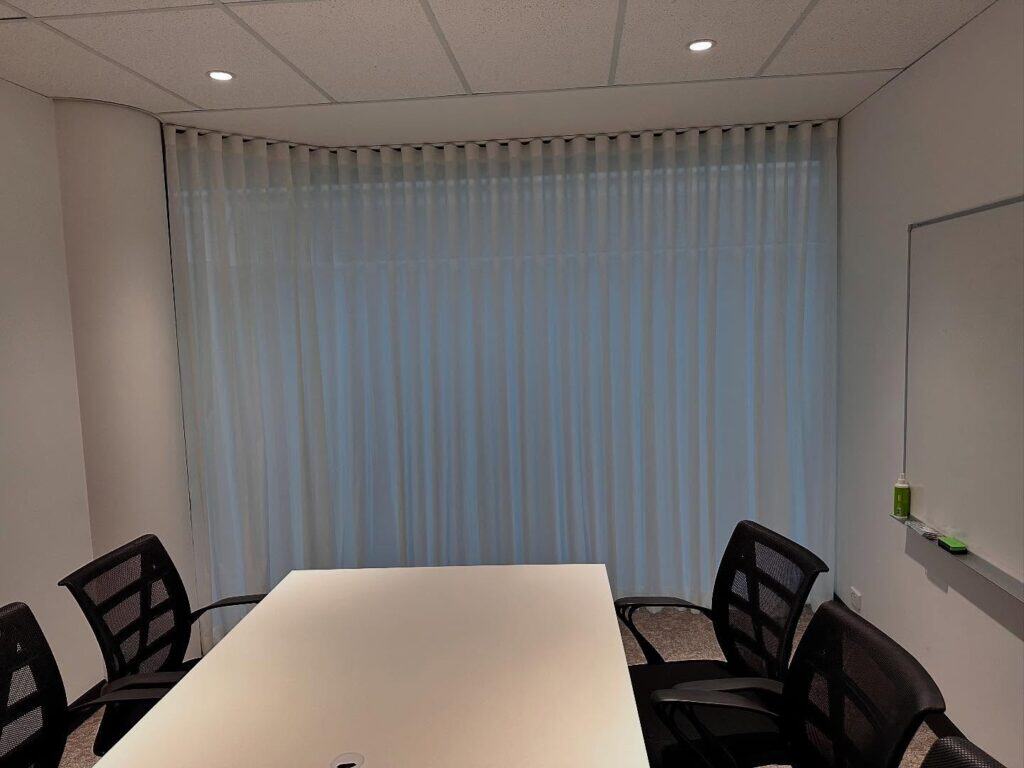
This is absorption, and it comes from the face fabric hung with generous fullness — it’s the waves in the fabric that soak up reverberation. Annie makes these curtains in our Nedlands workroom, using fabrics rated to NRC 0.90.
If you’re not sure which one you have, that’s exactly what a consultation establishes. Annie will tell you honestly which will help and which won’t.
People searching for acoustic blinds, soundproof blinds, sound absorbing blinds or noise reducing blinds are almost always describing the same thing: a room that’s too loud, and a hope that something at the window will fix it. The words vary; the problem doesn’t.
Here is the honest answer.
The acoustic range we supply includes blinds as well as curtains, and they are independently tested. Sound absorption fabrics reach a noise reduction coefficient of up to 0.90 — around ninety per cent of the sound reaching them absorbed rather than reflected back into the room. That is a genuine acoustic product, not a marketing claim.
This is worth separating from something stated earlier on this page. When UTS Tech Labs measured a traditional roller blind at zero noise reduction, that was an ordinary roller blind — standard fabric, no acoustic construction. It tells you that a regular blind does nothing for noise. It says nothing about an engineered acoustic blind, which is a different product that happens to share a word.
Almost every acoustic enquiry we receive ends in curtains, and that is usually the right outcome — for reasons of physics rather than preference.
Absorption depends on how much fabric is in the room and how it is hung. A blind sits flat against the glass, covering the window and no more. A curtain hung at 1.8x fullness carries nearly twice the fabric across the same opening, gathered into waves, and can overlap onto the wall at either side. More fabric, better presented to the sound.
The second reason matters if your noise is coming from outside. Insulation needs mass, and mass means layers — the interlined systems described above run an 800gsm acoustic interlining between the face fabric and the lining. That construction is a curtain. A blind cannot carry it.
So: if a blind is the only thing that will fit — a small window, a reveal with no wall space beside it, a room where a curtain would be in the way — an acoustic blind is a legitimate answer, and considerably better than doing nothing. Where there is room for a curtain, the curtain will do more.
Two alternatives are worth knowing about:
A Roman blind is sewn by hand in our workroom from proper curtain fabric and is considerably heavier than a roller blind. It sits between the two — the tailored look of a blind, with meaningfully more fabric doing the work.
Cellular honeycomb blinds trap air in their cell structure, which gives them a modest acoustic benefit alongside their real strength, which is thermal insulation. Modest is the honest word: they will take the edge off a room, not transform it.
Neither will match a properly specified acoustic curtain. Both are better than a standard blind, and both fit where a curtain will not.
That depends on whether your noise is arriving from outside or bouncing around inside, how much wall space you have, and what the room has to look like when it is finished. It is not a decision to make from a product page.
Annie will look at the room, tell you which treatment will actually help, and say so plainly if the answer is that none of them will do enough on their own. You can see the full range of curtains and blinds in Perth we work with, or start with a consultation.

Acoustic curtains aren’t made like ordinary curtains. The amount of gather (fullness) is critical — it’s the waves in the fabric that absorb reverberation — as is the overlap onto the wall and the way the curtains are installed. Because Annie both specifies and oversees the making, these details are controlled precisely. This is expertise a showroom reselling finished products simply cannot replicate.
This is why the test figures matter as much as the fabric. The NRC 0.90 rating was measured on a curtain at 1.8x fullness with lining — hang the same fabric flat and skimped, and it will not perform that way.
They can also be combined with a blockout lining where darkness and noise reduction both matter — see our blockout curtains. Motorised systems work well on acoustic treatments for large or hard-to-reach windows, where the weight of the fabric makes hand-drawing tiresome.
Traffic noise is the most common reason people call us — and increasingly it’s not from a main road. Streets in Mount Lawley, Wembley, North Perth and Subiaco that were quiet for decades now carry cut-through traffic avoiding congested arterials. The house hasn’t changed; the road has.
Annie often recommends acoustic curtains for:
Acoustic curtains bring a second benefit that often matters as much in Perth: the same dense construction that absorbs sound also insulates. A room that’s quieter in winter is usually warmer, and cooler through summer afternoons.
They’re just as effective in commercial spaces — see commercial curtains and blinds for offices, practices, salons and hospitality.
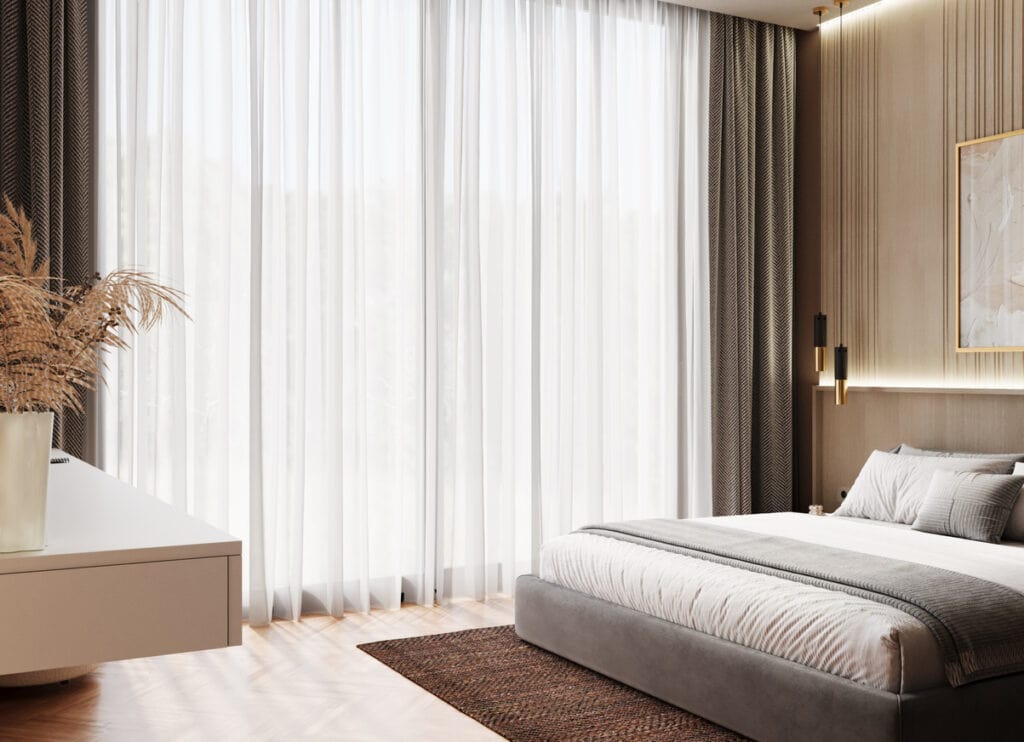
Acoustic curtains cost meaningfully more than standard curtaining. The fabrics are engineered rather than decorative, they’re heavier, and a properly specified treatment is a considered investment rather than a quick fix.
If noise is genuinely affecting how you live or sleep, they’re worth it. If it’s a mild annoyance, we’ll tell you honestly that it may not be.
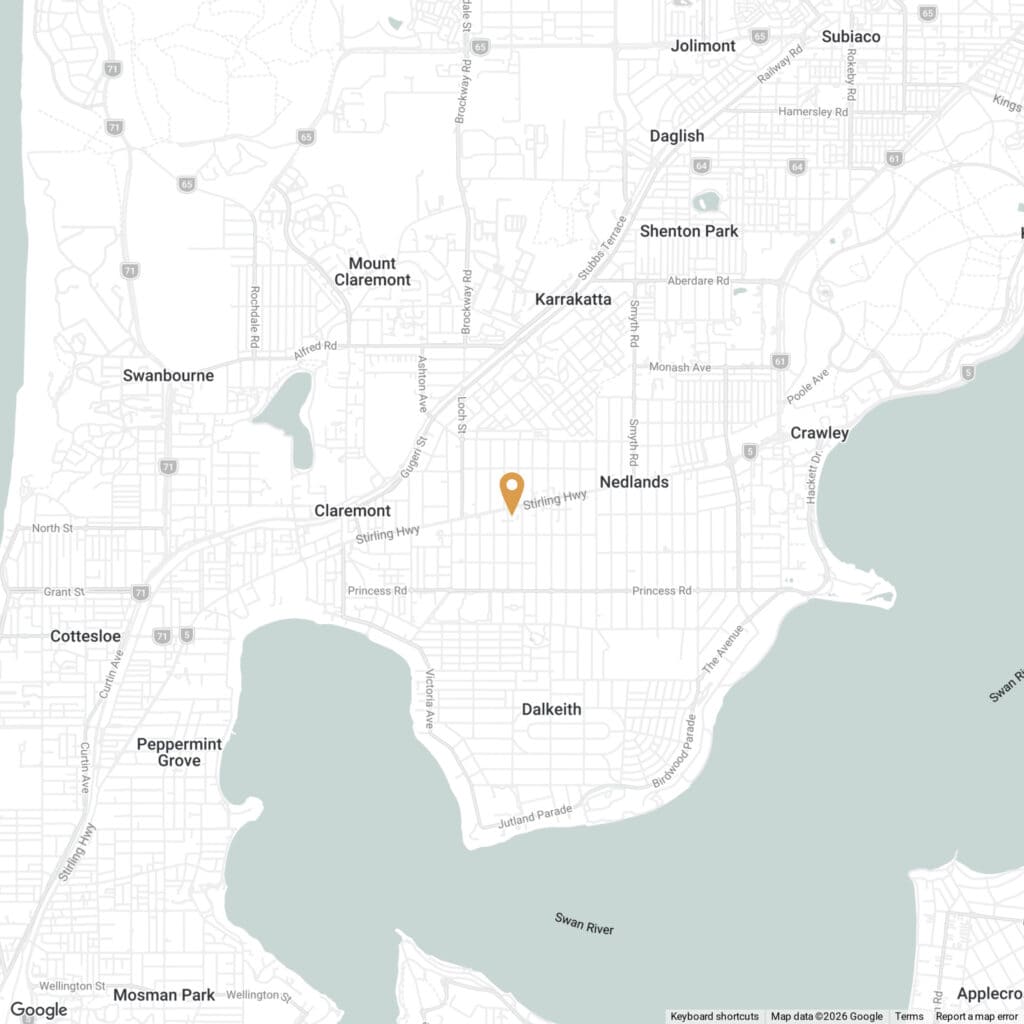
The best way to begin is to visit our showroom in Nedlands. You can explore hundreds of fabric samples in natural light, see finished examples, and often watch work happening in the attached workroom. Annie or a member of the team is always happy to talk through possibilities and answer questions.
Alternatively, we can arrange an in-home consultation at a time that suits you. This has the advantage of enabling us to consider your actual windows and provide advice on the best window dressings for your space.
Either way, you will receive honest, expert guidance focused entirely on what is right for your windows and your home.
We look forward to helping you create window furnishings you will love for many years to come.
It depends which problem you have. For noise inside a room — echo and reverberation — our fabrics are rated up to NRC 0.90, absorbing around ninety per cent of the sound that reaches them. For noise coming in from outside, testing recorded an 8dB sound reduction index and a 10dB sound level difference, roughly halving perceived noise. A traditional roller blind, tested the same way, recorded zero. Acoustic curtains make a clearly noticeable difference, though no curtain blocks sound entirely.
We are the exclusive Western Australian partner of Australia’s leading acoustic fabric supplier, and Annie understands the specific construction — fullness, overlap and installation — that makes acoustic curtains actually work. Most retailers offer generic noise-reducing curtains without either advantage.
Yes. The same dense construction that absorbs sound also improves thermal insulation, and with a blockout lining added, acoustic curtains can also provide complete light control.
They’re the same thing, described differently. “Soundproof” is how most people search for it; “acoustic” is the industry term. No curtain is truly soundproof — nothing short of building work eliminates sound — but a properly specified acoustic curtain reduces it substantially. If you’ve been searching for soundproof, sound absorbing or noise reducing curtains in Perth, you’re in the right place.
Acoustic blinds are genuine — the range we supply includes tested blinds with sound absorption rated up to NRC 0.90. In practice almost every enquiry still ends in curtains, because a curtain hung at 1.8x fullness puts far more fabric into the room than a blind lying flat against the glass, and only a curtain can carry the interlined construction that reduces noise coming in from outside. Where a curtain will not fit, an acoustic blind is a legitimate answer. Where it will, the curtain does more.
Yes — along with sound absorbing blinds, sound deadening blinds, sound blocking blinds and noise reducing blinds. They all describe a window covering intended to reduce noise. “Acoustic” is the industry term; the others are simply how people search. What matters is not the label but whether the product has been independently tested, and whether it is the right treatment for the particular noise problem you have.
Six to eight weeks from order to installation.