
The fabric you choose affects everything – how light filters or is blocked, how the curtains drape and move, how they feel in the room, and how they age. Choosing the right curtain material is one of the most important decisions in creating curtains you will love for years, and it is where Annie’s expertise adds the most value.
Because we make rather than resell, we are not locked to any single supplier’s range. Our fabric library draws on trusted names such as Warwick, Nettex, Charles Parsons and Hoad, alongside designer collections accessed through Australia’s leading distributors – and, where it suits a project, fabric you or your designer supply yourselves. It means Annie can recommend the right fabric for your home, not just the brand on the shelf. Linen and linen-blend curtains are among the most requested fabrics we work with, and they are a good example of why the advice matters: linen drapes beautifully and suits Perth interiors, but it relaxes and moves with humidity in ways a synthetic will not, and it needs to be made with that in mind.
Annie doesn’t just show you pretty swatches — she explains how each fabric will behave in your windows:
Many clients arrive thinking they know what fabric they want, and leave with something quite different — and better — because Annie has shown them how their first choice would actually behave in their specific windows and light conditions.
It is worth separating two words that get used interchangeably, because the difference matters when you are comparing options.
A fibre is what the cloth is made from — cotton, linen, wool, silk, viscose, polyester. A fabric is what has been made out of those fibres. Velvet is a fabric, not a fibre: you can have a cotton velvet, a silk velvet, a polyester velvet or a blend, and they will behave quite differently from one another despite all being velvet. The same is true of sheers, damasks and almost every other name you will see on a sample.
So when someone tells you a curtain is velvet, or linen-look, they have told you what it resembles rather than what it is. What it is made from determines how it drapes, how it wears, how it responds to light and moisture, and what it costs.
This is also why we work from named fabrics rather than descriptions. Every fabric in our library has a name and a composition, and both go on the quote.
There is no fabric that suits a bedroom and another that suits a living room. What actually drives the decision is the light your windows get, the air in your house, and how you want the curtains to look and behave.
Sunlight – Natural fibres deteriorate faster under strong light. Silk, cotton and linen are all beautiful and all vulnerable, and in a west-facing or coastal room they will not last as long as a polyester or a blend. That is not an argument against them — it is an argument for knowing before you choose, and for considering a lining that protects the face fabric.
Moisture – Air with a lot of moisture in it changes how natural fibres behave. Near the river or the coast, a polyester or a blend will hold its shape where a linen will move. This is the single most common source of surprise after installation, and it is worth taking seriously at the sample stage.
How the curtains will be used – A curtain that is opened and closed twice a day is a different proposition from one that is largely decorative. Fuller fabrics make heavier curtains, and a heavy curtain on a wide track is something you feel every time you draw it. Some clients love the weight and the volume; others find it more than they expected.

Silk and linen are, in Annie’s phrase, almost alive. They drop and they shrink depending on the moisture in the air, and they carry on doing it for the life of the curtain.
That movement is not a fault and it is not avoidable. Managing it is not an exact science either — after decades of making, Annie allows for it as best it can be allowed for, often by making a curtain longer than she otherwise would. But nobody can tell you exactly when the movement will happen, or precisely how much.
Linen also creases, and it is meant to. The relaxed, softly rumpled look is the reason people choose it. It is also the reason some people regret choosing it. If you want a curtain that hangs in straight, crisp lines and stays that way, linen is the wrong fabric — and it is far better to know that in the showroom than after the curtains are hanging.
None of this is a reason to avoid natural fibres. It is a reason to choose them deliberately, with a clear picture of what they will do.
Fabric is usually the largest single component of what a curtain costs, and it is the part with the widest range.
Curtain fabric runs from around $20 per linear metre to $400 or more, and most of our clients land somewhere between those extremes. Where you sit in that range depends on the fibre, the weave, the width, whether it is a designer collection or a dependable everyday range, and whether it needs particular performance qualities.
Because the heading you choose determines how many metres you need, the two decisions compound. A fuller heading in a mid-priced fabric can cost more than a modest heading in an expensive one, which is why it is worth settling both together rather than in sequence. Our curtain headings and styles page sets out how much fabric each heading requires.
A word on comparing quotes. Two fabrics can look almost identical on a sample board and be quite different underneath — one a linen blend, one entirely polyester. They will not drape the same, wear the same or cost the same. For two quotes to be genuinely comparable, they need to be for the same named fabric, not for fabrics that look alike. It is a reasonable thing to ask of anyone quoting you, ourselves included: what exactly is this fabric, and what is it made of?

For period homes, Annie sources sympathetic fabrics including classic Victorian-style prints through specialist suppliers such as Slender Morris — a well-priced source of traditional designs that suit Federation, Victorian and Edwardian interiors. See our heritage curtains page for more on dressing character and period properties.
For acoustic applications, our exclusive Western Australian partnership with Australia’s leading acoustic fabric supplier gives us access to specialist fabrics unavailable elsewhere in Perth — see acoustic curtains.
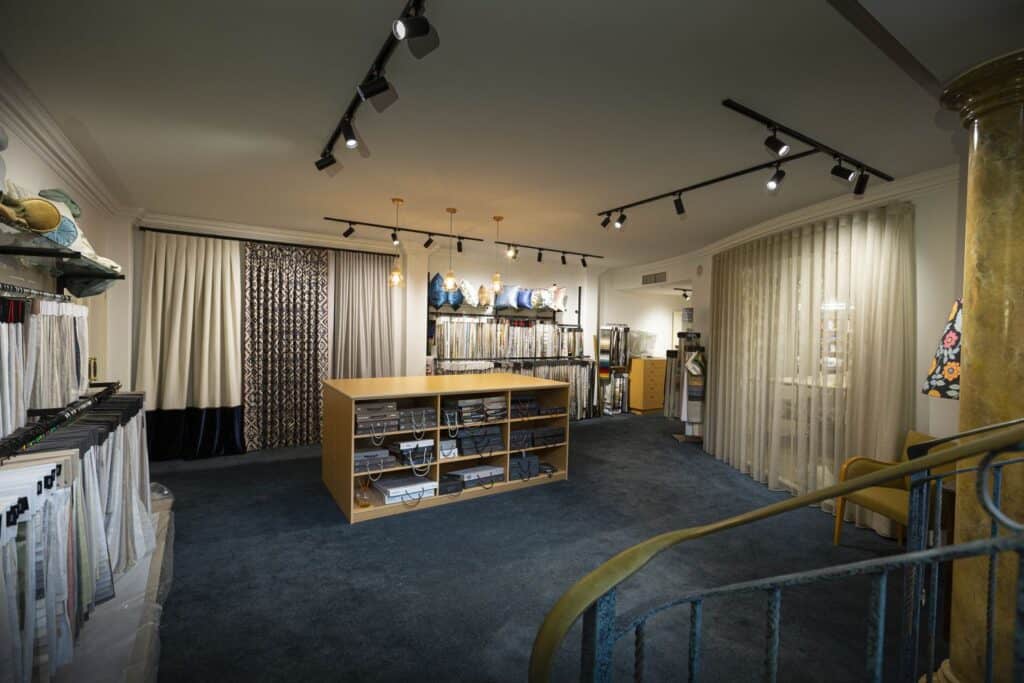
If you have been looking for a curtain fabric shop in Perth, our Nedlands showroom is where that search ends – though it is not quite a shop in the usual sense. We do not sell fabric by the metre off a roll. What we have is a working fabric library attached to a curtain workroom, where you can handle hundreds of samples, see them in natural light, and have someone who makes curtains for a living tell you how each one will behave in your windows.
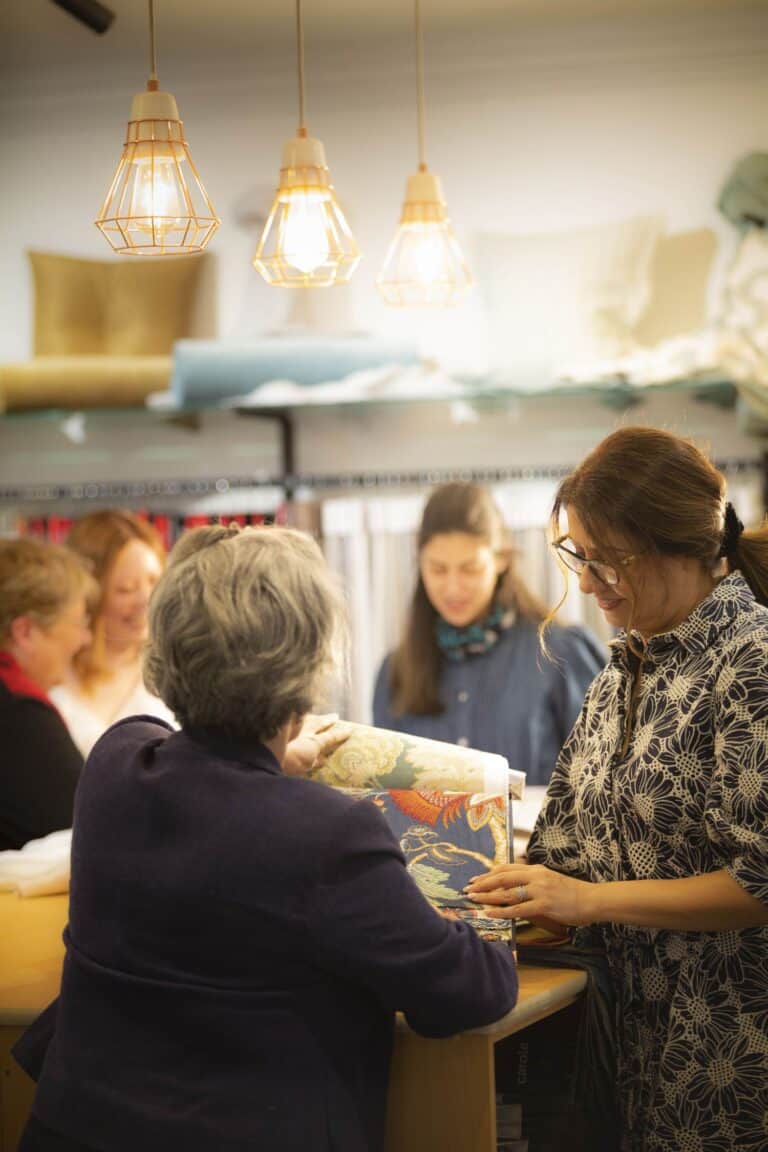
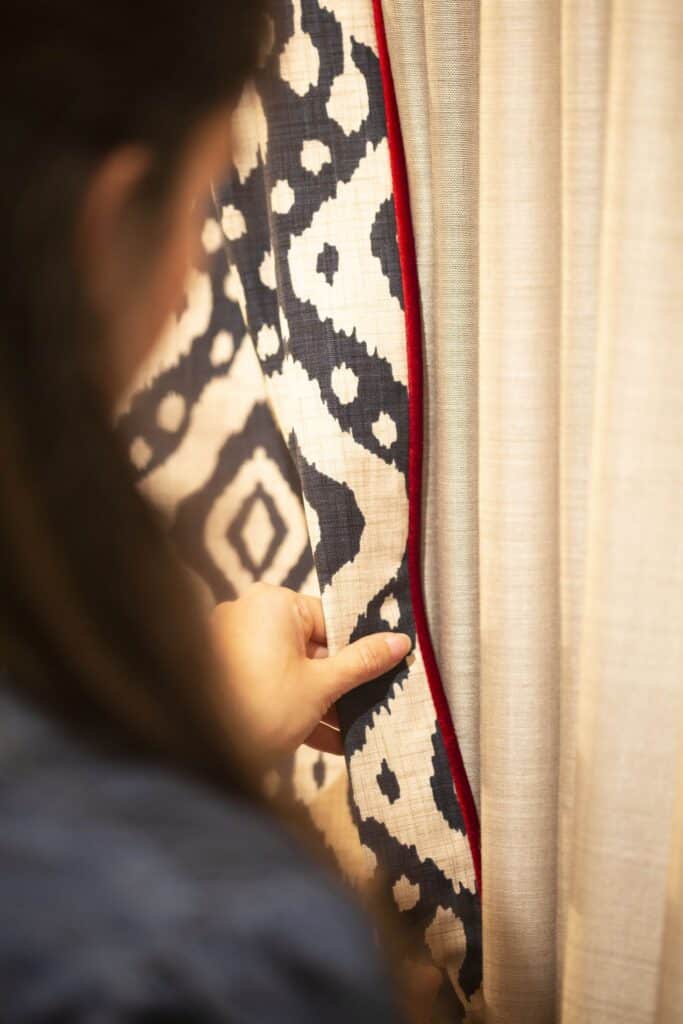
Fabric is tactile. The best way to choose is to visit our showroom, handle the fabrics, see how they filter or block light, and compare options side by side in natural light. We provide take-home samples so you can see them in your own rooms at different times of day — which often makes the final decision much clearer.
We have been choosing and making up curtain fabrics in WA since 1969, for curtains and blinds clients across Perth.
Once fabric is chosen, we discuss curtain headings, linings, motorisation and curtain accessories to complete the specification.
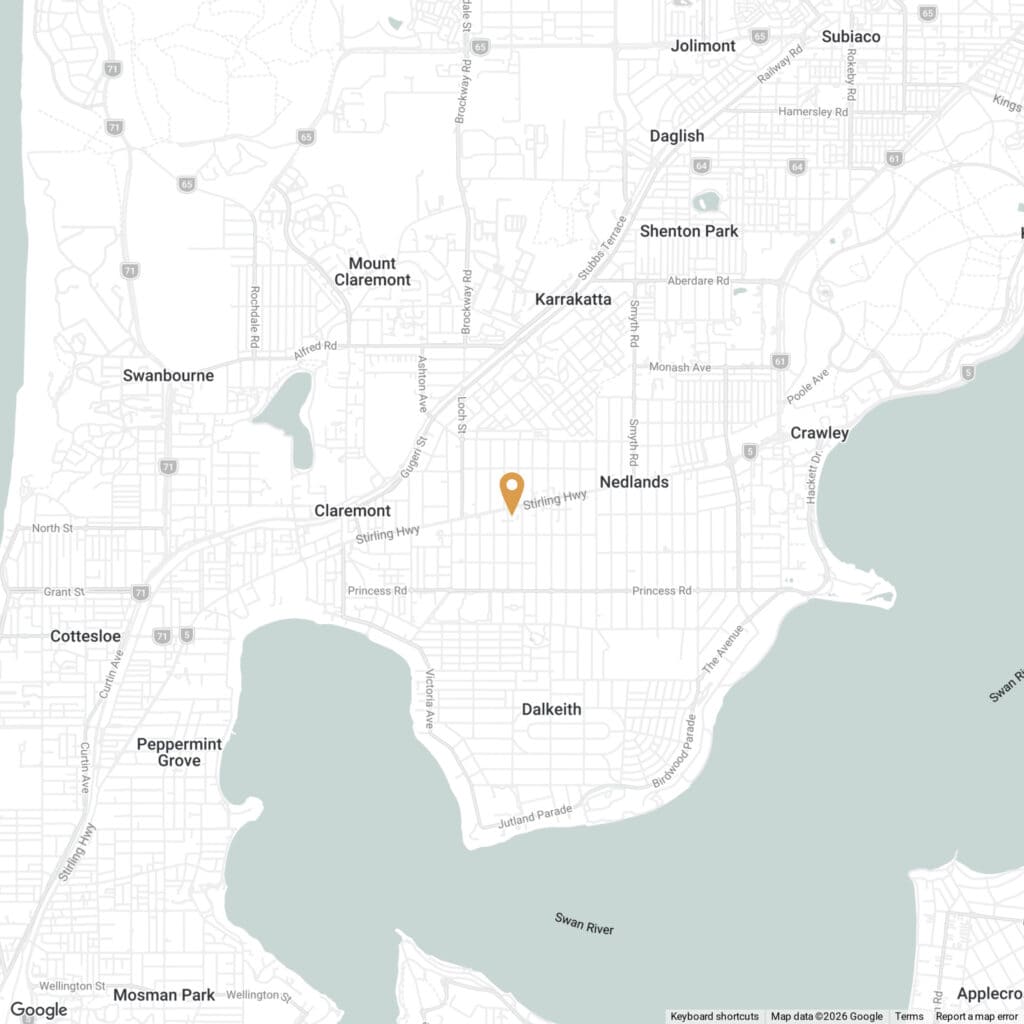
The best way to begin is to visit our showroom in Nedlands. You can explore hundreds of fabric samples in natural light, see finished examples, and often watch work happening in the attached workroom. Annie or a member of the team is always happy to talk through possibilities and answer questions.
Alternatively, we can arrange an in-home consultation at a time that suits you. This has the advantage of enabling us to consider your actual windows and provide advice on the best window dressings for your space.
Either way, you will receive honest, expert guidance focused entirely on what is right for your windows and your home.
We look forward to helping you create window furnishings you will love for many years to come.
Fabrics with good colourfastness and UV resistance are important, especially for west-facing and coastal windows. Annie recommends specific ranges that hold colour and structure under strong WA light — something she assesses for every fabric in our library.
Yes. Alongside dependable ranges like Warwick and Nettex, we access designer collections through Australia’s leading distributors. Because we’re not tied to one brand, we source widely to suit each project.
Often, yes — on a case-by-case basis. Annie checks the fabric is suitable for the intended treatment before proceeding, which is particularly useful for interior designers working to a specific scheme.
A fibre is what the cloth is made from — cotton, linen, wool, silk, viscose or polyester. A fabric is what is made out of those fibres. Velvet is a fabric rather than a fibre, and it can be cotton, silk, polyester or a blend, each behaving quite differently. When comparing fabrics, the composition matters more than the name.
Curtain fabric ranges from around $20 per linear metre to $400 or more. Where a project sits in that range depends on the fibre, the weave, the width and whether it is a designer collection. Because the heading determines how many metres are needed, the fabric and the heading are best decided together.
Yes, and that is what most people are choosing linen for. Linen relaxes into soft, natural creases rather than hanging in crisp straight lines, and it also drops and shrinks slightly with moisture in the air. If you want a curtain that stays perfectly straight, linen is not the right fabric — and it is much better to know that before it is made.