
A Perth Curtain Maker’s View
– Why the best living rooms use more than one treatment
The living room is the hardest room in the house to get right at the window. A bedroom has one job to do and does it at night. A living room has to handle glare on a screen in the afternoon, keep the heat off in summer, hold some privacy in the evening, and still let the room read as one space with the garden or the pool beyond it. No single treatment does all of that well, which is why the best living rooms usually end up with more than one, and why living room blinds and curtains are better chosen together than separately.
The starting point is not a product and it is not a fabric. It is a question: what does this window actually need to do?
Before anyone chooses between blinds and curtains, there are two decisions to make, and they happen in this order.
The first is whether the fabric needs to block light or filter it. That single choice narrows the field faster than anything else, because it determines what the treatment is for. Blocking light is about heat, sleep and screens. Filtering it is about softening glare while keeping the view and the daylight.
The second decision is the aesthetic one: plain, stripe, pattern, texture. This is the enjoyable part, and it is genuinely secondary. A beautiful fabric that does the wrong job at the window is a disappointment within a fortnight.
Most living rooms in Perth need both functions, in different places, which is where the layering comes in.
The single most common reason a plan changes in a Perth living room is width.
Living areas here are built around wide windows and sliding doors, often taller than in the eastern states, and often opening onto a garden, a pool or a river outlook. That scale changes what works. A Roman blind is a beautiful thing on the right window, but it is a single panel of fabric that stacks at the top, and there is a point past which one blind cannot span the opening. The answer is not to run two or three Romans side by side across one door. That reads as a compromise, because it is one, and the eye goes straight to the joins.
So on a wide opening, we use a curtain. It handles the span in one sweep, it stacks back off the glass, and it gives the room the softness a large expanse of glazing needs.
The Romans then go where they belong: on the smaller windows next to it. A curtain on a narrow adjacent window would sit out of scale beside the one on the main opening. A Roman keeps that window in proportion, and because the two sit in the same room they can share a fabric family without competing.
This is worth saying plainly, because it runs against how most people shop. You do not have to choose one product for the whole room. A well-dressed living room is very often a curtain on the big opening and Romans on the windows either side of it, and that is a deliberate decision rather than a compromise between two options.
This is the request we hear more than any other, and the instinct behind it is usually wrong.
Nobody wants to black out a living room during the day. If the room looks over a garden or a pool, blacking it out closes off the reason the room is where it is. The flow between inside and outside is the whole point of a Perth living area, and it is the first thing to protect.
What stops glare on a screen is not darkness. It is a light filtering sheer. It takes the hard edge off the afternoon sun, kills the reflection on the television, and leaves the room bright and the outlook intact. You can sit and watch something at three in the afternoon without the room feeling shut down.
That is why so many living rooms end up layered: sheer curtains for the day, and something heavier behind them for the evening or for the worst of the western sun. It is not decorative excess. Each layer is doing a different job at a different hour.
There is another job that layer can do, and open plan is where it comes up most. A large room with hard floors and a high ceiling carries sound rather than absorbing it, which is why conversation and television can feel louder here than the same volume does in a bedroom. Fabric is what settles that, and the amount of it matters more than the weight – see acoustic curtains for what is measurable and what is not.
If sheers are the direction you are heading, choosing and making them for a living room covers the heading, the fullness and the stack.


Romans are made in our Nedlands workroom, so we have a clear view of where they perform.
They suit the windows in a living room that are of a manageable width, and they are particularly good where you want the softness of fabric without the stack of a curtain taking up wall space. They read as tailored rather than casual, and because the fabric sits flat when the blind is down, a pattern reads properly instead of disappearing into folds.
One point specific to this climate. If a Roman blind is lined, we line it in blockout. That is not a light-control preference, it is a Perth decision: the lining is there for UV, for heat control and to stop the face fabric deteriorating in our light. In Melbourne you might reasonably line a Roman in cotton. Here, the lining is doing protective work, and blockout is what does it.
There is more to say about Roman blinds than one section of a living room post can carry, including the range of styles and how they are constructed. If Romans are the direction you are heading, our Roman blinds page is the fuller answer.
Not everything in a living room needs to be made from scratch, and we will say so.
Where the requirement is glare control on a modern window with a clean line, light filtering roller blinds do the job simply and unobtrusively. They sit tight to the glass, they disappear when raised, and they pair well behind or alongside curtains rather than competing with them.
Where heat is the dominant problem, particularly on a west-facing living room that takes the full afternoon, cellular honeycomb blinds are the ones we specify. The cell structure traps a layer of air against the glass, which is a genuine insulation benefit rather than a marketing one.
Both of these we supply rather than make, and we are straightforward about the difference. Curtains, Romans and pelmets are sewn here. Rollers and honeycombs are quality products we specify because they suit the window better than something we would make ourselves.
A few things matter more than people expect.
On a wide opening, the heading style does a lot of the work. A wave heading gives a soft, even, contemporary fall that suits large spans, while a pinch pleat reads more formal and structured. The choice changes the character of the room as much as the fabric does. Our guide to curtain headings and styles goes through the options properly.
Hardware matters too, and it is routinely underspecified. A long run of curtain on a sliding door needs curtain tracks that will carry the weight and glide smoothly for years, not one that fights you every evening. This is not a place to save.
And if you are still weighing the two families against each other in general terms rather than for this specific room, our piece on curtains or blinds sets out the honest case for each. For rooms with very tall glazing, floor-to-ceiling curtains covers the proportions in more detail.
The short version. Work out what each window needs to do before choosing anything. Let the wide opening take a curtain and the smaller windows take Romans, rather than forcing one product across the room. Add a light filtering sheer if the room is used during the day, especially with a screen in it. Protect the connection to the garden, because that is what the room is for.
We measure in your home, which is the only way to judge scale properly, and we make curtains, Roman blinds and pelmets in our Nedlands workroom. If you would like to talk it through, we work with homes right across Perth and would be glad to help.
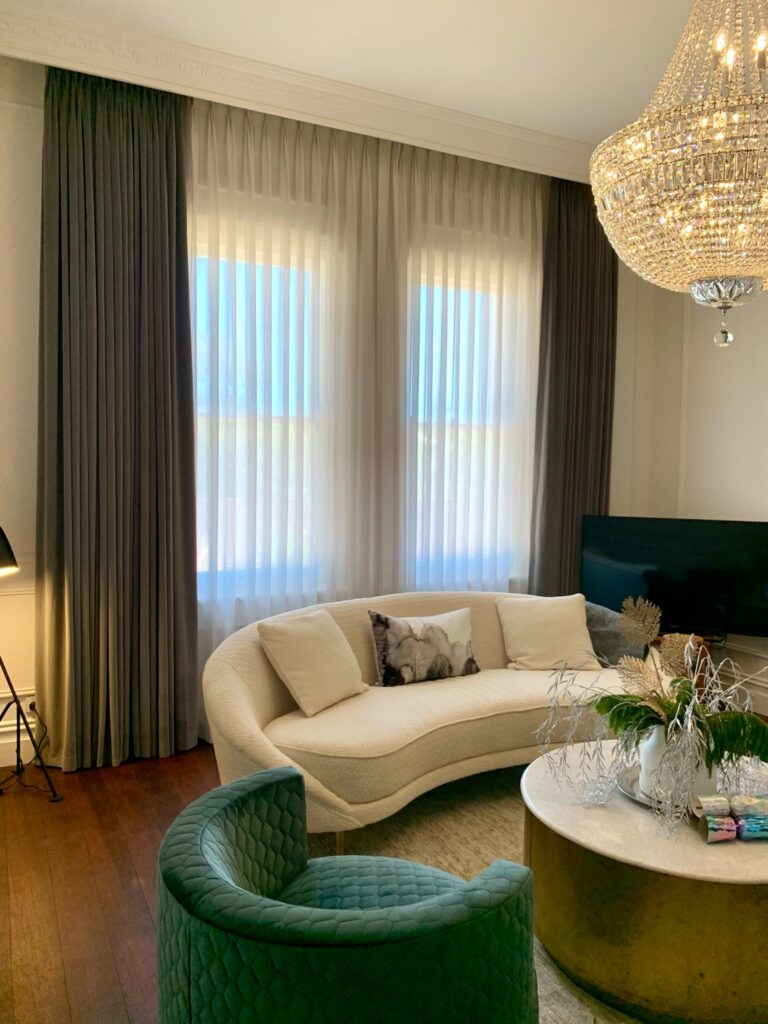
Very often the answer is both, in different places. Living areas in Perth are built around wide windows and sliding doors, and there is a point past which a single blind cannot span the opening well. A curtain handles the wide opening in one sweep, and Roman blinds suit the smaller windows beside it. Running several blinds side by side across one door is the thing to avoid.
With a light filtering sheer rather than a blockout. Nobody wants a living room blacked out in the middle of the day, particularly one that looks over a garden or a pool. A sheer takes the hard edge off the afternoon sun and clears the reflection from the screen while the room stays bright and the outlook stays open.
If a Roman blind is lined, we line it in blockout. In Perth the lining is doing protective work as much as light control: it manages UV and heat, and it stops the face fabric deteriorating in our light. In a cooler, milder climate a cotton lining would be a reasonable choice. Here it is not.
Usually not well. A Roman is a single panel that stacks at the top, and a standard sliding door is wider than one blind can cover convincingly. The alternative of two or three Romans across the one opening draws the eye straight to the joins. A curtain is the better answer on that span, with Romans kept for the windows either side.