

Even beautiful curtains can be let down by poor hardware. The track or rod, the finials, the tiebacks and the way curtains are hung all affect how they operate, how they look open and closed, and how long they last. Getting them right is part of creating curtains that feel complete and considered — and it’s something Annie addresses at every consultation, not as an afterthought.
At Hay Interiors we offer a carefully selected range of tracks, rods, tiebacks and hardware, chosen for quality, smooth operation and durability, and matched to your curtains and interior style.
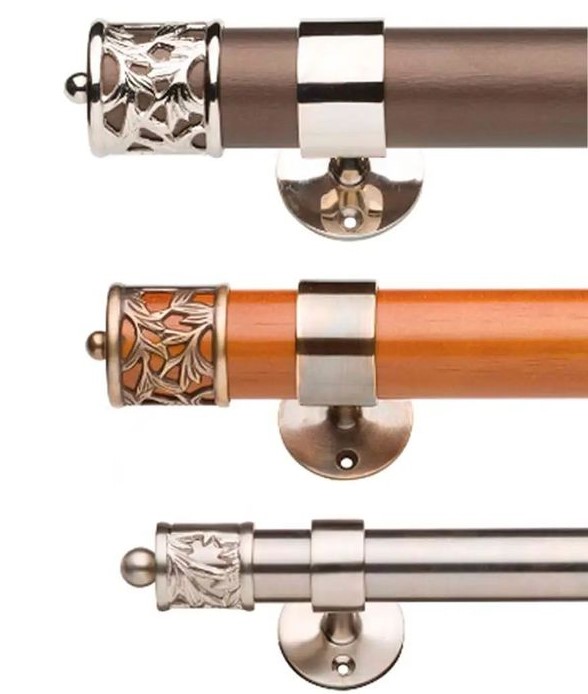
The system your curtains hang from is critical. We work with quality tracks that glide smoothly, carry the weight reliably and can accommodate motorised curtains. Options range from discreet ceiling-mounted tracks that virtually disappear to decorative rods and poles for traditional or statement looks.
Most of the time this is a question about how you want the hardware to read. A track can be made to disappear; a rod is meant to be seen. Rods suit more formal rooms — living and lounge rather than bedrooms — and come in contemporary, classic and highly ornate finishes. For a heritage or period interior, Annie would generally put a classic rod ahead of a track, and our heritage curtains page covers dressing a period room more fully.
Three things turn it from a preference into a decision, and all three are easier to accommodate before anything is ordered than after.
Motorisation – Motorised hardware is functional rather than decorative — it runs on a plain track, and there is no such thing as a motorised rod. If you want the curtains to open at the touch of a button, now or at some later point, you are having a track and the aesthetic conversation does not arise. Our motorised curtains page covers where that is worth doing.
Width – No rod can be joined to another. Different rods reach different maximum lengths, but whichever you choose, that length is your ceiling. A track can be joined and run as far as the window requires. Where a rod falls short, we would look first at a longer rod, and on a genuinely long window a track becomes the answer. Joining is possible in the sense that a break can be concealed behind a bracket — we have done it — but the runners will not travel across the join, so the curtain becomes two curtains that meet rather than one that draws. That is a decision to make knowingly.
Weight – Where a curtain is substantial — interlined, blockout-lined, or a layered treatment — we support the track with additional brackets along its length. A rod running on rings cannot take those supports. Our post on curtain linings covers what makes a curtain heavy in the first place.
One further note on s-wave, which is always underslung on a specialist track rather than hung from a rod. Our post on s-wave curtains explains why the track is what creates the wave.
A curtain can follow the line of a bay or turn a corner rather than cutting across it, and the way that is done is by bending the track to the shape of the window.
The track is bent to measure – It is not a standard curved component selected from a range — the angles are taken from your window and the track is formed to match. We bend for 90 and 45 degree turns, which between them cover almost every bay and corner window built.
Most rods cannot do this – Some can be bent and some cannot, so if you have set your heart on a rod for a bay it is worth establishing early whether the one you want is capable of it. Where it is not, a track is the answer.
This is worth raising before anything else is decided, because it affects the hardware, the curtain and how the window looks when the curtains are open. Our post on bedroom blinds covers why corner windows are the one place roller blinds consistently disappoint — and a curved track is a large part of why curtains do not.
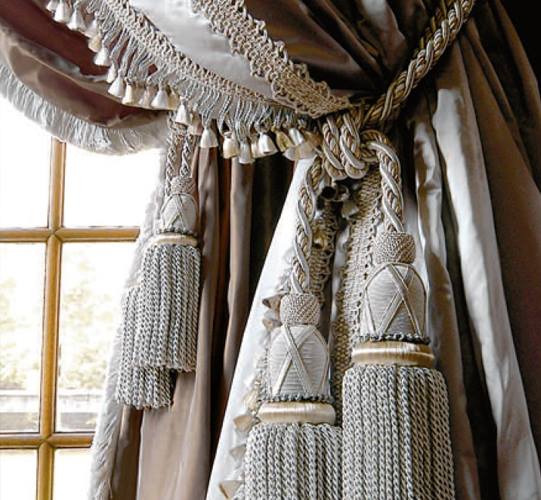
Tiebacks and holdbacks add both function and style, controlling how curtains frame the window when open and introducing texture or metallic accents that complement the overall scheme. A well-chosen tieback can transform a plain curtain into something that looks considered and styled.
Two details decide how a finished curtain looks and how well it performs, and neither usually appears on a quote.
A return is where the curtain turns back at each end to meet the wall rather than stopping at the edge of the hardware. Every track has one, and so do contemporary and classic metal rods. Where a rod does not provide one, Annie makes one — which is not something every supplier does. It looks considerably neater, because the fabric finishes against the wall instead of stopping in mid-air, and it closes the gap at the side.
An overlap is where the two curtains cross in the centre rather than meeting edge to edge. It is what prevents a line of light down the middle of a closed pair. Every custom track we supply has one. A rod running on rings cannot have one at all — the curtains meet, and light comes through where they do. If darkness matters in the room, that is worth knowing before the hardware is chosen, and our post on bedroom window treatments covers the wider darkness question.
Neither is expensive. Both are decided before anything is made, and neither can be added afterwards.
Where the track goes is decided first by how high you want the curtain to start, and then by what the room will allow.
Ceiling mounting – gives the tallest curtain and the cleanest line, and it is not always available. A cornice you would rather not cover, a ceiling that will not carry the weight, or a ceiling high enough that a full-drop curtain would look absurd will each rule it out. Where there is a bulkhead, ceiling mounting is sometimes the only option. Our post on floor-to-ceiling curtains covers the proportions in more detail.
Face fixing – to the wall above the window is the common alternative and suits most rooms.
Flush recessed track – sits inside the ceiling itself, so the curtain appears to emerge from the plaster with no visible hardware at all. It gives the most seamless modern result and it takes any heading. The catch is timing. The track is installed by the builder or ceiling contractor during construction, which means it has to be designed in — the conversation belongs with your architect, at the stage where the ceilings are being drawn rather than built. It cannot be retrofitted. These are becoming more popular, and if you are building or planning a substantial renovation it is worth raising early, because the window for the decision closes well before the window for the curtains.
Where the position of a track is questionable — a bulkhead, or anywhere the structure may not carry the weight of the finished curtain — we bring our installers in beforehand to establish what provisions are needed, rather than discovering the problem on installation day.
With Hay Interiors, hardware is never an afterthought — it’s discussed as part of your consultation, and we supply and install everything for a complete result. You don’t need to coordinate multiple trades or source hardware separately. For heritage homes we source hardware sympathetic to the period; for contemporary projects we focus on clean, minimalist systems that let the fabric do the talking. Visit our showroom to see tracks, rods and accessories alongside finished curtains and fabrics.
If you are replacing curtains and the existing tracks are sound, they can often be kept. We re-cord and service tracks and are glad to do it. It is not always cheaper once the work is accounted for, but where the tracks are in good condition it can be — and some clients prefer it simply for not throwing away something that can still work.
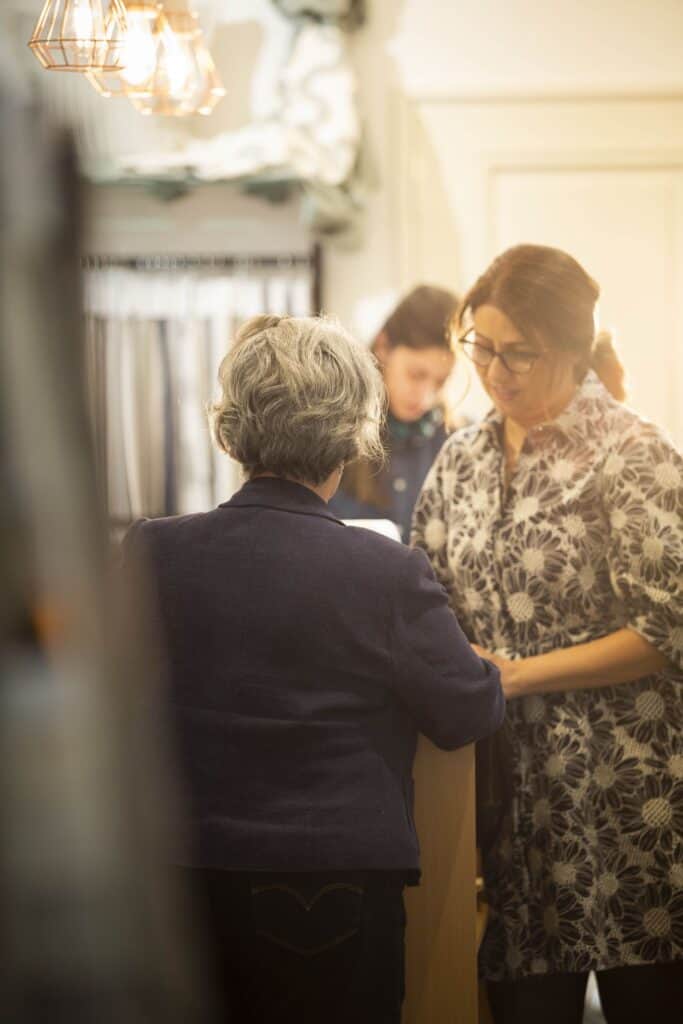
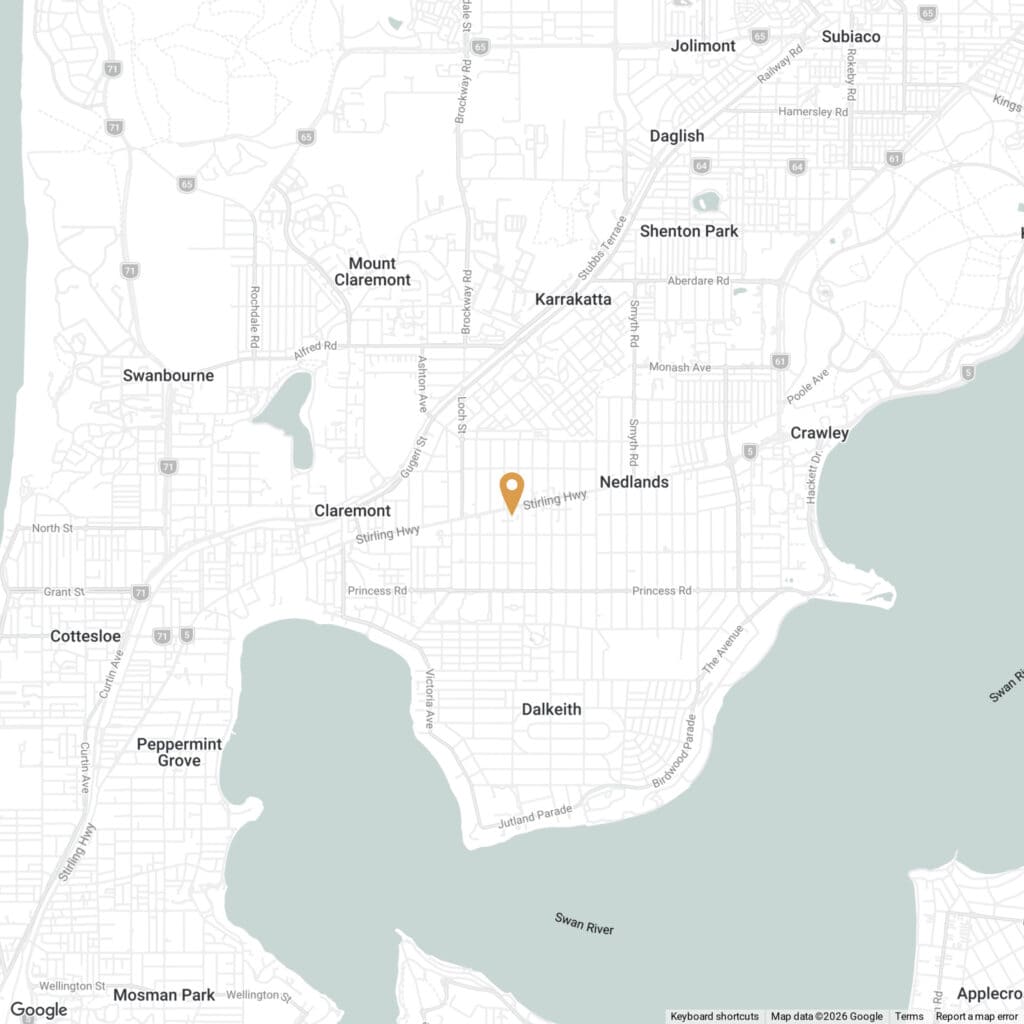
The best way to begin is to visit our showroom in Nedlands. You can explore hundreds of fabric samples in natural light, see finished examples, and often watch work happening in the attached workroom. Annie or a member of the team is always happy to talk through possibilities and answer questions.
Alternatively, we can arrange an in-home consultation at a time that suits you. This has the advantage of enabling us to consider your actual windows and provide advice on the best window dressings for your space.
Either way, you will receive honest, expert guidance focused entirely on what is right for your windows and your home.
We look forward to helping you create window furnishings you will love for many years to come.
Yes — we supply and install the complete system, matched to the weight and style of your curtains, so everything operates smoothly from day one. You don’t need to source hardware separately.
Many can. If you think motorisation may come later, tell Annie at the consultation and she’ll specify a track that’s motorisation-ready from the start — which avoids the cost of replacing hardware down the track.
A track is a functional system (often ceiling-mounted and discreet) that the curtain hooks or gliders run along; a rod or pole is a decorative element that sits above the curtain and is part of the visual display. Annie advises on which suits your curtains, heading style and interior.