

Classic Roman blinds — also called flat-fold Romans — are the most popular and versatile style. They form clean horizontal folds that stack neatly when raised and present a smooth, tailored surface when lowered — a refined, architectural look that works in both contemporary and traditional interiors.
At Hay Interiors our classic Roman blinds are made the proper way: quality curtain fabrics sewn and finished in our Nedlands workroom with rings, cords (or motorised systems) and appropriate linings. This construction delivers the soft drape and elegant finish that defines a true Roman blind — and distinguishes it clearly from the roller-fabric versions that many Perth shops pass off as Romans.
It also means the person who makes your blinds is the person who measures them. When you book a consultation Annie visits herself — not a salesperson working from a brochure. She looks at the window, talks through what will actually suit the room, and matches fabrics to what you already have.
The classic Roman suits almost any room — contemporary kitchens, traditional studies, bedrooms and dining rooms alike. When lowered, the flat, smooth surface shows off a beautiful fabric at its best — pattern, texture and colour all read clearly. When raised, it stacks into a neat, compact fold, leaving the glass almost entirely clear. Annie often recommends this style where a tailored, unfussy look is wanted and the fabric itself is the statement.
Practical benefits include excellent light control with the right lining, space efficiency, wide fabric choice across sheers, linens, velvets, patterns and performance fabrics, and the option of motorised operation for larger or higher windows.
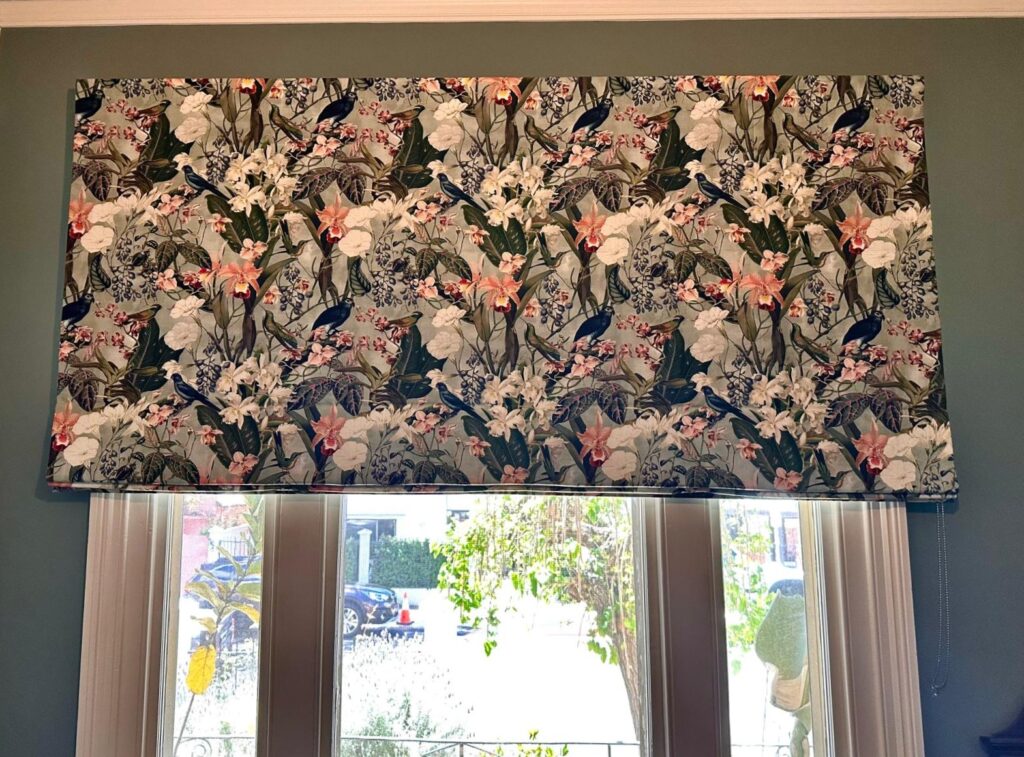

Because we make in-house and aren’t tied to a single supplier, our fabric choice is wide. Annie guides you through options based on your room’s light, the look you want and how the blind will be used. Lining matters too — sheer for soft diffused light, light-filtering for balanced privacy and brightness, or blockout for complete darkness and insulation. Interlining adds body, weight and improved thermal performance. Pattern matching is available for statement fabrics. Annie advises on the right combination for each window during your consultation.
The lining does most of the work, and the right choice depends on the room.
Bedrooms — a blockout lining gives complete darkness for sleep while the blind keeps its tailored appearance both from inside the room and from the street.
Living areas — a light-filtering lining lets daylight through while maintaining daytime privacy, which is usually what these rooms actually need.
Home offices and dining rooms — something between the two, so you can work or entertain comfortably without feeling exposed.
Kitchens — a practical fabric that tolerates steam and cleaning, with the lining chosen for glare rather than darkness.
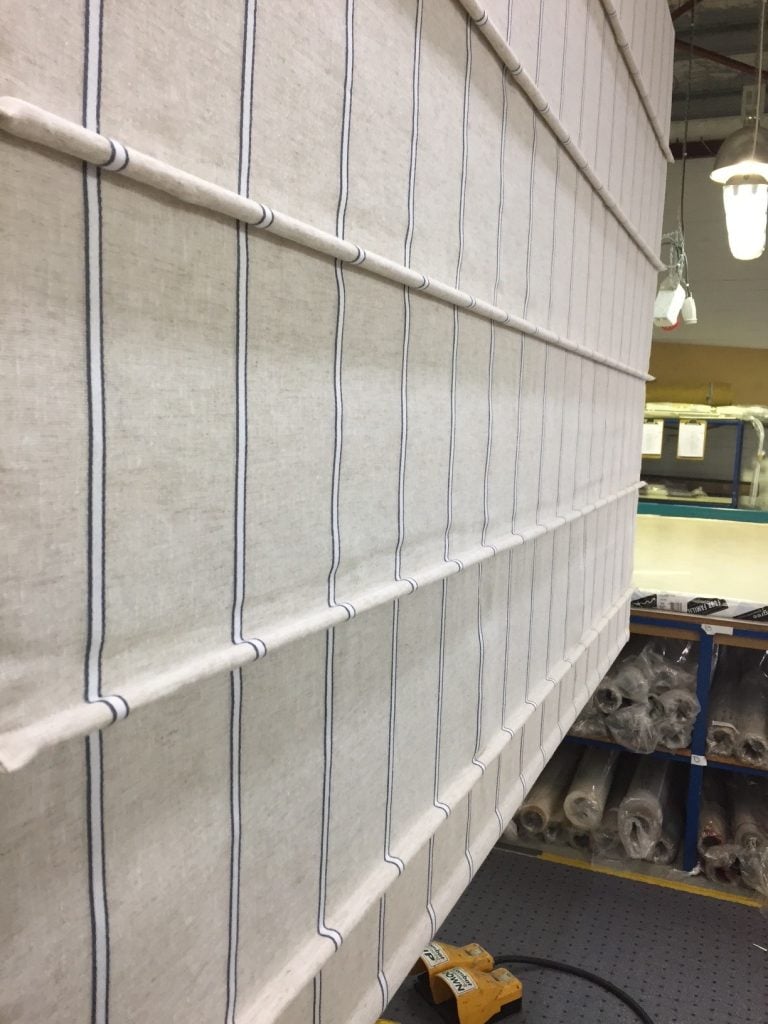
Construction can be varied too. The dowel rods that keep the folds even normally sit in pockets on the back of the blind, hidden from view. Occasionally we are asked to bring them to the front, as in the blind below, made for a Perth home — which produces a distinct ribbed effect across the face of the fabric. It is uncommon, and it is exactly the sort of detail available when a blind is made rather than ordered.
The classic Roman suits almost any interior, but the fabric should follow the room.
In traditional rooms, richer fabrics tend to work best — a silk or damask, often with a classic pattern — sitting comfortably alongside ornate furniture and period detail.
In contemporary spaces, solid colours and subtle textures in neutral tones keep the look uncluttered and let the architecture lead.
In more eclectic or relaxed rooms, a bold print or a strong colour lets the blind become the focal point that draws the other elements together.
Annie will bring samples chosen for your room rather than the entire range, which makes the decision considerably easier than it sounds.
The classic Roman is defined by its crisp, flat surface when lowered — achieved by horizontal rods in the back that keep the folds even and controlled. This separates it from the soft Roman blinds, which omits the rods for a gentler look, and the relaxed Roman blinds, which uses side cords only to create a single curved swag at the hem. Annie can show you all three styles and explain how each would look in your specific windows — including pairing them with sheer curtains or pelmets where the room warrants it.
A mock Roman blind is a different proposition again. Despite the name it isn’t a working blind at all — it’s a fixed fabric heading with no lifting mechanism, closer in function to a padded pelmet. Mock Romans cost less and suit windows where the blind never needs to move, but they won’t control light on their own. Our guide to mock Roman blinds explains where each approach makes sense.

The best way to begin is to visit our showroom in Nedlands. You can explore hundreds of fabric samples, see finished examples, and often watch work happening in the attached workroom. Annie or a member of the team is always happy to talk through possibilities and answer questions.
Alternatively, we can arrange an in-home consultation at a time that suits you. This has the advantage of enabling us to consider your actual windows and provide advice on the best window dressings for your space.
Either way, you will receive honest, expert guidance focused entirely on what is right for your windows and your home.
We look forward to helping you create window furnishings you will love for many years to come.
A classic Roman has crisp, structured flat folds — usually with horizontal rods in the back — for a tailored, architectural look. A soft Roman omits the rigid rods so the fabric falls in gentler, rounded folds. It’s a warmer, less structured look. Annie can show you both.
Sheer for soft diffused light, light-filtering for daytime privacy with brightness, or blockout for darkness and insulation. The right choice depends on the room, its aspect and how you use it. Annie advises at the consultation.
Yes — motorisation works particularly well on classic Romans, keeping the clean look while adding effortless operation. It suits high, wide or hard-to-reach windows especially well.
A classic Roman is a working blind — the fabric lifts and folds on a cord or chain mechanism, so it controls light and privacy on its own. A mock Roman blind has no mechanism. It’s a fixed fabric heading, much closer to a padded pelmet, and is usually paired with a roller blind behind it to do the actual light control.