

Hay Interiors has been making window furnishings in Perth since 1969, and commercial work has been part of that from the beginning — offices, consulting rooms, salons, boutiques, hospitality venues and boardrooms.
What makes us different from most commercial suppliers is that we make what we sell. Curtains are cut and sewn in our Nedlands workroom, which means we can build to a specification rather than to a catalogue: a particular drop, a fabric your designer has chosen, a fullness that will actually perform acoustically. Annie measures and advises personally, so the person you consult is the person responsible for the result.
We also work to the practical requirements commercial premises carry — fire retardancy where regulations demand it, fabrics that survive cleaning and heavy traffic, and installation scheduled around your trading hours rather than ours.

We’re a workroom, not a contracting business. Our commercial work is the boutique that needs changeroom curtains, the practice replacing curtains that have had their day, the salon where one end of the room is too loud, the restaurant chasing something that looks considered and sounds calmer.
Annie visits, measures, and advises on what will suit the space and hold up in use. Typically four weeks from order to installation, or six to eight weeks for acoustic work.
One thing we don’t do. We don’t price as a component of someone else’s tender. If you are assembling a submission for a larger project and window furnishings are one line among many, we are not the right call — those packages are decided on price across the whole job, and a small workroom will not win them. We would rather say so now than after we have both spent a fortnight on it. The same applies to large-volume roller blind packages across multiple sites.
Everything else is welcome, and no job is too small. A café that wants the front window softened, a practice replacing curtains that have had their day, a single roller blind for the office next door — that is the work this workroom was built for.
And if you are an architect or interior designer working directly with us, none of the above applies. Working from your specification, from plans, or alongside you at the design stage is exactly how we prefer to work.
“Huge thanks to Hay Interiors for our new soundproof curtains at my beauty salon! They look stunning and have made a big difference in blocking out background noise. So glad we went ahead with the install — highly recommend! The whole process was seamless with excellent customer service.”
— Elle Louise Beauty, Google review
“From the very first consultation through to the final installation, the entire process was handled with exceptional professionalism and care. Annie took the time to understand our vision, offered thoughtful design suggestions, and ensured every detail aligned perfectly with our space and branding.”
— Cade Eglington, Cleaver Group, West Perth
Noise is the complaint we hear most from commercial clients. Hard floors, glass partitions and high ceilings look excellent and sound terrible — conversations carry, meetings become difficult, and a room that was designed to feel open ends up feeling exhausting.
Hay Interiors is the exclusive Western Australian partner with Australia’s specialist in tested acoustic window furnishings. We provide the advice, construction and installation for their Western Australian clients, and specify the same products for our own.
Worth stating plainly, because it has been measured: in testing at UTS Tech Labs, a traditional roller blind recorded 0dB of noise reduction, against 8dB (ΔRw) and 10dB (ΔDw) for an acoustic curtain. If noise is your reason for considering window furnishings, standard products are not a cheaper version of the answer. They are not an answer at all.
Tested performance
Examples from the acoustic face fabric range, tested at the University of Sydney to ISO 354 at 1.8x fullness with lining:
| Fabric | Composition | NRC |
|---|---|---|
| Soundli Wool | 100% wool, 730gsm | 0.90 |
| Randwick Texture | 100% polyester, 280gsm | 0.85 |
| Wellington Texture | 100% polyester, 365gsm | 0.75 |
An NRC of 0.90 means around ninety per cent of the sound reaching the curtain is absorbed rather than thrown back into the room — performance comparable to acoustic wall panels, without the industrial look. The full range is in our Nedlands showroom.
For spaces that also need insulation from outside noise, the WorkWell curtain layers designer face fabrics on both sides over an 800gsm acoustic interlining. Because both faces are finished, it works as a room divider or partition as readily as at a window. Tested at the University of Adelaide’s transmission loss suites to ISO 10140-2: Rw 18dB, NRC 0.55, Dw 19dB. The SleepWell system adds full blockout lining for accommodation and short-stay: Rw 15dB, NRC 0.45–0.65, an improvement of 14–16dB over glazing alone.
Full test reports are available on request.
Where noise is coming in from outside, the usual answers are double glazing or secondary glazing — expensive, disruptive, and often impossible in a leased tenancy or a heritage building.
Acoustic curtains cost between a half and a third of the price of glazing work. They retrofit to existing windows with no building work, meet BCA fire ratings, and made-to-measure product installs within eight weeks.
Acoustic curtains are a premium product, and there’s a genuine range depending on what your room needs.
Acoustic face fabric alone — the entry point, and often the right answer. Where the problem is echo inside a room, a single layer of acoustic fabric hung with proper fullness does the work.
Acoustic sheers — where light and outlook matter more than mass, particularly in offices and boardrooms.
The engineered systems — WorkWell and SleepWell, with an 800gsm acoustic interlining. These carry the tested insulation figures and are the answer to traffic and external noise. They cost considerably more.
Annie will tell you honestly which tier your problem calls for, and won’t sell you the top of the range if the bottom will fix it.
Where we’re asked most often: dental and medical practices · hairdressers and beauty salons · boutiques and changerooms · cafés and restaurants · small offices and consulting rooms · boardrooms and meeting rooms
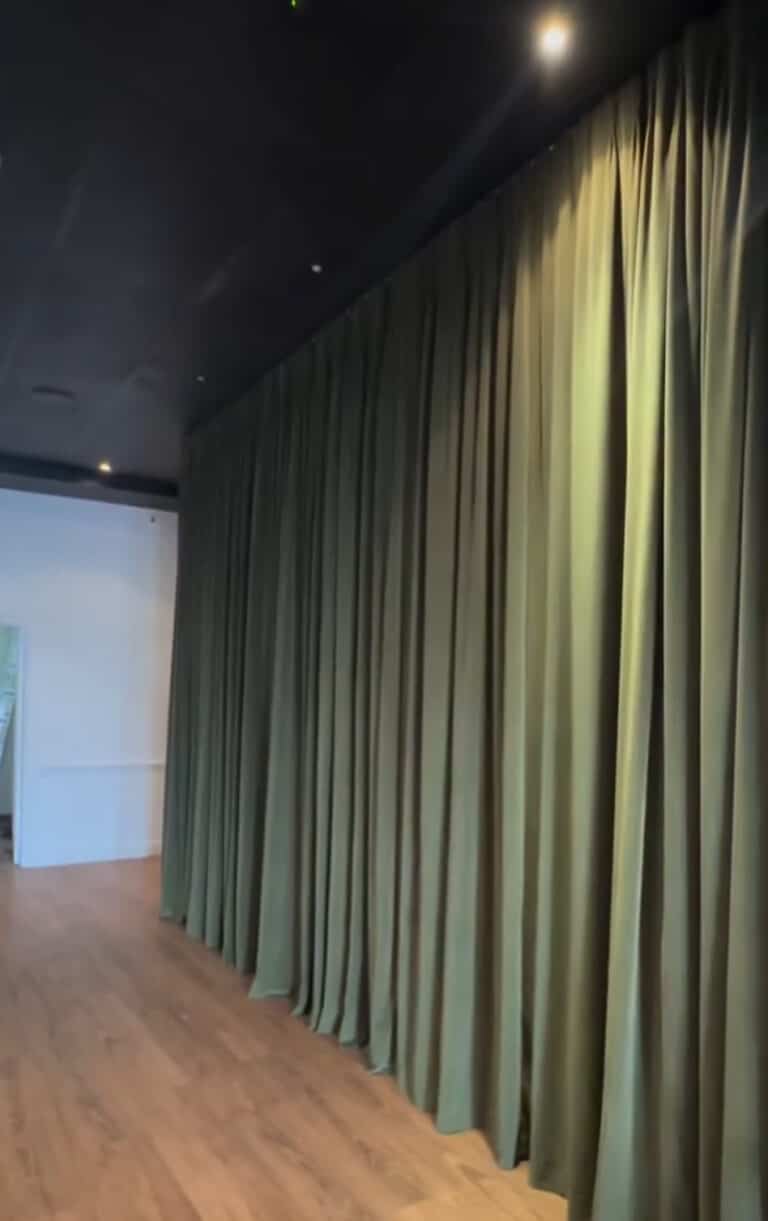
Because the WorkWell curtain carries finished designer fabric on both faces, it works as a partition as readily as at a window — creating a separate, quieter space without building anything.
Cleaver Group in West Perth used one to divide their function room, giving them a space that works on its own rather than competing with the rest of the room. Brett’s Bar in City Beach did the same to create a private function and dining area.
It’s a flexible answer to a common problem: a room that needs to be two rooms sometimes, and one room the rest of the time. Drawn back, it’s a curtain. Drawn across, it’s a wall that absorbs sound rather than reflecting it.
“The craftsmanship and quality of the finished curtains exceeded our expectations, adding a refined and cohesive touch to our interior.”
— Cade Eglington, Cleaver Group, West Perth
Decking Perth’s showroom on Stirling Highway in Mosman Park had a problem that only showed up when business was good. With several couples in at once, each talking to a different staff member, the room turned into a wall of overlapping conversation. Nobody could hear their own salesperson properly — and a sales conversation you have to repeat is a sales conversation you’re losing.
Annie treated it in two directions. Acoustic curtains on several windows brought the reverberation down across the floor, and a second run was hung as a partition to the staff area — separating the working end of the room from the selling end, without building a wall through a showroom that needed to stay open.
The result did two jobs at once, which is generally the point with acoustic curtains in a retail space: the room got quieter, and it also looked considerably better for it.
“Really happy with her work. She made some sound-deadening curtains for our high-end showroom on Stirling Highway. They look great and really elevated the look of the place. Highly recommend.“
— Decking Perth, Mosman Park, Google review
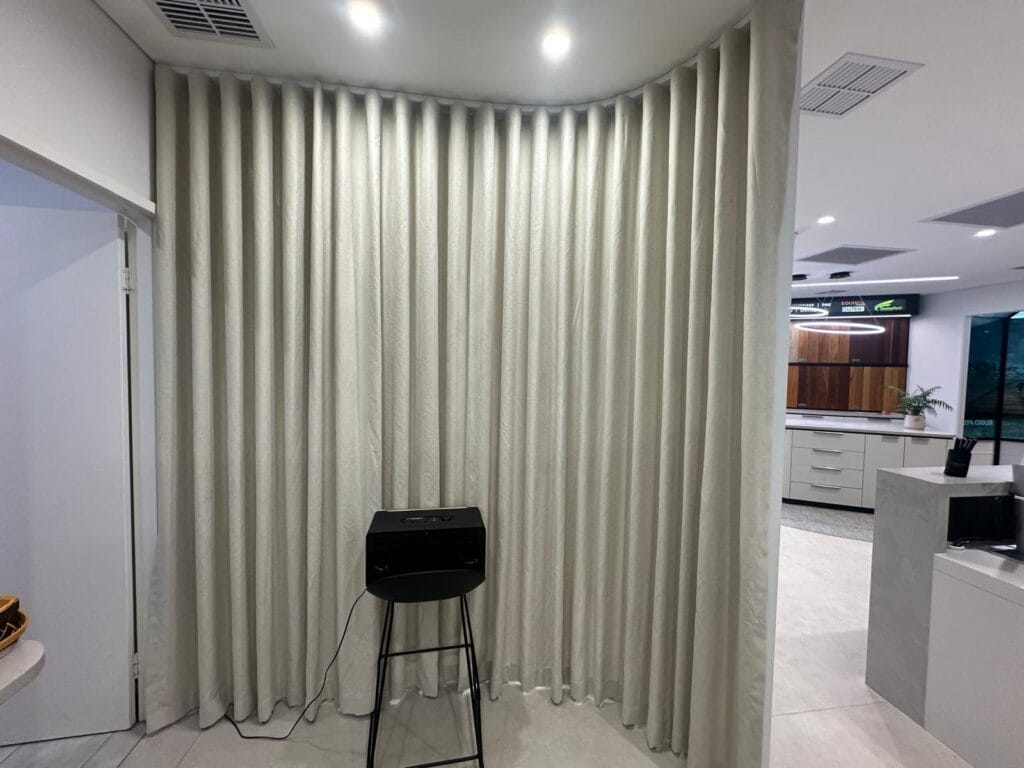

An environmental consultancy in Perth had a boardroom with three glass walls. It looked excellent and sounded terrible — the glass turned the room into an echo chamber, and it was worst exactly where it mattered most, on Zoom and Teams calls where people couldn’t follow what was being said.
Heavy drapery would have fixed the acoustics and ruined the room. Annie specified Hampden Texture in Ecru, hung across two of the three glass walls — a light, pale acoustic fabric that reads like sheers, keeping the space bright and open while adding a degree of privacy.
Where the fabric goes matters as much as how much of it there is. Two adjacent walls work better than two facing ones: sound reflecting between parallel surfaces bounces back and forth, and treating opposite sides doesn’t break that path as effectively as catching it on the perpendicular. Two walls were enough. The client was happy with the result, and the third was never needed.
Acoustic work is where we are asked most often, because it is the problem few others in Perth can solve the same way. But a good deal of our commercial work is simply making something that suits the space and the business in it.
C Restaurant sits high above the Perth CBD, turning slowly behind a wall of exterior glass, and the view is the entire reason people book. The problem was on the inside. The inner wall of the circle had a shiny finish, and it threw its own reflection onto the glass — so diners were looking at the room as much as the city beyond it.
The answer was to cover the reflective surface in a muted, low-sheen fabric that would absorb the light rather than bounce it back. The same treatment brought an acoustic benefit the client also wanted, in a room where hard surfaces and a full house make conversation harder than it should be.
It is an unusual brief, and a good example of why the site visit matters. Nobody arrives asking for curtains to fix a reflection.


Arthur G sell furniture and homewares, and a showroom selling those things has a particular difficulty: everything in it is meant to look as though it belongs in a house, while the space itself looks like a shop. The curtains were specified to close that gap — treating the showroom as a family room rather than a retail floor, so the furniture reads in something like the setting a customer is imagining it in.
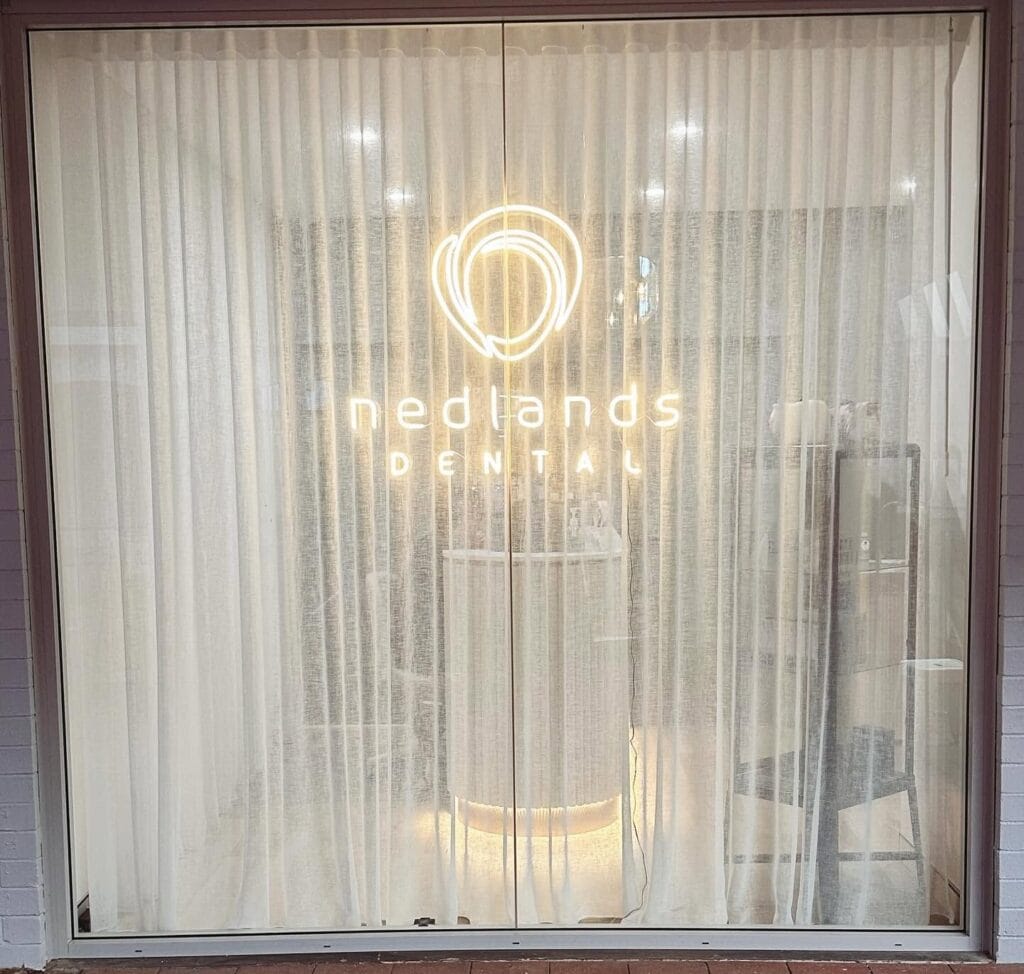
A dental waiting room is an awkward design problem. Patients are there because they would rather not be, and everything in the room is either settling them or not. At the same time, a practice at street level wants to look open and inviting, not closed off.
Sheers at the reception window solved both. The receptionist no longer felt she was sitting on the footpath, and patients in the waiting room got a degree of privacy from the street — while the practice stayed visible and welcoming from outside. Sheers are one of the few treatments that give privacy in one direction without shutting the space down.
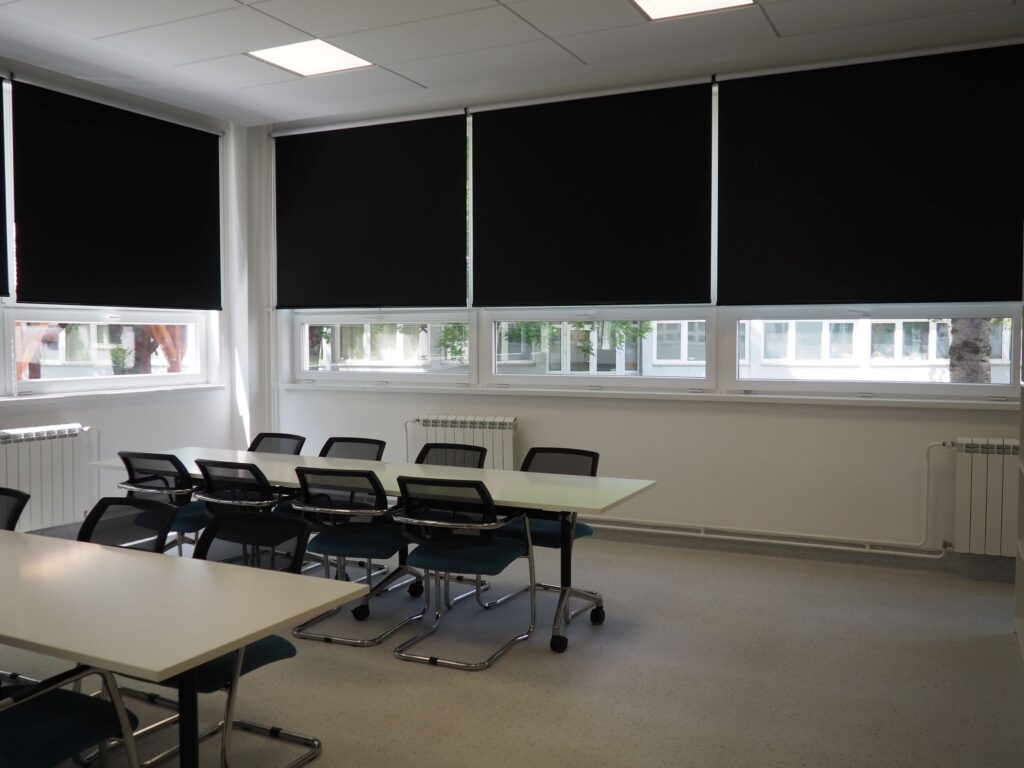

Annie works directly with interior designers, business owners and practice managers — reading a space, advising on what will suit it, and getting the work done without disrupting your trading.
Annie is a Member of the Design Institute of Australia, and trained as a curtain maker in Southampton, England.
The best place to start is your premises. Seeing the space lets us measure accurately, assess the practical requirements — traffic, cleaning, glare, noise — and recommend something that will hold up in use. We can work around your trading hours.
You’re also welcome at our Nedlands showroom, where you can see hundreds of fabric samples including the full acoustic range, view finished work, and often watch making happening in the attached workroom.
Either way, you’ll get honest, expert guidance focused entirely on what’s right for your premises.
Yes — we source fire-retardant fabrics and treatments where building regulations require them, and advise on compliant options for your project type.
Yes, and it has been independently measured. Testing at UTS Tech Labs recorded 8dB of noise reduction from an acoustic curtain against 0dB from a traditional roller blind, and University of Sydney testing rated acoustic wool at NRC 0.90 for sound absorption. In everyday terms, perceived noise roughly halved. We can supply the full reports.
Yes — we regularly collaborate with architects, interior designers and builders from specification through to installation, and are happy to work from plans and drawings at the design stage.
Almost always curtains. Acoustic blinds do exist and are tested, but the fabric mass and fullness a curtain provides is what does the work. A traditional roller blind, by contrast, measured zero noise reduction in testing.
Typically between a half and a third of the price, with no building work required — which matters in a leased tenancy or a heritage building where the windows can’t be altered. Made-to-measure product is generally installed within six to eight weeks.
Every job is quoted individually, since fabric, drop, fullness, track type and installation access all affect cost. After a site visit you’ll receive an itemised quotation.