
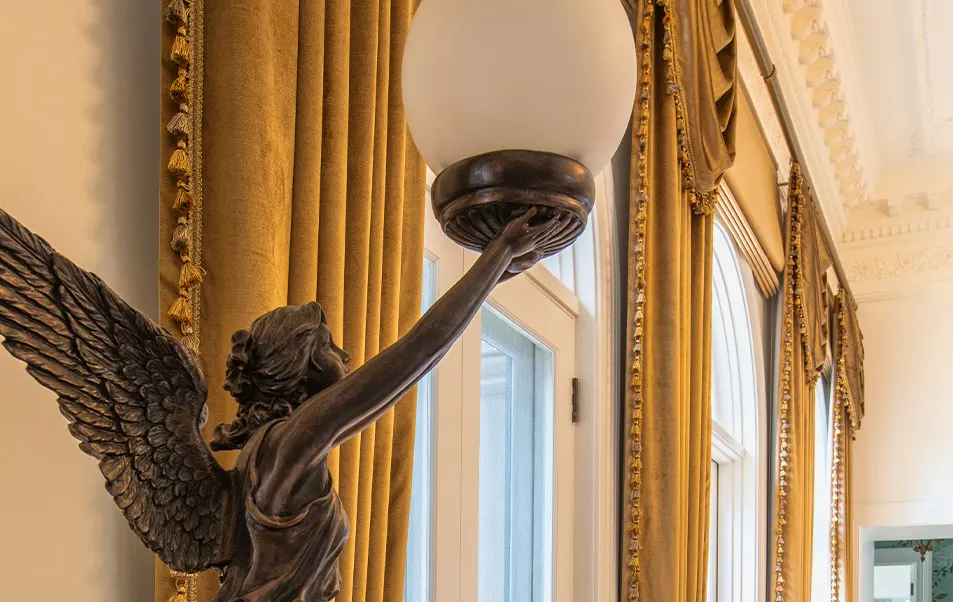
Swags and tails are among the most traditional and formal of window treatments — opulent fabric arrangements that frame a window with graceful curves and cascading tails. Executed with skill and proportion, they bring history, grandeur and refined beauty to a room, and suit Perth’s heritage homes, period properties, formal dining rooms and grand entrances.
Many Perth curtain shops don’t make these at all. At Hay Interiors we create swags and tails that feel authentic rather than theatrical, informed by traditional techniques and genuine respect for architectural proportion. It is one of Annie’s signature specialties, and one of the clearest expressions of what makes a traditional workroom different from a retail showroom.
Annie’s training in Southampton, England included mastering the precise calculations, pattern matching, pleating and finishing that beautiful swags and tails demand. She understands how these treatments interact with cornices, architraves and window proportions — knowledge essential for heritage work — and draws on her experience with historic buildings and museums to create treatments that honour the original architecture.
Getting swags and tails right requires more than skill with a sewing machine. The calculations for balanced proportions, the cutting of bias-draped fabric, the shaping of the tails and the final dressing of the treatment at installation all require experience that takes years to develop. Annie brings that experience to every project — see also our heritage curtains page for more on our period-home speciality.
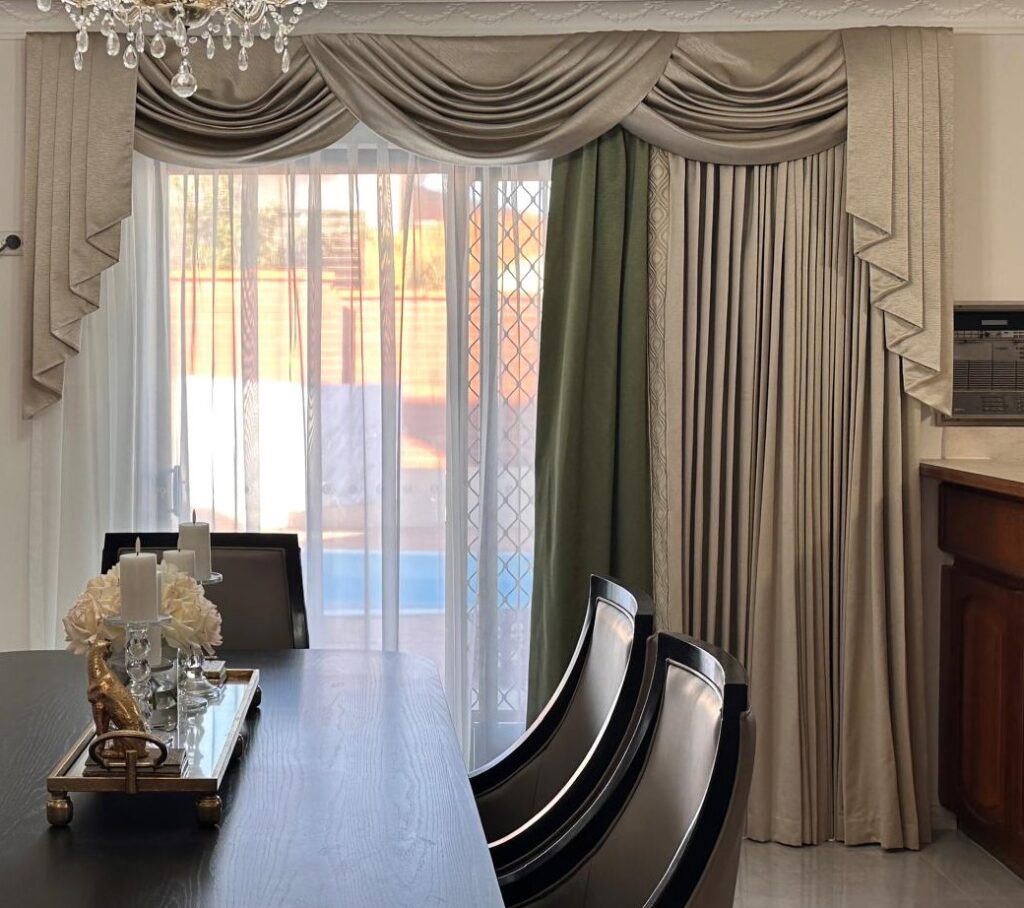
Swags and tails are not one treatment but a family of them, and the differences are more than decorative — depth, symmetry and the number of folds all change how formal the result reads and how much fabric it takes.
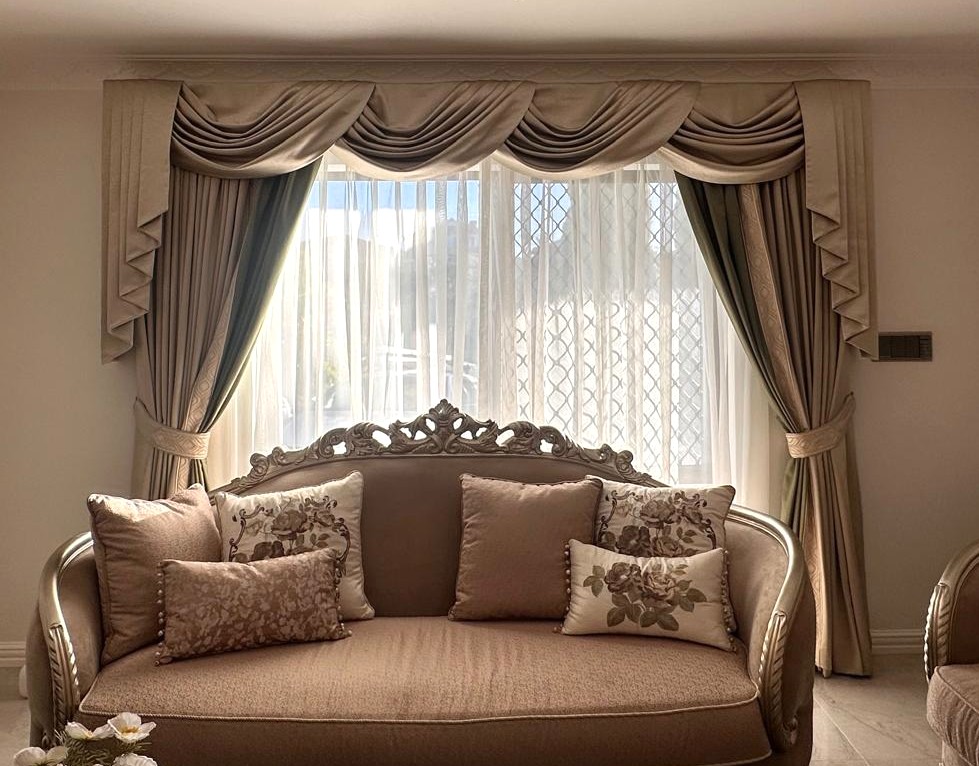
Classic swag — symmetrical curves draped across the top of the window, either pleated or softly gathered. The default, and the right answer in most traditional and Victorian rooms.
Empire swag — deeper and fuller, with pronounced pleating. Suits rooms with the ceiling height to carry it, and is often layered over sheers.
Ascot swag — a single piece of fabric with a stiff centre pleat and pointed, triangular ends. Works on smaller windows where a full swag would overwhelm, and layers well for a more dramatic effect.
Scarf swag — a long length of fabric draped over a rod in soft loops with the ends falling free. The most casual and romantic of the family, and the one that sits most comfortably in a contemporary or transitional room.
Balloon swag — rounded, puffed folds. Country and French provincial interiors, usually in lighter fabrics that will hold the shape without weight.
Waterfall swag — a series of cascading folds, often asymmetrical. Formal and dramatic; dining rooms and drawing rooms rather than bedrooms.
Tails are also called jabots — the two terms mean the same thing.
Classic tail — long pleated panels tapering as they fall at each side. The most formal, and the most structured.
Layered tails — made from multiple fabric layers, often with a contrasting lining that shows in the fold. Adds depth, and is where a contrast lining earns its cost.
Angled tails — wide at the top, narrowing to the bottom. A more contemporary reading of a traditional shape, and useful on tall or narrow windows.
Swag without tails — a more restrained option, often used above a blind or shade rather than a pair of curtains.
Fringed or trimmed tails — finished with fringe, tassels or braid. Traditional, and at home in a heritage or formal room where the detail will be noticed.
Trims run through the whole family — tassels, beading, fringe and contrast linings are all part of the vocabulary, and the choice of trim often does more to set the tone than the swag style itself.
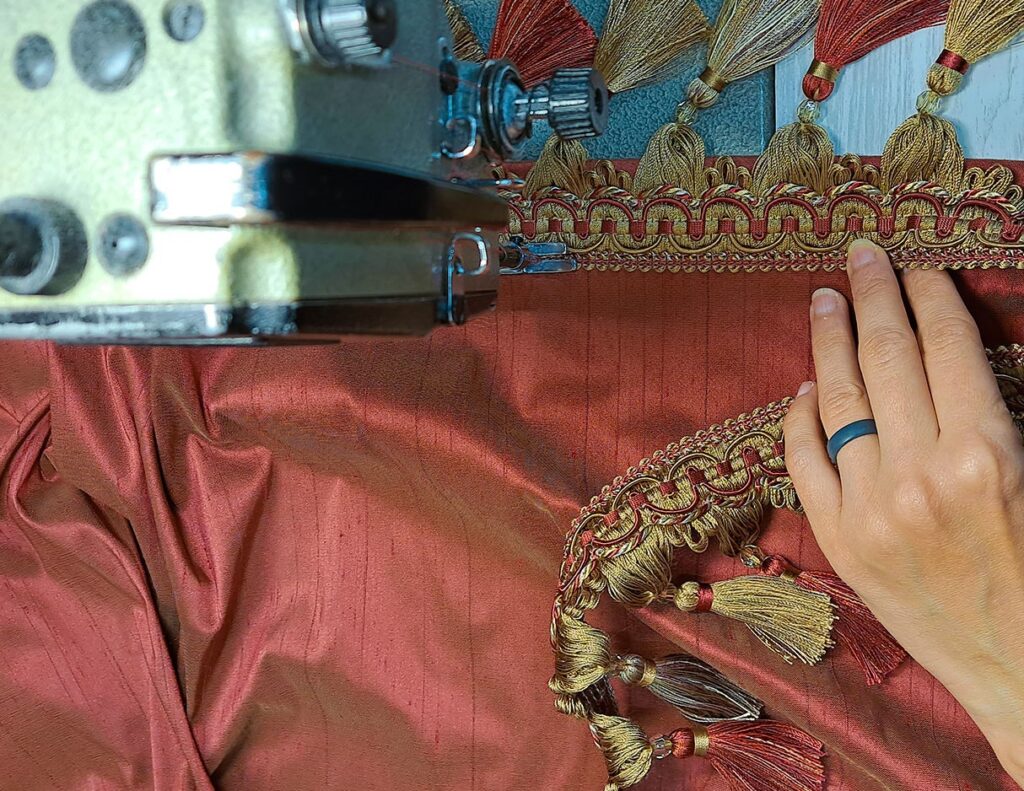
Every fold, pleat and tail must be perfectly proportioned. Because we make them in our Nedlands workroom, we control every detail from pattern-making and cutting to hand-finishing and installation. We work closely with clients on fabric — often silks, velvets or high-quality linens that drape and age beautifully — and create complementary pelmets and traditional curtain headings where appropriate. One rule is worth knowing before you fall in love with a fabric: patterns and swags do not go together. Because a swag is cut on the bias to make it drape, any pattern in the cloth is cut across its own grain — stripes bend, repeats distort, and a print that looked beautiful on the roll comes out visibly skewed. Plains, textures and self-patterned weaves are what swags are made from, and a pattern you love is better spent on the curtains beneath or elsewhere in the room.
For heritage blind styles that complement swags and tails, we also make London Blinds, Austrian Blinds and Festoon Blinds — decorative styles that share the same traditional sensibility and are equally rare in Perth.
Swags and tails aren’t right for every window, and Annie will always say so honestly. A room with low ceilings, modest proportions or a casual contemporary feel is unlikely to suit formal drapery — and a treatment that fights the architecture rarely looks as good as one chosen sympathetically, even if the latter is simpler and less expensive.
The consultation is where these decisions get made properly. Annie considers ceiling height, window proportions, cornice and architrave detail, how the room is used, and fabric — because a heavy silk swag reads very differently from a linen one, and both differ from a patterned damask. Getting that combination right is what produces a result that feels genuinely distinguished rather than merely decorative.
There is also a practical case, which surprises people who assume swags are purely decorative. Because the swag sits above and across the heading, it closes the gap where light would otherwise spill over the top of the curtains — the same job a padded pelmet does, achieved with drapery instead of a board. In a formal bedroom that needs to be dark as well as handsome, that is a genuine reason to choose them rather than an indulgence.
If swags and tails are the right choice, you’ll have something few Perth homes have and fewer Perth makers can produce. If they’re not, Annie will recommend what is — a beautifully lined pinch pleat curtain, a decorative pelmet or something simpler. Either way, you leave the conversation with a clear picture of what will work and why.
The best way to begin is to visit our showroom in Nedlands. You can explore hundreds of fabric samples in natural light, see finished examples, and often watch work happening in the attached workroom. Annie or a member of the team is always happy to talk through possibilities and answer questions.
Alternatively, we can arrange an in-home consultation at a time that suits you. This has the advantage of enabling us to consider your actual windows and provide advice on the best window dressings for your space.
Either way, you will receive honest, expert guidance focused entirely on what is right for your windows and your home.
We look forward to helping you create window furnishings you will love for many years to come.
A traditional, formal curtain treatment where draped fabric curves across the top of the window (the swag) and falls in pleated cascades at each side (the tails). They suit heritage and formal interiors and require specialist skill to execute well.
Very few — they require specialist calculation, pattern-matching and hand-finishing that takes years to learn. Annie’s Southampton training and heritage experience make this one of her signature specialties.
Silks, velvets, fine linens and damasks all drape and age beautifully. Annie advises on fabric weight and behaviour during your consultation — the wrong fabric can prevent the treatment from hanging correctly regardless of the sewing quality.
They went out of fashion in the minimalist decades and have been returning with the wider revival of traditional interiors. The honest answer is that they were never right for every room and still aren’t — a low-ceilinged contemporary space will not carry them. But in a period home, a formal dining room or a grand entrance, nothing else does the same job, and a well-proportioned swag in a good fabric does not read as dated. The scarf and angled-tail styles are the ones that sit most easily in a modern interior.