
What a curtain maker decides after you have chosen sheers
– heading, fullness, colour, and the things that go wrong
Most people arrive at sheers already convinced. They have seen a living room with light coming through fabric and they want that. What they have usually not seen is the half dozen decisions that sit between the photograph and the finished window – and those decisions, not the fabric name, are what determine whether the result looks like the picture.
If you are still weighing sheers against a blind, our post on living room blinds and curtains covers that argument, and our sheer curtains page covers what we make and how. This is about what happens once the decision is made.
This is the single most common disappointment with sheers, and it is entirely avoidable.
S-wave has become the default heading for sheers, and in the right fabric it is beautiful – a continuous, even ripple with no pleats and no fussiness. But the wave is created at the top by the track, and the fabric has to have enough body to carry that shape down its length. A soft sheer will not. It waves for the first third and then goes slack, and what you have is a curtain that looks like it was meant to do something and gave up.
Linen sheers are the ones to watch here. They are having a moment, they are lovely, and they are the least likely of all sheers to hold a wave from top to hem. A linen sheer on an s-wave track is the most reliable way we know to be disappointed by a window. That is a heading problem rather than an argument against the fabric, and it is worth knowing what you are choosing between before you settle it – our post on linen curtains covers natural linen, blends and linen-look polyester, and which headings each one will actually hold.
None of that is an argument against s-wave – it is an argument for matching the heading to the cloth rather than choosing the heading first because it is what everyone is doing.
This surprises people, because pinch pleat sounds like the more traditional choice and sheers sound contemporary.
The reason is structural. A pinch pleat is held by a tape sewn into the heading, and that tape holds the shape of the pleat whether or not the fabric itself has body. Even a soft sheer will hold a pinch pleat. And critically, a pinch pleat does not ask the fabric to maintain a column all the way to the floor the way a wave does – the pleat does its work at the top and the fabric is then free to fall as it wants to.
So on a soft or fluid sheer, a pinch pleat will very often look better at the hem than a wave will. Our guide to pinch pleat curtains sets out the difference between double and triple and where the cost sits.
Goblet pleat is the exception. A goblet needs genuine body and volume to hold its shape, and most sheers do not have it. It is a heading for weighted cloth, not for a sheer.
A living room is not one thing, and sheers behave differently in each version of it.
An open plan living area wants the casual answer. A wave heading in a fabric with enough body to carry it, minimal stack, clean lines, often motorised across a wide span. The sheer is a functional layer that softens light and disappears when you are not looking at it.
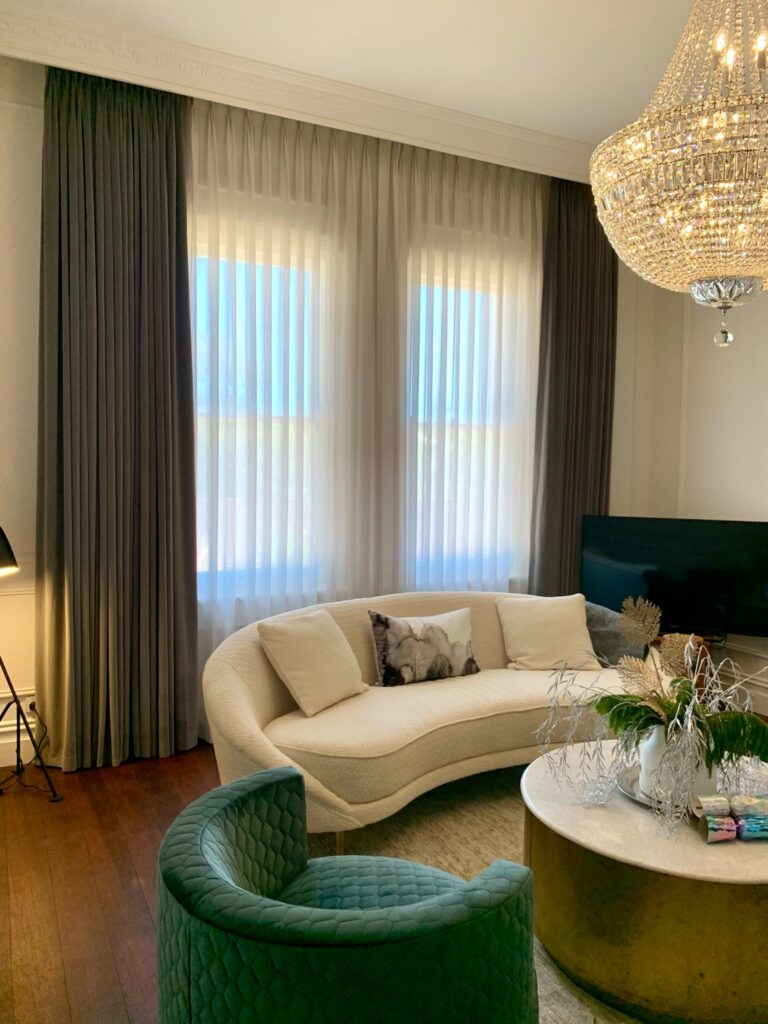
A formal living room is a different proposition. Here the sheer is part of a composition rather than a device, and the things that make it read as formal are the fabric and the heading. A silkier sheer with a slight sheen reads considerably more formal than a matte or textured one – the light catches it differently and the whole window lifts. Pair that with a triple pinch or a box pleat rather than a wave, and the window looks dressed rather than fitted.
That is also where a sheer sits beautifully under a pelmet or behind swags and tails, because a pleated heading stands proud and gathers into vertical folds. A wave heading cut off by a pelmet loses exactly the thing that makes it a wave.
The full range is on our curtain headings and styles page, and the choice between them is worth making with fabric in your hand.
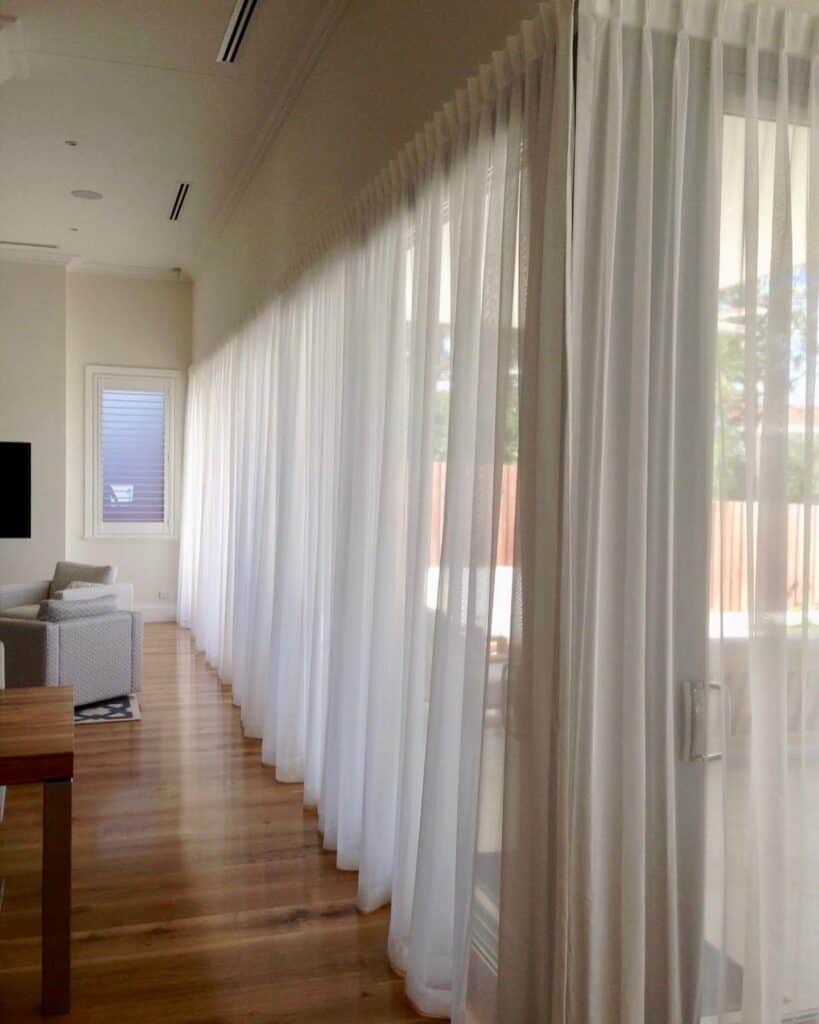
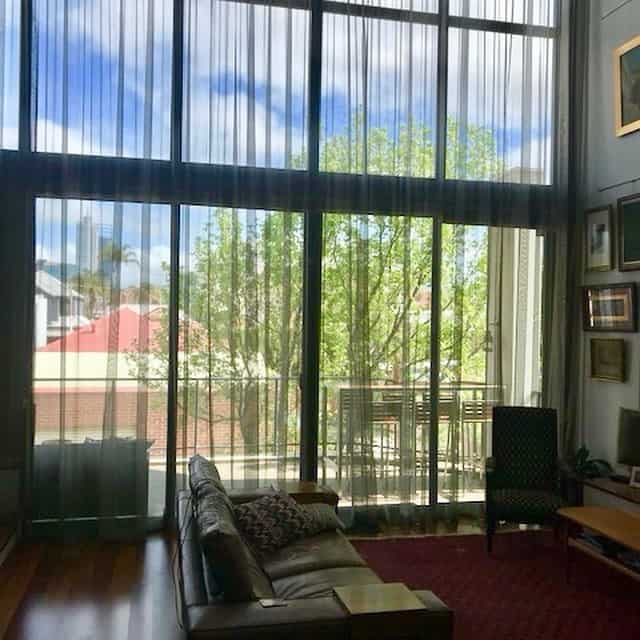
A sheer is mostly air, which makes it tempting to think it needs less fabric than a solid curtain. The opposite is closer to the truth – because there is nothing else going on, the fullness is the entire look.
We cut a pinch pleated sheer at around 2.4 to 2.5 times the track width, which is the same territory as a triple pleat in a solid fabric. Cut leaner than that and the pleat will not hold its definition down the length of the curtain, and the whole thing reads flat. Not dramatically wrong, just disappointing – a curtain that looks hung rather than made, and nothing to be done about it once it is up.
It is a fair question to ask of anyone quoting you: what fullness is this cut to?
White is the default for a reason, and it is also the safest choice for fade. But a lot of people find white sheers clinical, and the move at the moment is toward colour and texture – which our piece on window treatment trends covers in more detail.
Two things to know before you commit to a colour.
The first is that a coloured sheer colours the room. Light passes through it, so a red sheer does not simply look red – it casts a red hue across everything behind it for the hours the sun is on that window. That is either exactly what you want or a genuine shock, and it is very hard to picture from a small sample.
The second is that Western Australian light is hard on colour. Fading and colour shift are a real risk here in a way they are not in milder climates, and a strong colour has further to fall than a white does. It is not a reason to avoid colour. It is a reason to choose a fabric rated for it, and to protect it – which brings us to the thing most people get wrong.
One specific warning, because it is currently fashionable and we have seen it disappoint.
Very open, loosely woven sheers look wonderful in a showroom and photograph beautifully. Some of them stretch. Hung on a tall window under their own weight, they drop over the following months, and a curtain that finished perfectly at the floor is now sitting on it. Linen open weaves are the most prone to it.
That is not a reason never to use one, but it is a reason to know before rather than after. Some drop can be allowed for in the making. Some cannot. Our curtain fabrics page is the place to start, and this is a question worth asking directly about any open weave you fall in love with.
Here is the belief we correct most often.
People with a verandah outside the living room, or a big tree over the window, assume the sheer is protected from the sun. It is not. UV does not only arrive as direct sunlight – it reflects. Off a pool, off light-coloured paving, off a neighbour’s Colorbond roof, off a white rendered wall. A window that never sees the sun directly can still be taking a substantial UV load all day, and a sheer is a thin, unlined fabric with nothing between it and that light.
Annie’s position is straightforward: a sheer should be protected. That means something behind it – blockout curtains, a blockout roller blind, or shutters – drawn or closed when the room is not in use and the light is at its worst.
That layer is usually specified for night privacy or for darkness anyway. It is worth understanding that it is also what makes the sheer in front of it last.
The last one, and the one that gets discovered after the furniture is in.
When a sheer is drawn open it has to go somewhere, and on a wide living room opening that somewhere can be up to thirty per cent of the length of the track. On a four metre span that is well over a metre of fabric sitting against the wall at the sides.
The counterintuitive part: a thinner fabric does not give you a smaller stack. The bulk is not really the cloth, it is the runners – the same number of them regardless of what is hanging from them, each taking its own small bite of the track. A gossamer sheer and a heavier one on the same track stack to a similar depth.
And a wave heading stacks deeper than a pleated one, because a wave needs its runners spaced more closely to create the ripple. More runners, more stack.
This matters for where the sofa goes, whether the sheer sits over the glass when open, and whether the track should extend past the window onto the wall so the stack clears the view. It is a five minute conversation at the consultation and an irreversible one afterwards.
One more thing worth knowing about that layer behind, if the room is noisy as well as bright. The heavier the curtain and the fuller it is cut, the more it does about sound – which means the layer you are specifying for UV and for night privacy can be asked to do a third job at the same time. It is a decision worth making once rather than twice, and our sound absorbing curtains page explains what actually drives the difference.
Match the heading to the fabric, not to the trend. Cut it full enough that the heading holds. Decide whether the room is formal or casual before choosing between a sheen and a texture. Ask about stretch on any open weave. Put something behind it to take the UV. And allow for the stack before the furniture arrives.
We make sheer curtains in our Nedlands workroom, which means the fullness, the heading and the finish are decisions we make rather than specifications we pass on. Annie will look at the room at the hour the light is worst, tell you which headings your fabric will actually hold, and show you samples hanging rather than flat. We work with living rooms across the Perth metropolitan area, from open plan riverfront homes to formal front rooms in character houses.
It depends on the fabric more than the room. S-wave suits a sheer with enough body to carry the ripple down its full length, and looks right in a contemporary open plan space. A soft or fluid sheer – linen sheers especially – will not hold a wave to the hem, and a pinch pleat is usually the better answer because the heading tape holds the pleat regardless of how soft the cloth is. Goblet pleat needs real body and is rarely right for a sheer.
Because the fabric does not have enough body to carry the shape. The wave is formed at the track, and a soft sheer will hold it for the first part of the drop and then go slack. It is not a fault in the making – it is a mismatch between the heading and the cloth, and it is the reason we ask what heading you have in mind before we talk about fabric.
Fuller than people expect. We cut a pinch pleated sheer at around 2.4 to 2.5 times the track width. Because a sheer has no pattern or weight to carry it, the fullness is essentially the whole look, and an under-full sheer reads flat and loses the definition of its heading down the length of the curtain.
They can, and coloured sheers are more at risk than white. Western Australian light is hard on fabric, and a sheer is thin and unlined. The other thing worth knowing is that shade does not protect a sheer the way people assume – UV reflects off pools, paving, light walls and Colorbond roofs, so a window under a verandah can still be taking a heavy load. We recommend a blockout layer behind any sheer, both for privacy and to protect the sheer itself.
White fades least and stays neutral, but many people find it clinical, and coloured and textured sheers are increasingly popular. The thing to understand is that a coloured sheer tints the light coming through it – a red sheer casts a red hue across the room while the sun is on that window. Look at a large sample against the actual glass before committing.
Allow up to about thirty per cent of the track length for the stack. A thinner fabric does not reduce it much, because the depth comes from the runners rather than the cloth, and a wave heading stacks deeper than a pleated one because its runners sit closer together. Worth planning before the furniture is placed.