
How to dress bedroom windows for sleep, light, privacy, silence and style
— from blockout layering to the details that make a bedroom feel calm
When it comes to the bedroom, there are two core questions: how dark do you need it, and how quiet do you need it?
Everything flows from the answers. A light sleeper who wakes at first glow needs a very different treatment from someone who sleeps through anything and just wants the room to look beautiful. Likewise, some people seek absolute silence, whilst others are comfortable with outside noise.
Fortunately, with modern layering you can achieve darkness and softness, privacy and morning light, and with modern fabrics you can go a long way to reduce outside noise.
This guide walks through the way Annie approaches a bedroom consultation: blockout first, beauty second, and usually both in the same treatment.
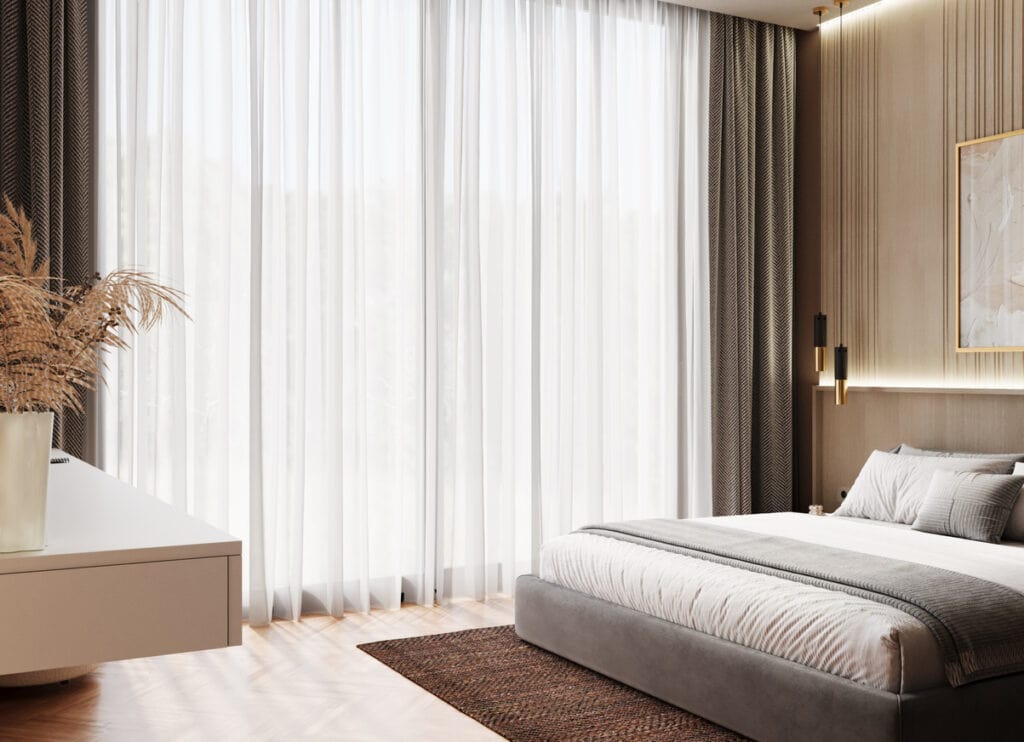
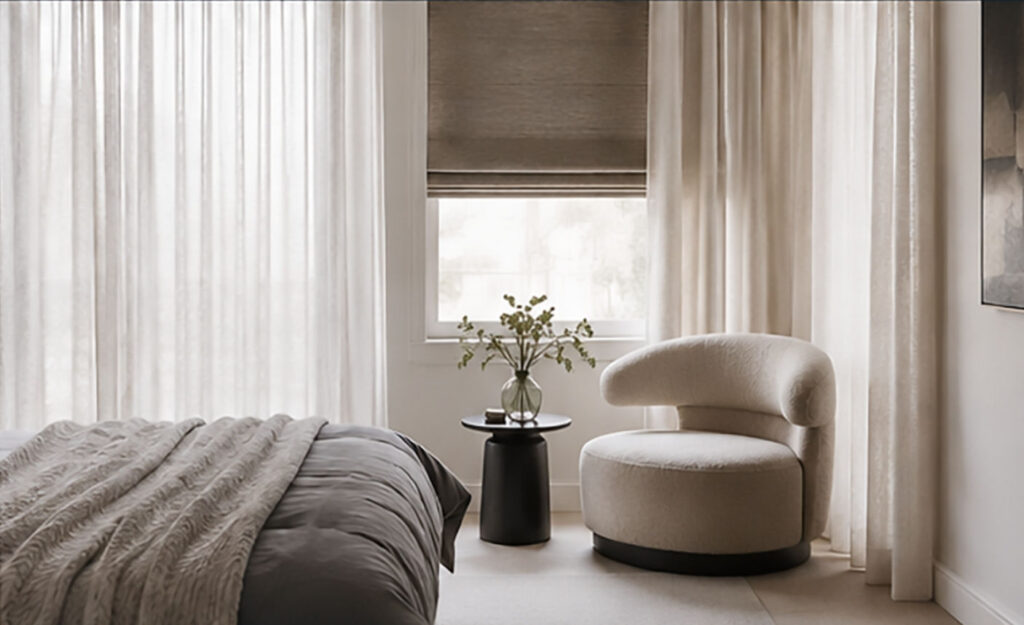
Perth delivers summer light by 5am. If you value sleep, blockout capability isn’t a luxury — it’s the baseline. But “blockout” doesn’t mean one product; it means a result, and several routes get you there.
Blockout curtains in a lined, opaque fabric are the most effective: properly made, they seal the window in fabric from ceiling to floor, trapping light at every edge. The keys are full-length drop (floor-to-ceiling, not stopping at the sill), generous width so the folds overlap at centre, and a return to the wall at each side so light can’t leak around the edges. Done properly, it’s the closest you’ll get to total darkness without shutting the window up entirely.
Blockout roller blinds achieve the same result in far less depth — ideal where the window sits tight to a bed head or built-in wardrobe and there’s no room for a curtain to stack. A double roller blind layers a blockout with a sunscreen or light-filtering fabric on one bracket: full darkness when the blockout is down, filtered daytime light when it’s up.
The honest truth: a blockout blind alone stops the light, but it can’t soften the room the way fabric fullness does. In bedrooms with the space for it, the layered treatment — blockout at the glass, curtain in front — wins on every count.
There is a hardware decision underneath all of this that rarely gets discussed. A pair of curtains on a track has an overlap, where the two curtains cross in the centre – which is what stops a line of light coming down the middle when they are closed. A rod running on rings has no overlap at all: the curtains meet, and light comes through where they do. If darkness is the point of the treatment, that is worth settling before the hardware is chosen rather than after, and our page on curtain tracks and hardware sets out what each system can and cannot do.
A bedroom isn’t only for sleeping. Morning light through a sheer curtain turns a bedroom from a cave into a room you want to be in — filtered, gentle, private from the street but luminous from inside. In a layered treatment, the sheer lives in front of the blockout: during the day it carries the room’s softness and light; at night the blockout drops behind it and does the heavy work invisibly.
Full-height sheers in a linen-look fabric are the most popular bedroom treatment we sew — they suit every style from coastal to contemporary, and they age beautifully. On wider windows or sliding doors, s-wave sheers on a ceiling track give the cleanest, most uniform wave.
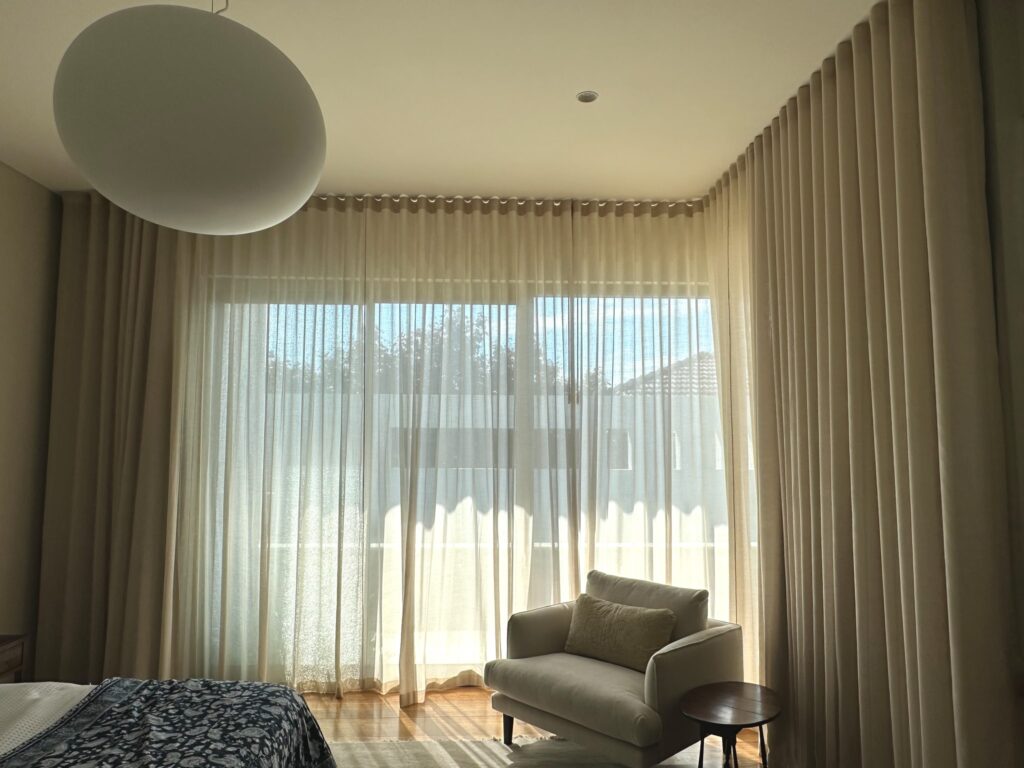
If this guide has a single recommendation, it’s this: layer. A layered bedroom treatment gives you filtered daytime light (sheer), total darkness for sleep (blockout curtain or blind), privacy at every hour, insulation through winter, and the visual softness that makes a bedroom feel calm rather than clinical.
The combinations we make most often:
Sheer curtain + blockout curtain — the most refined result. Two curtains on a double track (or two separate tracks), one behind the other. The sheer dresses the room by day; the blockout draws closed at night. Add a pelmet across the top and the tracks, headings and hardware disappear behind a clean, finished line.
Sheer curtain + blockout roller blind — the modern default. The roller sits hidden at the glass, the sheer hangs in front. Slimmer, simpler, slightly less insulating than a double curtain but visually almost identical from inside the room.
Double roller blind — for bedrooms where depth is tight. Blockout and sunscreen on one bracket, no curtain at all. Practical, compact, and the right call where built-ins or a bed head crowd the window.
Annie specifies layered bedrooms more than any other room — it’s where the consultation makes the most tangible difference, because she’ll measure the exact light leak points, plan the stack-back, and make sure the blockout genuinely blocks out rather than almost-blocks-out.
A pelmet does more work in a bedroom than almost any other room. In a layered treatment it hides the double track, the headings, and the top edge of the blind — all the working parts that would otherwise interrupt the clean, calm visual. In a single-curtain bedroom it adds structure and intention to the top line.
We make padded pelmets — a rigid shaped board fully covered in fabric, often matching the curtain or picking up a room colour, and upholstered with a soft edge where the room suits it. Shapes range from a clean straight line to a gentle curve. A curved padded pelmet over a simple sheer is one of the most effective bedroom treatments we see: minimal, calm, and far more considered than a bare track.
If you’re layering, ask Annie about a pelmet at the consultation stage — it’s easier (and cheaper) to plan the pelmet into the treatment from the start than to add one later.

Bedrooms near a road, a neighbour’s air conditioner, or under a flight path have a problem no amount of blockout solves: noise. Heavy, lined curtains absorb a surprising amount of sound — the difference between a bare window and a fully dressed one is audible immediately. For bedrooms where noise is a genuine sleep issue, acoustic curtains are worth exploring: specialist fabrics and construction designed to dampen external sound significantly beyond what standard curtains achieve. It’s one of the areas our workroom has developed particular expertise in, and Annie can assess whether your bedroom’s noise problem is one curtains can meaningfully help with.
Full-length, lined curtains also insulate. In a Perth winter that means noticeably warmer mornings; in summer, less radiant heat from the glass. The bedroom is the room where you feel insulation most directly — you’re still, you’re quiet, and every degree counts.
The full treatment: layered sheer and blockout (curtains or curtain-plus-blind), pelmet, floor-to-ceiling drop. This is the room that justifies the investment — you’ll use it every night for a decade or more, and the quality of your sleep is directly at stake. Annie’s consultation almost always starts here.
Blockout is even more critical — early risers and daytime nappers need total darkness on demand. A blockout roller behind a simple curtain is the practical default: the curtain can be playful or colourful, the roller does the work. Cordless operation matters for safety; motorised is worth considering if the budget allows.
A simpler treatment is perfectly fine here — a single lined curtain or a quality Roman blind serves a room used occasionally without the investment of a full layered treatment. Prioritise blockout capability (guests shouldn’t suffer your dawn) and a fabric that suits the room’s style.
Treat them as floor-to-ceiling curtains on a ceiling track — the door already runs near-full height, so the curtain simply extends the line. S-fold sheers with a blockout roller behind is the combination we specify most for bedroom sliders.
Annie’s shortcut: decide how dark you genuinely want 6am to be, then work backwards. Every other choice — fabric, style, layering, pelmet — follows from that one honest answer. The bedroom is the room where the treatment’s job matters more than its look, and the look follows naturally when the job is done properly. A free consultation starts with Annie standing at your bedroom window at whatever time of day the light bothers you most — and everything else flows from there. We make curtains and blinds for Perth homes from Dalkeith to Mount Lawley, and the bedroom is usually the first room we’re asked to solve.

Blockout-lined curtains in a full-length drop — ideally layered with a sheer for daytime light and privacy. The combination gives you total darkness for sleep, soft filtered light during the day, and the insulation and acoustic benefits of heavy fabric at the window.
Either can achieve blockout; the difference is feel. Curtains bring softness, insulation and sound absorption; blinds are compact and practical where space is tight. The best result is often both layered together — a blockout blind at the glass with a curtain in front.
Yes — a pelmet hides the track, headings and blind hardware, giving the treatment a clean, finished top line. In layered bedrooms especially, a pelmet turns two visible systems into one seamless piece.
Three things: full-length drop to the floor (no gap at the bottom), generous width so fabric overlaps at centre close, and a return to the wall at each side so light can’t leak around the edges. A pelmet across the top seals the last gap. Made-to-measure curtains fitted by a professional get all three right.