
Cotton, dimout, blockout or interlined
— what each one does, how to choose between them, and the one that fails without warning
Lining is the part of a curtain nobody asks about. It does not appear in the photograph that made you want curtains in the first place, it is rarely explained, and on a quote it often appears as a single word: lined.
That word can mean four quite different things, at different prices, doing different jobs. It also happens to be the decision that determines whether your curtain filters light or blocks it, whether the face fabric survives the sun, and — more than most people expect — whether the finished curtain looks tailored or looks hung.
We line curtains in our own workroom in Nedlands. What follows is what the options actually are, how Annie chooses between them, and what goes wrong when the choice is made badly.
The first reason has nothing to do with light.
Annie’s comparison is a jacket. A tailored jacket has a lining, and a cheap one does not, and you can tell at a glance which is which without knowing anything about tailoring. It is the same with a curtain. The lining hides the hems and the seam allowances, so what you see is a clean fall of fabric rather than the construction that holds it together.
That is why, unless the curtain is a sheer, Annie will line it. Not because the room needs darkening — because a lined curtain is what a bespoke curtain looks like, and an unlined one reads as a length of fabric at a window however good the fabric is.
The functional reasons follow after that, and they are real: light control, protecting the face fabric from the sun, insulation, and how the curtain hangs. But if you take the lining question as purely practical you will miss the reason it matters most of the time.
Once a curtain is being lined, there is one question that decides everything else: how much light do you want stopped?
There are three answers, and most people only know two of them.
Cotton lining. For light filtering rather than blocking. The room stays soft and usable during the day, with light coming through rather than being shut out. This is what a living room usually wants.
Dimout lining. Stops around ninety to ninety-five per cent of the light. This is the one almost nobody asks for, because almost nobody knows it exists — and it is frequently the right answer. A room that is properly dark but not sealed, which for a great many bedrooms is exactly the brief.
Blockout lining. Designed to block light entirely. This is the specification where sleep genuinely matters — a shift worker, a light sleeper, an east-facing bedroom, a nursery where sleep happens in daylight.
The useful part, and it is worth knowing before anyone quotes you: these three sit at broadly similar prices. Cotton is marginally cheaper than blockout and dimout is much the same. So the choice between them is not really a budget decision at all. It is a decision about what you want the room to do, made on its merits, and there is no saving to be had by choosing the one that stops less light.
If the room in question is a bedroom, the darkness question is worth settling properly first — our post on bedroom window treatments covers how dark a bedroom actually needs to be, which is a different question from what most people assume.
Sheers are the exception, and the only one.
A sheer exists to be seen through. Lining it would remove the reason for choosing it, so a sheer is made unlined and that is not a compromise or an economy — it is the correct specification.
This catches people out with linen, because unlined linen is a look people specifically want and have often seen in a photograph. The distinction is whether the linen is a sheer or a solid. A linen sheer is not lined. A solid linen curtain is lined like any other solid curtain, and the only remaining question is whether the room is for sleeping.
Sheers do need protecting even though they are unlined, and that protection comes from whatever hangs behind them rather than from a lining. Our piece on sheer curtains for living rooms explains why, including the part about reflected UV that surprises most people.
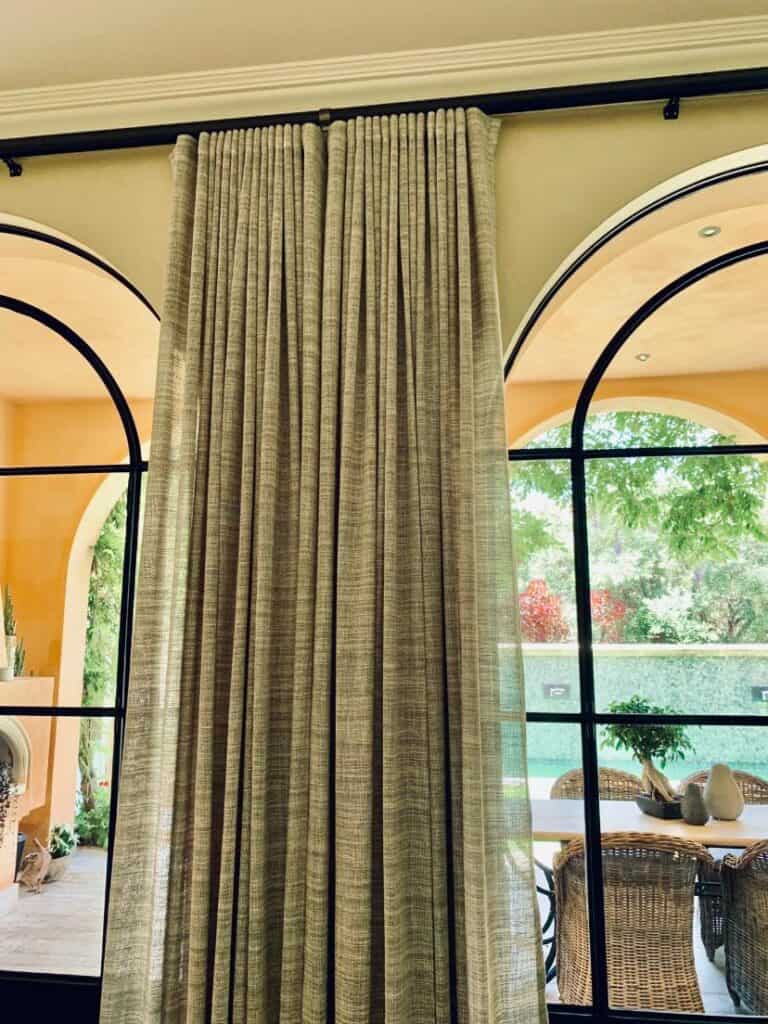

Interlining is a separate layer that sits between the face fabric and the lining, running the full length of the curtain. It is made of cotton or polyester, and it is the least understood item on any curtain quote.
What it does is add body. A curtain with interlining hangs with more weight and structure, the folds are deeper and more regular, and the whole thing reads as more substantial. In Europe most quality curtains are interlined as a matter of course, for exactly that reason — the finished result simply looks better.
Annie recommends it in four situations.
Interlining costs more, and it is the largest single lining decision by price. It is also the one most likely to be quietly left out of a cheaper quote, because nothing about the finished curtain announces its absence until you see one hanging beside one that has it.
One clarification, because the word appears in two different contexts. The acoustic curtains we make use an 800gsm acoustic interlining, which is a different product entirely — an engineered material with independently tested performance figures, not a heavier version of the interlining described here. If noise is the problem you are trying to solve, our acoustic curtains page is the right place, and ordinary interlining is not a substitute for it.
Most of what goes wrong with a curtain is visible on the day it is installed. Lining is the exception, and it is the reason this decision deserves more attention than it gets.
Two failures, both of which arrive later.
The first is a lining that was never going to do the job asked of it. A cotton lining on a window that needed UV protection will not protect the face fabric, and the fabric deteriorates behind it. Nothing looks wrong at installation. The consequence turns up in the face fabric, months or years later, and by then the damage is to the expensive layer rather than the cheap one.
The second is poor quality blockout. A blockout lining is a coated fabric, and a bad coating breaks down. It goes yellow, or it goes black, and it degrades. Annie has seen it at eighteen months.
Eighteen months is the number worth holding on to. That is well inside the period where you still think of the curtains as new, and it is a failure that no amount of looking at the quote would have predicted, because the quote said lined.
There is no economical fix. A curtain can be relined, but in practice around eighty per cent of the time it is remade instead — because relining means taking the heading apart and redoing it, and at that point you are most of the way to a new curtain. The saving on the original lining is comprehensively lost.
This one surprises people, and it is worth knowing before the fabric is cut.
Standard blockout lining comes in ivory or white. Behind a thick or dark face fabric that is usually invisible, but with some fabrics the lining reads through and shifts the colour of the curtain as you see it from inside the room. It is not dramatic, and it is not always a problem, but it is not what you chose.
The answer is straightforward: where the face fabric is at risk of it, we use a coloured lining instead. It is a decision made at specification rather than a fault to be discovered afterwards.
The same logic works in reverse for what the outside sees. In apartment buildings, strata requirements sometimes call for every window to present the same way from the street — where that applies, a black blockout lining gives a uniform exterior regardless of what the face fabric is.
What lining does not change is how the curtain stacks, or how the heading sits. Those are decided by the fullness and the heading itself, which our guide to curtain headings and styles covers.
If a quote says lined and nothing more, you do not know what you have been quoted for.
Lined with what — cotton, dimout, or blockout? The three do quite different jobs and a quote that does not distinguish between them has not told you what your curtains will do. It is a reasonable thing to ask of anyone quoting you, ourselves included.
This is a fifth item to add to the four things that have to match before two curtain quotes can be compared. Our post on what drives the cost of made-to-measure curtains sets out the other four — the exact fabric, the heading, the fullness, and the overhang each side of the window.
The risk is highest where you cannot see or ask, which in practice means buying online. A lining you cannot inspect, from a supplier you cannot question, on a curtain that cannot be economically relined, is where the eighteen-month failure tends to come from.
Decide first whether the curtain is a sheer or a solid, because that settles whether it is lined at all. If it is a solid, decide what the room is for — sleep points to blockout, everything else points to cotton, and dimout sits between them and is worth asking about by name. Consider interlining if the fabric is silk, if the room is cold, or if you want the curtain to hang with real weight.
Then ask what lining is actually being supplied, and satisfy yourself it is a good one. That is the part you cannot check afterwards.
Annie will look at the room, at the light it gets and at what you need the curtain to do, and specify the lining accordingly. We make and line curtains in our Nedlands workroom, and have done since 1969.
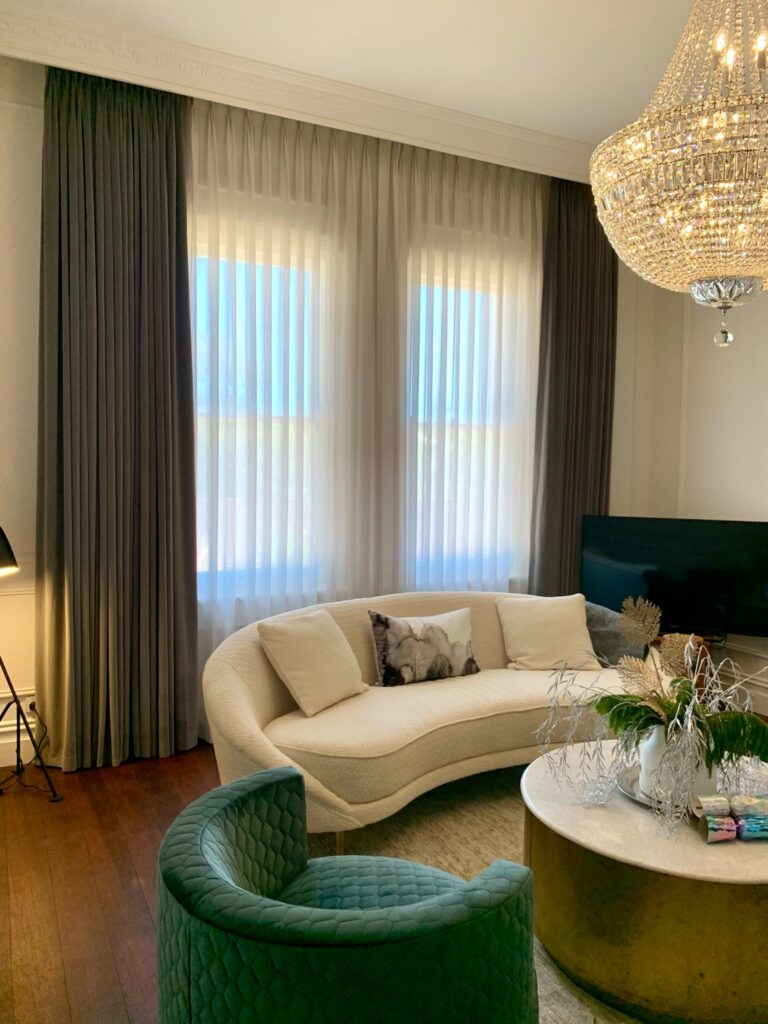
Solid curtains, yes — for the look as much as the function. A lining conceals the hems and seam allowances, which is the difference between a curtain that reads as tailored and one that reads as a length of fabric. Sheers are the exception and are made unlined, because being seen through is the point of them.
Dimout stops around ninety to ninety-five per cent of the light. Blockout is designed to stop all of it. Dimout is the option most people have never heard of, and for a great many bedrooms it is the right answer — dark enough to sleep, without sealing the room. They sit at broadly similar prices, so the choice is about the room rather than the budget.
It is a third layer between the face fabric and the lining, and it adds body. The curtain hangs with more weight, the folds are deeper and more even, and it insulates better. Silk must be interlined. It is also worth considering where a room is draughty, or where a curtain is being used as a partition with both sides on show.
It can, but around eighty per cent of the time it is remade instead. Relining means taking the heading apart and reconstructing it, and by that point the work involved is close to making a new curtain. It is the main reason to get the lining right the first time.
A good one lasts the life of the curtain. A poor one can break down within eighteen months — going yellow or black and degrading. Because a quote usually says only “lined”, the quality of what you are getting is not something you can assess from the paperwork, which is why it is worth asking directly.