
What actually moves the number on a quote
— and the four things to check before you compare two of them
Two quotes arrive for the same window. One is considerably higher than the other. Both are for made to measure curtains, both name a heading, both look like they describe the same thing — and there is no obvious reason for the gap.
Most of the time there is a reason, and it is sitting in measurements and specifications that neither quote has put in writing. This is not a matter of one supplier being dishonest. It is that the things which decide what a curtain costs are mostly invisible in a finished photograph and almost never itemised.
We make curtains in our own workroom in Nedlands, which means we are quoting on decisions we make ourselves rather than passing on someone else’s price. What follows is what genuinely moves the number, what to ask before you compare anything, and — because it matters more than the rest — where Annie would tell you not to spend at all.
Ask a maker what drives the price and the honest answer is fabric. It is the largest single element in almost every quote, and the range within it is enormous — the same curtain, made the same way, can differ by a multiple depending on what is hanging.
There is a second answer that sounds like it contradicts this one, and does not. Fullness — the ratio of fabric width to track width — is the biggest driver of how much fabric a curtain needs. Fabric is the biggest driver of what that fabric costs. A pencil pleat cut at three times the track width needs roughly two metres more than a triple pinch pleat on a four-metre window, and what that two metres costs you depends entirely on what it is made of.
Both numbers matter and they multiply each other. Our comparison of pencil pleat and pinch pleat sets out how much fabric each heading actually needs and why the cheaper-sounding one usually is not.
The part that catches people is that fabric is the one variable they have usually already fixed. By the time two quotes are being compared, the client has chosen a fabric and assumes both suppliers are quoting on it. Frequently they are not — and that single fact makes the comparison meaningless before anything else is considered.
This is the practical heart of it. If you take one thing from this page, take this.
Before you can compare two curtain quotes, four things have to be the same on both.
The exact fabric. Not a similar look, not the same colour in another brand, not something described as an equivalent. The same fabric from the same supplier. This is the single biggest reason quotes differ and the easiest one to check, because a fabric has a name and a brand and a quote can state both.
The heading. Headings do not cost the same as one another, so a quote for a double pinch pleat and a quote for a triple are not describing the same curtain even if both say pinch pleat. Our guide to curtain headings and styles sets out what each one is and what it needs.
The fullness. Two curtains in the same fabric with the same heading can be cut at different ratios and both be honestly described. This is rarely stated on a quote and it is entirely reasonable to ask.
The overhang. How far the track runs past the window on each side. This one is almost never discussed and it changes both the fabric quantity and the finished result, which is why it has its own section below.
If all four match, you are comparing like with like and the remaining difference is genuinely about the supplier. If any of them do not, you are comparing two different products that happen to be described with the same words.
Curtain track does not stop at the edge of the window. It runs past it on each side, so that when the curtains are drawn open the fabric has somewhere to sit that is not in front of the glass. How far past is a decision, it is made before anything is cut, and it is invisible on a quote.
The common minimum is around 100mm each side. Annie will not work to it, for a reason that becomes obvious the first morning you open the curtains: the track only runs as far as the overhang allows, so with 100mm the stack has nowhere to go and sits over the window. You have paid for a window and covered part of it with your own curtains.
Her allowances are considerably more generous. At least 200mm each side for a sheer. Between 300 and 400mm where there is a blockout curtain or two layers, because there is more fabric to accommodate and it needs somewhere to stack that is not the glass.
The cost consequence is straightforward. A wider overhang means a longer track, more fabric across the whole curtain, and a higher number on the quote. A quote built on 100mm will always look better on paper than one built on 350mm, and the curtains will always look worse on the wall.
This is worth asking about directly, because the words vary. Some suppliers call it the return, some the extension, some the overhang. What you are asking is: how far past the window does the track run on each side?
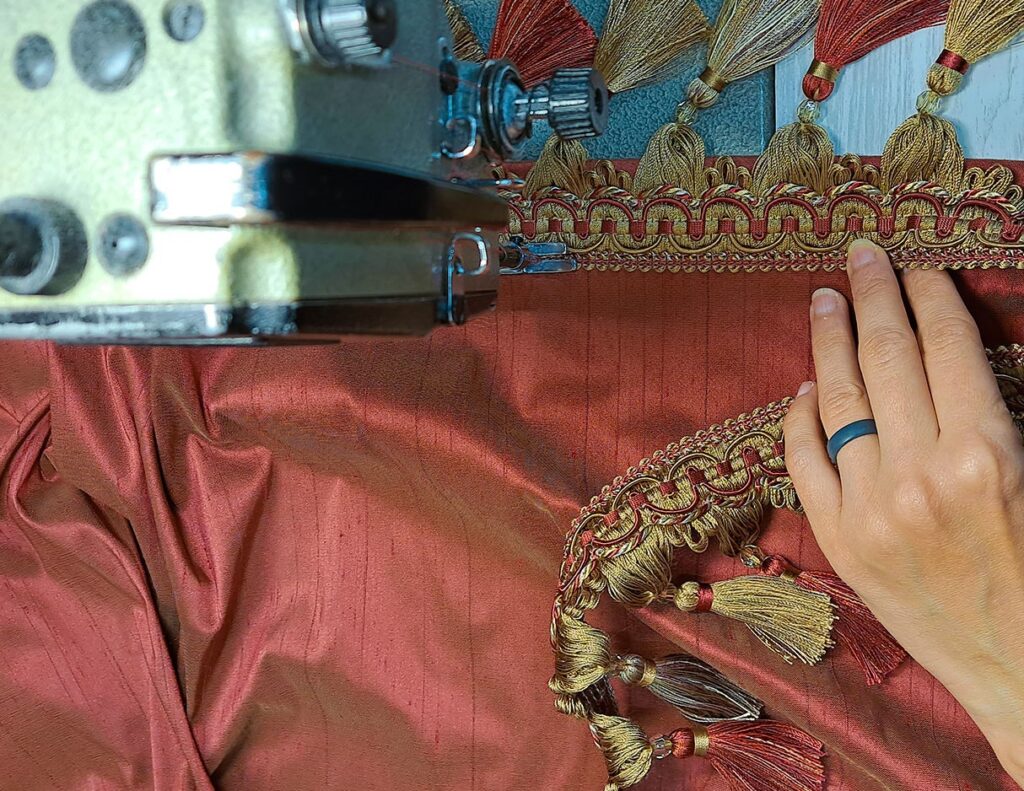

Some of what you are paying for is decided at the machine and is genuinely impossible to assess from a photograph.
The clearest example is how much fabric goes into each pleat. It is a real measurement, it varies substantially between workrooms, and it is visible from across the room once the curtains are up — as a pleat that stands proud and throws its own shadow, or one that reads as a crease. Our post on pinch pleat curtains sets out the figures we work to and what others commonly cap at.
The same principle applies to a wave heading, where the fullness decides whether the wave holds its curve down the full drop or goes slack a third of the way down. Our piece on s-wave curtains explains what that ratio is and what happens below it.
Neither of these appears on a quote. Both are fair questions.
There is one more, and it is the least visible of all: the track. Tracks come at very different price points and very different qualities, and a quote does not usually name the one being supplied. A long run of heavy curtain on a good track glides for twenty years. On a cheap one it fights you every evening, and replacing it means taking the curtains down.
Two windows in the same house, same fabric, same heading, and two different numbers. The reasons are mostly physical.
Height and width are the obvious ones — a taller or wider window simply needs more fabric, and the increase is not gentle. A corner window needs more again, because the treatment has to run around the corner rather than across a flat span.
Installation is more consistent than people expect and is rarely where the difference sits. The exception is access. A window that needs scaffolding to reach costs meaningfully more to install than one that does not, and that is a site condition rather than a product decision.
This is the honest reason a quote cannot be given over the phone. The specification is a response to the room.
The costliest thing we see is curtains ordered remotely — made somewhere else from measurements the client has taken and supplied, and shipped in.
It fails in three ways and usually more than one at a time.
The measurements are wrong. Measuring for curtains is not measuring a window, and the errors are not recoverable once the fabric is cut.
Nobody advised on the specification. The decisions that make a curtain work — heading against fabric, lining against orientation, overhang against stack — are made at the point of selection, by someone who has seen the room. Ordering remotely removes that step entirely, and the client generally does not know it was a step.
And the lining is frequently not rated for the light here. Perth UV is harder on fabric than most places these products are specified for, and a lining that performs adequately elsewhere will not necessarily perform here. Our page on curtain fabrics covers what that means in practice.
The saving is real at the point of ordering. It stops being a saving the moment anything is wrong, because there is no practical remedy at that distance.
This is the part that matters most, and it runs against the interest of anyone writing it.
Her first test is not about money at all. A window treatment has to do two things: look right, and improve how you live in the room — privacy, light control, warmth, quiet, sleep. If a client cannot say what the treatment is for, Annie’s position is that it should not be made.
The example she gives is a sheer specified for a room where the client intends to leave it open all day. It is a beautiful thing and it is doing nothing. The money would be better spent on the window that is actually a problem, or not spent yet.
She will say no where the vision and the need do not line up. That is not a sales technique in reverse — it is that a curtain which does not answer a real question is a curtain the client stops liking, and neither of us wants that outcome.
Where the budget will not stretch to the whole house, the answer is not to make everything slightly cheaper. It is to prioritise. The main rooms get the treatment and the fabric the client actually wants. The minor rooms and the office take a simpler answer. A house where the living room is right and the spare room is modest reads considerably better than one where every room is a compromise.
And there is one thing worth knowing about the cheap version, which Annie is blunt about. Curtains that will look bad in five years look bad immediately. Cheap fabric, cheaply made — the disappointment is not deferred, it arrives with the installation. Whatever else you decide, that is the part that cannot be fixed afterwards without remaking the curtain.
Settle the fabric before you compare anything, and make sure every quote names the same one. Ask what fullness the curtain is cut to, and how far the track runs past the window. Ask what track is being supplied. Then compare — and if the numbers still differ, you will know what you are paying for rather than guessing.
Annie’s consultation is free and the quote carries no obligation. She will tell you where to spend, where to save, and where she would leave a window alone for now. If you are holding a quote from somewhere else, bring it — she would rather explain what it does and does not include than have you find out afterwards.
We make curtains, Roman blinds and pelmets in our Nedlands workroom, and have done since 1969.
Because a price without a specification is meaningless. The same window can be quoted at very different numbers depending on fabric, fullness, heading and overhang, and a published figure would either be so wide as to be useless or so narrow as to be misleading. What we will do is tell you exactly what drives the number, which is what this page is for.
Check four things match: the exact fabric including the brand, the heading, the fullness, and the overhang each side of the window. If all four are the same, the comparison is real. If any differ, the two quotes are describing different curtains.
It costs more than a ready-made panel of the same nominal size, yes. Whether it costs more than the right answer for your window is a different question — a ready-made curtain that does not fit the opening, does not stack clear of the glass and is not lined for the light here is not a cheaper version of a made curtain. It is a different thing.
Fabric quantity, in one form or another — a leaner fullness, less depth in each pleat, or a narrower overhang. All three reduce the amount of fabric, all three reduce the price, and none of them usually appear in writing.