
Most people comparing curtain headings start here. Pencil pleat and pinch pleat are the two everyone has heard of, they look quite different, and almost everyone approaches the decision with the same assumption: that pencil pleat is the economical option and pinch pleat is the upgrade.
It is the wrong way round. A properly made pencil pleat uses more fabric than the fullest pinch pleat we make, which means it generally costs more — and on the large windows common in Perth homes it performs worse when you open it.
That does not make pinch pleat the automatic answer. It makes the decision a real one, worth understanding before you commit several thousand dollars of fabric to it. Here is how the two compare on the things that actually matter.
If you want the detail on either heading on its own, we have separate guides to pinch pleat curtains and to pencil pleat curtains.
Pinch pleat – gathers the fabric into distinct stitched groups at set intervals, with flat fabric between them. It is structured, tailored and formal, it stacks tightly, and it is what we make most often.
Pencil pleat – gathers the whole width continuously into narrow upright folds with no groups and no flat spaces. It is softer and less formal, it needs more fabric, and it does not stack as neatly.
For most rooms, most windows and most budgets, pinch pleat is the better choice. Pencil pleat earns its place in specific situations rather than as a default.
This is where the assumption goes wrong.
Fullness is the ratio of fabric width to track width, and it is the single biggest driver of what a curtain costs. We cut a triple pinch pleat at 2.5 times the track width and a double at 2.2. A pencil pleat needs 3 times the track width to look right.
On a four-metre track, that is roughly two metres more fabric than a triple pinch pleat and three and a half metres more than a double. In a mid-range fabric that is a few hundred dollars. In something at the upper end, considerably more.
Pencil pleat also has no cheaper version that still looks good. Below 3x fullness the gather goes shallow, the folds sit too far apart, and the heading reads as sparse — which is precisely why ready-made pencil pleat curtains look the way they do. A pinch pleat, by contrast, has a genuine range: a double at 2.2 is a legitimate, good-looking curtain, not a compromised one.
So if the budget is the constraint, pinch pleat gives you somewhere to go. Pencil pleat does not.
Stacking is the thing people forget to ask about and then live with for fifteen years.
A pinch pleat has structure built into it. Each pleat folds against the next in a repeating rhythm, so when you draw the curtain back it concertinas into a neat, predictable column against the wall. A triple stacks deeper than a double because there is more fabric, but both stack in an orderly way.
A pencil pleat has no fold line to work along. The gather is continuous, so rather than folding, the fabric bunches. It does not compress as tightly, and the resulting stack is both wider and untidier than people expect.
On a small window this barely registers. On the wide openings common in Perth homes it matters twice over: the stack sits across more of your glass during the day, and it looks less considered doing it.

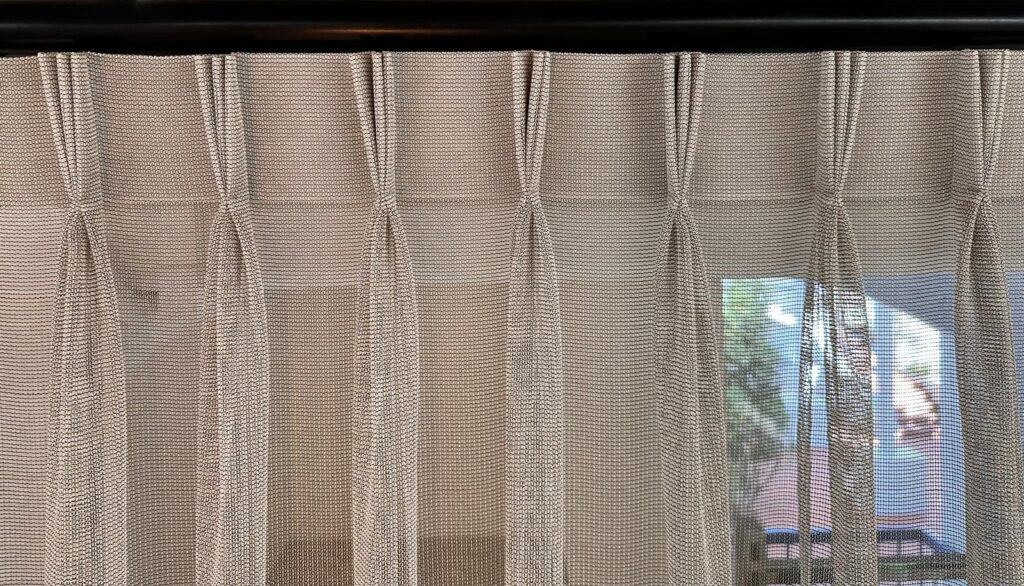
Pinch pleat – is forgiving across weights. Mid-weight linens, velvets, wools and weighted silks all work, and the heavier cloths are where a triple pleat earns its cost. What it does not tolerate is a fabric with no body at all, which will not hold the fold at the base of the pleat.
Pencil pleat – wants lighter and mid-weight fabrics — cottons, light linens, anything soft enough to gather cleanly. Heavy cloth fights the continuous gather and produces a stiff, lumpy heading rather than an even ripple.
Both have the same weakness with large-repeat patterns. Any heading that consumes fabric at the top will interrupt a bold pattern, so a large-scale print is usually better spent on a Roman blind, a pelmet or cushions than fought into a heading.
Pinch pleat reads as tailored. The vertical folds and the rhythm of pleat and space give it order, which is why it sits so naturally in period homes, formal rooms and anywhere with cornices and deep skirtings to answer to. It also takes trims well — a contrast leading edge or a braid has somewhere to sit.
Pencil pleat reads as soft. The unbroken gather has no formal structure, which can be charming on a modest window or in a cottage interior. It is also the heading most strongly associated with a particular era of Australian interiors — customers looking at samples in our showroom say it unprompted: “my mum and dad had that.”
Neither association is wrong. It depends entirely on whether the room wants tailoring or softness.
You are matching existing curtains – If a room already has pencil pleat and you are adding a window or replacing one panel, match the heading. Nothing else is worth considering.
Period accuracy matters – In a house being restored to a particular period, the heading is part of the record.
The window is small – The stacking disadvantage is a function of width. On a modest window it is not enough to notice, and the soft gather can look right where a formal pleat would be overworked.
There is a pelmet – A pelmet conceals the heading entirely, which removes the visual objection and leaves only the fabric quantity to think about.
The window is wide – Better stacking, less fabric, less weight. On a large opening it wins on every practical measure.
The room is formal – Dining rooms, drawing rooms, main bedrooms — a triple pleat in a good weighted fabric is about as considered as a window gets.
The fabric is heavy – Velvet, wool and weighted silk need the structure of stitched pleats to hold their shape.
You want trims – Contrast leading edges, braid and fringe all sit better on a pleated heading.
Budget is a real constraint – A double pinch pleat at 2.2 is a proper curtain at a lower fabric cost. There is no equivalent economy in pencil pleat.
If the room has clean lines, no cornices and floor-to-ceiling glass, an s-wave heading will usually sit better than either of these — it holds a continuous curve rather than gathering into folds, and reads as modern rather than traditional.
The full range, including goblet, box inverted and tall soldier, is set out on our curtain headings page.
If you are still weighing it up, the fastest way through is usually a photograph of the window and its measurements. Ceiling height, the width of the opening and whether there are cornices tend to answer the question before any discussion of taste begins.
We sew curtains in our Nedlands workroom and fit curtains and blinds across Perth.

A pinch pleat gathers the fabric into distinct stitched groups at intervals, with flat fabric between them. A pencil pleat gathers the entire width continuously into narrow upright folds with no groups at all. The first is structured and tailored; the second is soft and unstructured.
Pencil pleat, in most cases. It needs 3 times the track width in fabric against 2.5 for a triple pinch pleat and 2.2 for a double, so it uses more cloth for the same window. The common assumption that pencil pleat is the budget option comes from ready-made curtains, which are gathered at far less than 3x.
Pinch pleat. Its pleats give the curtain a fold line to concertina along, so it compresses into a tight, orderly column. A pencil pleat bunches rather than folds and takes up more space when open — noticeable on wide windows.
You can, but we generally advise against it. At 3x fullness a wide curtain becomes heavy, and the stack sits across more of your glass than most people expect. If the look is what you are after, a pelmet will conceal the heading and remove the visual objection.
Often neither. In a contemporary room with clean lines and large glass, an s-wave heading usually sits better than either pencil or pinch pleat. Of the two, a double pinch pleat in a plain fabric is the more contemporary.