
Curtains and blinds for children’s bedrooms, nurseries and playrooms
– darkness for daytime sleeps, cordless safety, and fabric that survives the room
A child’s window has a harder job than any other in the house. It has to make a room dark at two in the afternoon, not just at ten at night. It has to be safe enough to leave a toddler alone with. It gets pulled on, hidden behind and slept against. And the room it belongs to will change completely – twice – before the curtains wear out.
That combination is why children’s curtains are worth more thought than the pair on a shelf suggests. Here is how we approach a nursery or a child’s bedroom in our Nedlands workroom, and where a made curtain earns its keep.
Adults need a dark room once a day. A baby needs one at eleven in the morning, again after lunch, and then at seven in the evening while it is still bright outside. In Perth that means a nursery has to work against full summer daylight, which is a much harder ask than working against a streetlight.
This is the part almost every parent searches for, under nursery blackout curtains or blackout curtains for a children’s room, and it is worth being precise about what actually delivers it. A curtain that is merely thick is not dark. Light comes in at the edges, over the top and under the hem, and a room that is dim rather than dark will not buy you a two-hour sleep.
The routes to genuine darkness are the same as in any bedroom, and we have set them out properly on our page for blockout curtains – full drop, generous width so the fabric overlaps at the centre, and a return to the wall at each side. Where a cot or a chest of drawers sits tight under the window and there is no room for a curtain to stack, a blockout roller blind does the same work in a fraction of the depth, and a double roller blind gives you darkness for the nap and filtered light for the rest of the day on a single bracket.
The combination we specify most often in a nursery is a blockout blind at the glass with a simple curtain in front of it. The blind does the work; the curtain makes it a room rather than a box. It also means the curtain can be whatever the parents like, because it is not being asked to block anything.
Corded window coverings and small children are a genuine safety issue, not a marketing one, and it is regulated in Australia for good reason. Any blind in a child’s room needs its cords out of reach and secured, and a cot should never be positioned where a cord can be reached from inside it.
The straightforward answer is to remove the cord from the equation. Cordless operation is now standard on most blinds, and motorised roller blinds or motorised curtains remove it entirely, which also means you can drop a nursery into darkness from the doorway with a baby on your shoulder. Cellular honeycomb blinds are worth a look in a child’s room for the same reason, with the added benefit that the cells insulate – a nursery that holds its temperature overnight is a nursery that stays asleep.
A curtain, of course, has no cord at all. That is not an argument against blinds, which we sell and fit constantly – it is simply one of the reasons fabric ends up in so many children’s rooms.
This is the part worth sitting with before you buy anything.
A nursery becomes a toddler’s room, then a school-age bedroom, then a teenager’s. Each of those transitions usually takes the wall colour, the furniture and most of the contents with it. What survives, if it was made properly in the first place, is the curtain – because a well-made curtain in a good plain fabric was never the thing that made the room a nursery. The cot and the giraffe on the wall did that.
Which is the case against buying a themed pair, and the case for made to measure children’s curtains in a fabric chosen for the window rather than for the age of the child. A pair bought to match a nursery theme is obsolete in three years by design. A curtain made to fit the window outlasts every phase of the room, and can be remade or relined later if it needs to be. Parents replacing children’s curtains twice tend to spend more than parents who had them made once.
If you want the room to feel like a child’s room, do it with the things that are easy to change – the bedding, the walls, a custom bedspread or an upholstered bedhead that can be recovered when tastes move on. Let the window be the grown-up part.
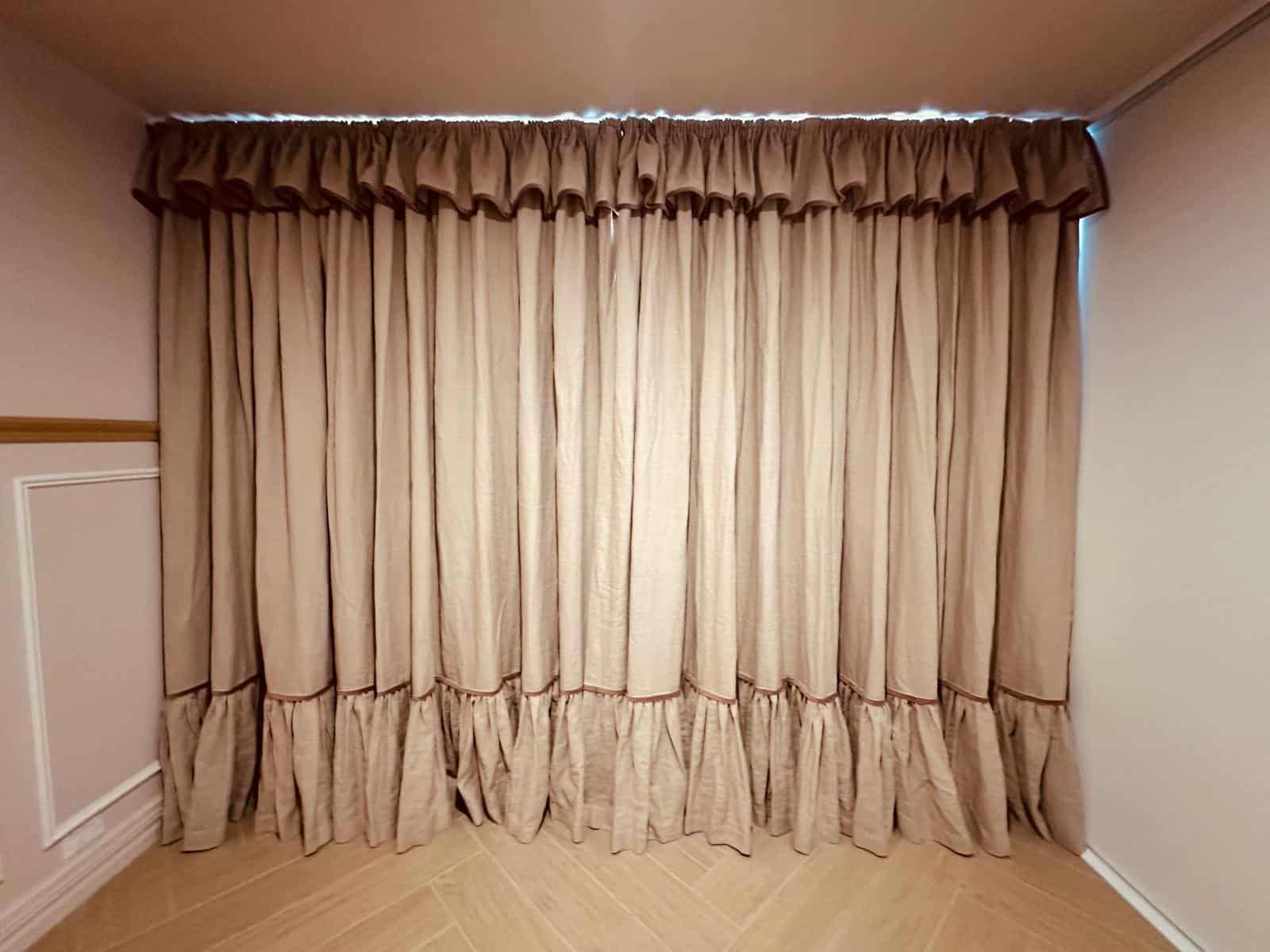
The curtains below were made for a young girl’s bedroom. There is not a character or a themed print anywhere in them – the whimsy is entirely in the making, in a frilled heading and a frilled hem above a contrast band, both of which take real skill to cut and sew. They are also thick blockout curtains, which is the part people do not expect: a curtain can be built for darkness and still be the prettiest thing in the room. In a plain natural linen, they will suit the room she grows into as well as the one she has now.
The video in Annie fitting these curtains. Everything we make is measured, made and installed by the same team – which is why an adjustment afterwards goes back to the people who made them rather than into a service queue.
Children’s curtains take a beating that adult ones do not. They get held, wiped on, drawn by someone too short to reach the top of them, and periodically breathed on by something that has been unwell.
So the first question about any fabric for a child’s room is what happens when it needs cleaning. Some fabrics wash and rehang beautifully. Others shrink, and a curtain that shrinks two per cent is a curtain that no longer reaches the floor. Others again are dry-clean only, which is fine for a formal living room and less fine for a six-year-old. We go through this properly on our curtain fabrics page, and it is the single question we would ask first in a child’s room.
The other practical matters: colour fades in Perth light, so a strong pigment on a west-facing window will not stay strong; a lining protects both the fabric and the room; and a busy weave or a small pattern forgives marks that a pale plain will show for the rest of its life.
Darkness first, and everything else second. A blockout blind at the glass with a soft curtain in front, in a colour that is not aimed at a baby. Cordless or motorised operation. A drop that clears the floor rather than pooling on it, so nothing is within grabbing distance from a cot. Neutral fabrics are the most common request we get for nurseries, and they are also the ones that survive the room becoming something else.
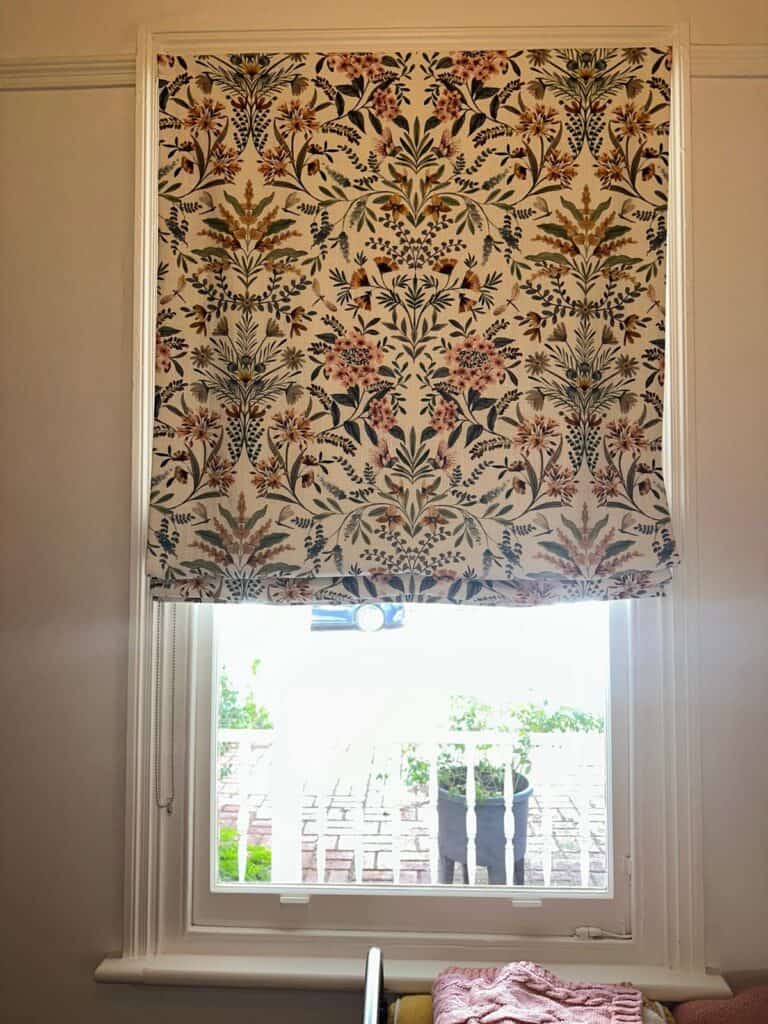
The room is now used awake as well as asleep. Light control still matters for early risers and for winter mornings, but so does the room feeling like theirs. This is where a plain made curtain plus changeable soft furnishings works far better than committing the window to a theme. If the window is small or sits above a bed, a sewn Roman blind is often the better answer than a curtain – it takes real fabric, it raises completely clear, and there is nothing hanging within reach.
Two children in one room brings a second question: how do you give each of them a bit of dark and a bit of their own space. Curtains around a bunk or a loft bed are one of the most searched things in this whole subject, and they are genuinely useful – but they are a made-to-measure job, not a shelf purchase, because the frame dictates every dimension.
Playroom windows want light, not darkness, and they want to be out of the way. Something that raises fully clear is usually the answer, in a fabric that can be wiped or washed. A sill-length treatment beats a full-length one anywhere toys are on the floor.
Two things change in a child’s room. The first is how the curtain is fixed – it is going to be pulled sideways by someone holding it at their own height, not by someone taking the leading edge, so the track or pole and its fixings need to take a load that an adult curtain never sees. The second is the heading itself, which decides both how the curtain hangs and how it takes that load. We have set out the options in full on our page for curtain headings and styles, and the right one for a child’s room is usually the sturdiest rather than the most decorative.
Decide how dark the room needs to be at two in the afternoon, then make everything else fit around that answer. Choose a fabric you can wash. And buy the window as though the child is already ten – because by the time the curtains are worn out, they will be.
A free in-home consultation is the quickest way through all of it. Annie will stand in the room at the hour the light is worst, tell you what will genuinely make it dark, and bring fabrics you can hold against your own wall. We make curtains and blinds throughout Perth, from nurseries in Nedlands to bunk rooms in Fremantle, and children’s rooms are some of the most satisfying work we do – because a room that finally sleeps changes the whole household.

A made-to-measure curtain in a washable fabric, with genuine light control behind it – usually a blockout blind at the glass or a blockout lining in the curtain itself. Choose a fabric and colour that suits the window rather than the child’s current age, and let the bedding and walls carry the theme. That way the curtains still work when the room changes.
Darkness comes from covering the whole opening, not from thick fabric. That means a full drop past the sill, enough width that the fabric overlaps generously at the centre, and a return to the wall at each side so light cannot come around the edges. A blockout roller blind fitted close to the glass with a curtain in front of it is the combination we specify most often in Perth nurseries.
Both work, and many children’s rooms end up with one of each. A blind gives you compact, complete darkness at the glass and nothing hanging within reach, which suits cots and beds pushed under windows. A curtain adds warmth, softness and sound absorption, and has no cord at all. The usual answer is a blockout blind behind a simple curtain.
Cords must be kept out of reach and secured, and a cot should never sit where a cord can be reached from inside it. The simplest solution is to remove the cord entirely – cordless operation is standard on most blinds now, and motorised curtains and blinds take the question away altogether while letting you darken a room from the doorway.
Ideally, yes – and it is worth asking before you choose the fabric rather than afterwards. Some fabrics wash and rehang perfectly, some shrink enough to change the drop, and some are dry-clean only. In a child’s room we would treat washability as the first question about any fabric, not the last.
Bed curtains are made to fit the frame, so every dimension comes off the bed itself rather than a standard size. Bring the measurements, or we will take them at the consultation.