
Blockout for true darkness, tested acoustic fabrics for sound
– and the details that separate a dark room from a dim one
A home theatre asks two things of a window that no other room does: complete darkness, and sound that behaves. Get either wrong and the room never quite works — the picture washes out on a Saturday afternoon, or the dialogue disappears into an echo and everyone reaches for the subtitles.
Most of what’s sold for media rooms addresses the first and ignores the second. This is what we’d actually specify, from a workroom that sews the curtains and sells the blinds, including the parts where fabric isn’t the answer.
Blockout fabric is the easy part. Every supplier has it, and on its own it will get a room to about eighty per cent dark — which sounds close, and isn’t. The last twenty per cent is where a media room is won or lost, and it has nothing to do with the fabric.
Light doesn’t come through a blockout curtain. It comes around it: over the top through the gap between track and ceiling, down the sides where the curtain meets the wall, and underneath if the drop stops short. A projector screen shows every bit of it.
So the details that matter are the ones nobody quotes on:
Fit the track to the ceiling, or box it in. A pelmet or a ceiling-recessed track kills the light spill above the curtain, which is usually the worst offender — and a padded pelmet does a second job here, adding fabric mass at the top of the window where sound also escapes. On a new build this is a conversation to have before the plasterer arrives.
Return the curtain to the wall. The curtain should wrap back to the wall at each side rather than stopping at the edge of the window. It’s a small amount of extra fabric and it removes the two vertical light lines either side of your screen.
Take the drop to the floor. Sill-length in a media room leaves a glowing strip beneath the window. Floor length, or as close as the room allows.
Be generous with fullness. Skimped curtains sit flat and let light find the weave at the folds. Full curtains block better and, as it happens, absorb sound better too.
None of this is exotic. It is, however, the difference between a dark room and a room that’s merely dim — and it’s why custom made curtains outperforms a ready-made of the same fabric.
A dedicated media room is usually the worst-sounding room in the house, and for a reason. It tends to be a box — square or close to it, hard floors or a thin carpet, plasterboard walls, a large flat screen, and very little soft furnishing. Every one of those surfaces reflects sound.
What you hear is a room fighting your speakers. Dialogue loses clarity because reflections arrive a fraction behind the direct sound. Bass gets boomy in the corners. You turn it up, and it gets worse rather than better.
Curtains are the most effective soft treatment you can add to a room like this, and unlike acoustic panels they don’t announce themselves. Heavy fabric hung with generous fullness absorbs sound across the speech frequencies — the range that carries dialogue — which is exactly where a hard room does its damage.
The performance is measurable. Our acoustic curtain fabrics are rated up to NRC 0.90, tested at the University of Sydney to ISO 354.
That is an absorption figure: it describes how much of the sound reaching the curtain is soaked up rather than thrown back into the room, which is the problem in a hard, square media room. A separate question is how much sound passes through a treatment to the other side, and in testing at UTS Tech Labs a traditional roller blind registered no measurable reduction on that count either. Neither result is a criticism of a roller blind doing its own job. It simply has no mass and no fullness, and both of those are what absorb sound.
Two things worth knowing if you’re treating a theatre room for sound:
Where the fabric goes matters as much as how much of it there is. Two adjacent walls work better than two facing ones — sound bouncing between parallel hard surfaces keeps bouncing, and catching it on the perpendicular breaks that path more effectively. In practice this often means the window wall plus one side wall.
You don’t have to treat everything. In a boardroom we recently worked on, two of three glass walls were enough to fix the problem entirely. A media room is usually smaller and often needs less than people expect.
Acoustic curtains also work in the other direction, which matters more in a media room than most: they reduce how much of your film escapes into the rest of the house.
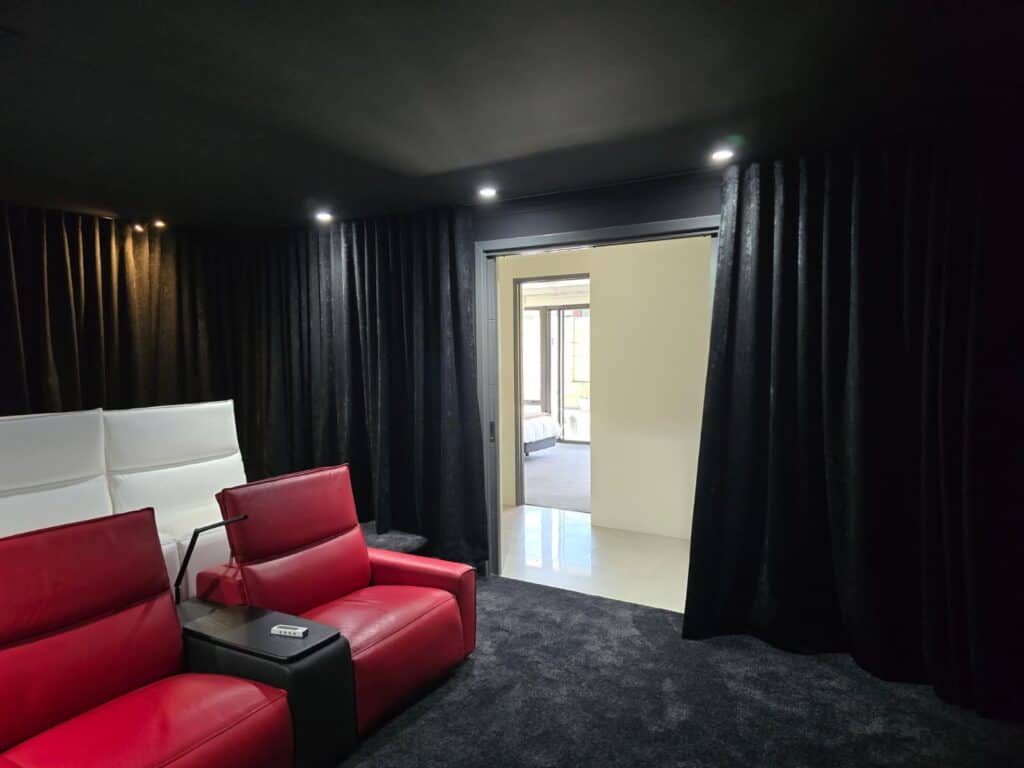

Full-drape blockout curtains are the natural answer for a theatre room. They deliver the darkness, they bring the fabric mass that helps the acoustics, and they give the room the sense of occasion a cinema should have. Sewn to measure with proper returns and fullness, they’ll outperform anything else on this page.
Where the room is genuinely echoey, or where you want the film to stay in the room, acoustic curtains are the upgrade. They can be paired with a blockout lining so you get both properties in one curtain — the lining handles the light, the face fabric handles the sound.
Some media rooms don’t have the wall space for a full curtain, or the window is high and awkward. Blockout roller blinds fitted inside a reveal with side channels get closer to true darkness than a blind has any right to, and take up almost no room. What they won’t do is anything for the acoustics — so if sound is part of the problem, pair them with fabric elsewhere in the room.
A sewn Roman blind in a heavy lined fabric suits a TV room that isn’t trying to be a cinema. You get real fabric, real structure and a tidy look that raises fully clear of the glass. Less absorbent than a full curtain, but considerably better than a roller. Or for something with flair, consider an Austrian blind or London blind.
The most flexible media rooms use two treatments: a blockout roller or Roman inside the reveal for absolute darkness, and curtains over the top for sound, warmth and the look. It costs more, and it’s the setup that actually gets used at every hour of the day.
Motorised curtains are a convenience in most rooms and close to a necessity in this one. Media room curtains are heavy — blockout lining, acoustic interlining, full fullness across a wide span — and hand-drawing them twice an evening gets old faster than you’d think. On tall or high-set windows there’s often nothing to reach for anyway.
There’s a second reason. Heavy curtains dragged by hand wear at the leading edge, and the fabric that makes them good at their job is the fabric least forgiving of handling. A motor pulls from the track evenly every time.
We fit Acmeda and Somfy systems, which integrate with most home automation setups — so the curtains can close as the lights dim, if that’s the room you’re building. On a new build, run the power before the plastering; retrofitting it later is the expensive way to do the same thing.
Dark colours, and not for the reason most people assume. A dark curtain doesn’t block more light than a pale one of the same fabric — blockout lining does that regardless. What dark fabric does is stop light *reflecting* back at the screen. A pale wall or curtain catching projector spill and bouncing it around the room lifts the black levels and flattens the picture. Deep charcoals, navies, forest greens and true blacks all work.
Texture over pattern. A busy pattern in your peripheral vision competes with the screen. Textured plains — velvets, heavy weaves, wools — give the room depth without pulling the eye.
Velvet is the classic for a reason. The pile absorbs both light and sound, it hangs beautifully at weight, and it gives a media room the cinema feel people are usually after. It’s also heavy, which makes motorisation more attractive.
Weight matters more than in any other room. The properties you want — light control, sound absorption, drape — all follow from mass. This is not the room to save money on fabric.
No natural light needed, ever. Blockout curtains floor to ceiling, wall to wall, in a dark textured fabric — often across the whole wall rather than just the window, which handles both the light and the acoustics in one move. Acoustic fabric if the room echoes. Motorised.
The common Perth case: a room used for films at night and daylight the rest of the time. Layer it — sheers or a light-filtering blind for daytime, blockout curtains over the top for viewing. Both on the same track wall so the room reads as one thing.
Usually the hardest acoustically: concrete floor, plasterboard, square, and often a large roller door wall. Fabric on two adjacent walls does more here than anything else you can do cheaply. Blockout on the window, acoustic on the perpendicular.
After a good number of Perth theatre rooms, the shortcut runs: block the light where it actually gets in — the top and the sides, not just the glass. Use enough fabric, because everything you want from it follows from weight and fullness. Treat two adjacent walls, not two opposite ones. And go dark, so the room stops reflecting your own picture back at you.
The right answer depends on your actual room — where the screen sits, which way the window faces, whether it’s a cinema or a lounge that hosts films. That’s what a free in-home consultation settles: Annie will look at the room, tell you what will genuinely make a difference, and bring fabric samples you can see in the light you’ll be living with. We fit Perth curtains and blinds from Cottesloe to Mount Lawley, and a media room is one of the rooms most worth seeing in person. Curtains and Roman blinds are made by hand in our Nedlands workroom; rollers are made to our specification by trusted specialists. Six to eight weeks for acoustic work, around four
for everything else.
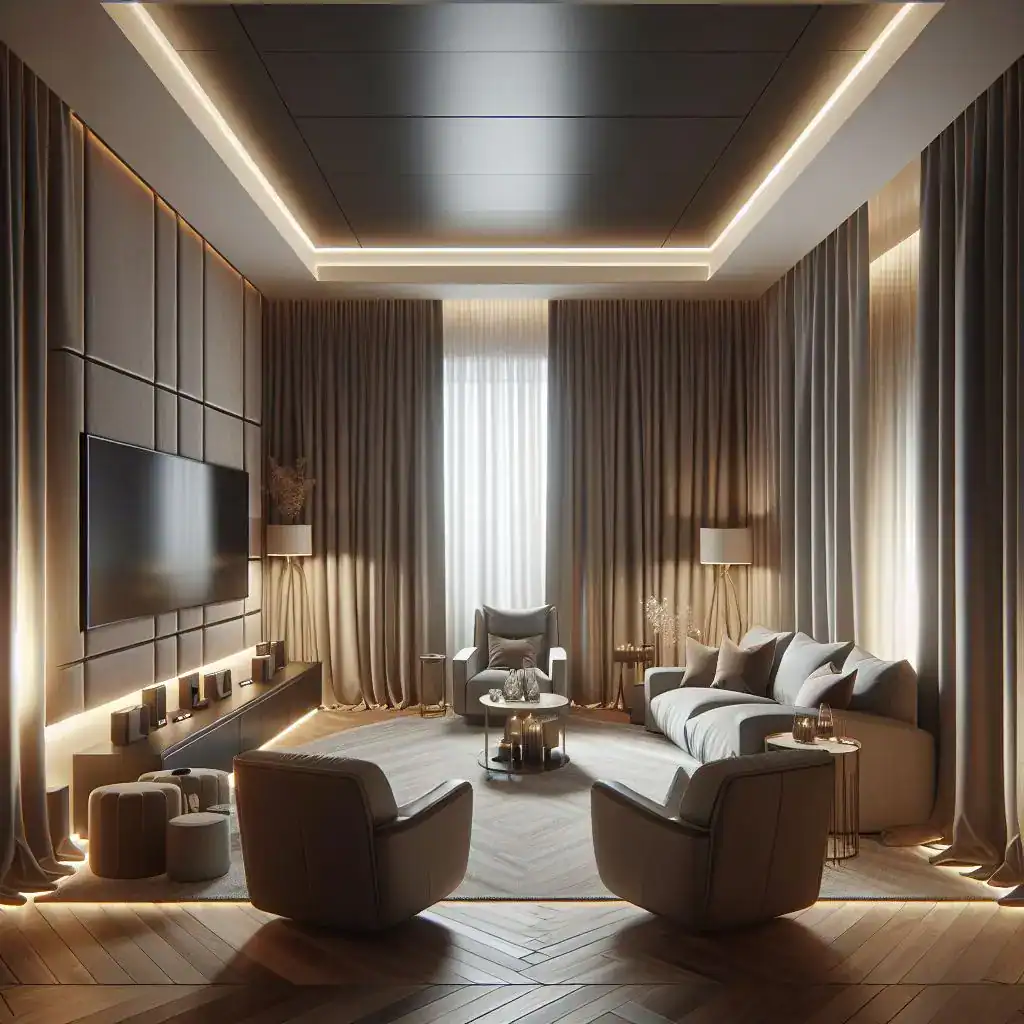
Blockout curtains in a heavy, dark fabric, sewn to measure with full returns to the wall and a floor-length drop. The fabric matters less than the fit — most light in a media room arrives around the curtain rather than through it. Where the room also echoes, an acoustic fabric or lining adds sound absorption on top.
Yes, considerably. A dedicated media room is usually a hard, square box that reflects sound and muddies dialogue. Heavy curtains hung with generous fullness absorb across the speech frequencies — our acoustic fabrics are rated to NRC 0.90 in independent testing. They also reduce how much sound escapes into the rest of the house.
Curtains, in most rooms. They achieve better darkness through returns and fullness, and they do something for the acoustics, which a blind cannot — a traditional roller blind measured zero noise reduction in laboratory testing. Blockout roller blinds with side channels are the right call where there’s no wall space for a curtain, or as a layer beneath one.
Dark. Not because dark fabric blocks more light — the lining does that — but because pale surfaces reflect projector spill back at the screen and wash out the picture. Charcoal, navy, deep green and black all work. Textured plains rather than patterns, so nothing competes with the screen.
It’s the room where motorisation makes most sense. Media room curtains are heavy and wide, they’re operated twice an evening, and the windows are often high or awkward. Motors also spare the fabric the wear of hand-drawing. On a new build, run the power before plastering.
More than a standard room. Fullness drives both light blocking and sound absorption, and the curtain needs enough width to return to the wall at each side rather than stopping at the window edge. This is the most common place cheaper quotes save money, and the most visible place it shows.