
What belongs in an enclosed wet room, where fabric genuinely works
— and the honest answer about linen in a bathroom
The standard advice about bathroom windows is that moisture decides for you: blinds or shutters, nothing made of fabric, end of discussion.
That is right about one kind of bathroom and wrong about several others. A bathroom with a shower in it and a door that stays shut is a genuinely hostile place for fabric. A separate WC with no shower in it is not. Neither is an ensuite that opens off a bedroom and shares its air, or a window nowhere near the water.
So the first question is not what to put at the window. It is which kind of bathroom you actually have.
The second question is the one most people arrive with, and it is worth saying plainly because it shapes everything that follows. You want privacy, and you want light. Nothing is worse than a bathroom that is dark in the middle of the day, and nothing is worse than one you feel watched in at night. Almost every decision below is a way of getting both.
Three things, and only one of them is about the room being a bathroom.
How close the window is to the shower – Not whether the room has a shower — how close. A window in the shower recess and a window across the room on the far wall are different propositions.
Ventilation – If the room has an exhaust fan that gets used and a window that gets opened, moisture leaves. If ventilation is at the minimum and the door stays shut, it does not — it sits in the air, and then it sits in the fabric.
Whether you want something low-maintenance – This one is about you rather than the room. A fabric treatment in a bathroom asks for a little attention. If you would rather wipe something down and forget it, that is a legitimate answer and it rules fabric out in a room where it would otherwise have been fine.
Annie asks all three at the consultation, in those terms: how do you use this bathroom, does it get steamy, and is the fan actually used. If the window sits above the bath there is a fourth — are there children in the house who splash.
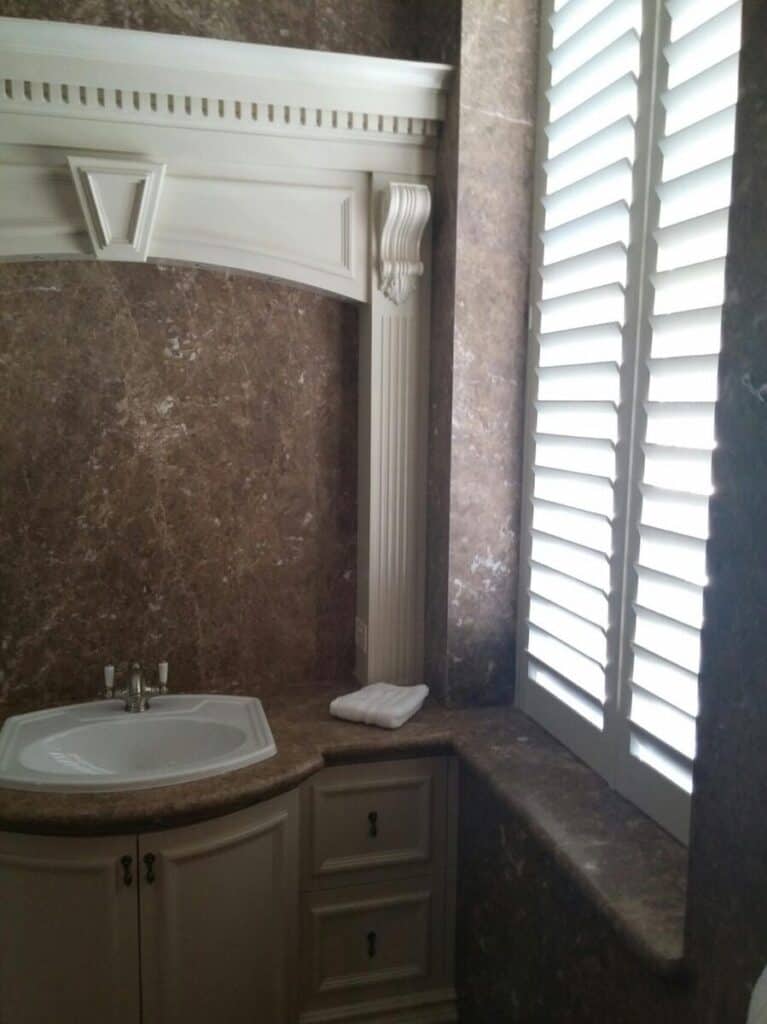
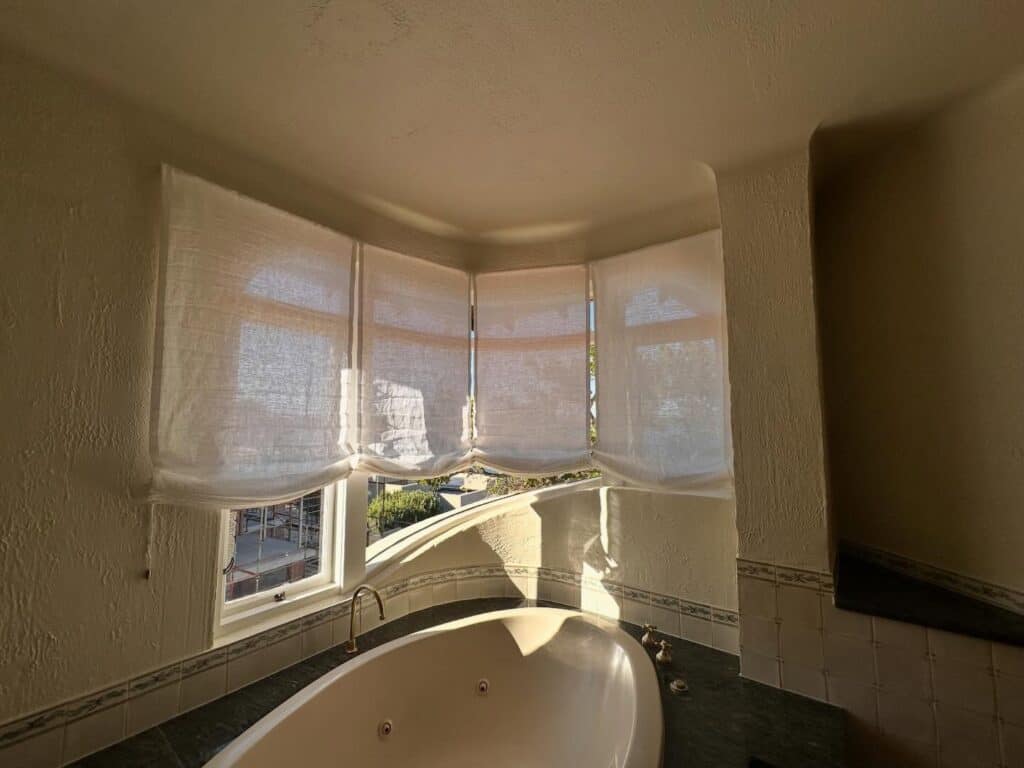
This is the common case, and it is where the standard advice is correct.
Shutters are the first answer – Timber-look venetians or PVC shutters — the material matters more than the look here, because what you want is something that shrugs off moisture and wipes clean. They also solve the light-and-privacy problem better than anything else at the window: tilt the slats and you have daylight without a view in, which is exactly the brief. Our page on plantation shutters covers the range.
Light filtering roller blinds – are the other strong answer, and often the better one on a small window. They give you privacy with the blind down and light still coming through, which is the thing a blockout roller cannot do. A bathroom is not a bedroom; you almost never want it dark. See light filtering roller blinds.
A double roller – gives you both positions on one bracket — a light filtering fabric for the day and something more private for the evening. Worth it where the window faces a neighbour directly. See double roller blinds.
Cellular honeycomb blinds – work, with a caveat worth knowing. They are not as easily wiped down as a shutter or a roller, and they are not as mould resistant. In a well-ventilated bathroom they are a good answer, particularly for insulation. In a steamy one they are the wrong pick for a reason that has nothing to do with how they look. See cellular honeycomb blinds.
The common thread is that every one of these gives you a way to have light and privacy at the same time, rather than choosing between them.
Three situations, and they are more common than the standard advice allows.
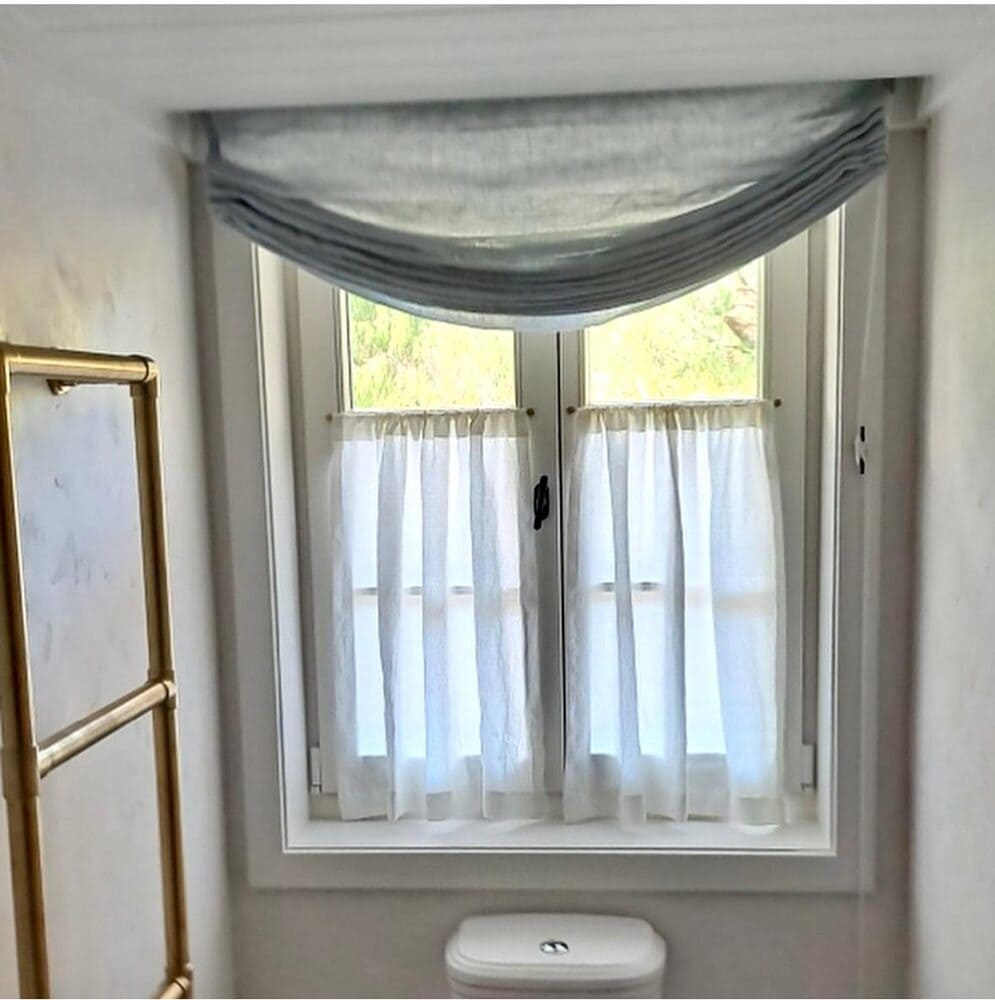
A separate WC – No shower, no steam, and a window that usually wants softening. This is where café curtains earn their place — the lower half of the window covered for privacy, the top half left open for light. It is a small, old-fashioned solution and it is exactly right for a small room where the only thing you need is not to be seen from the waist down.
An open ensuite – Where the bathroom opens off a bedroom rather than sitting behind a closed door, the air volume is much larger and the moisture disperses instead of hanging in a small sealed box. Fabric behaves here in a way it does not in an enclosed room of the same size.
Open-air, or nowhere near the water – A window on the far side of a generous bathroom, or one that opens straight outside, is not really a wet-room window at all.
In all three, the fabric choice is no different from anywhere else in the house. There is no special bathroom fabric. If the treatment is a relaxed Roman, linen is the best choice — our post on linen curtains covers the natural-versus-linen-look decision underneath that.
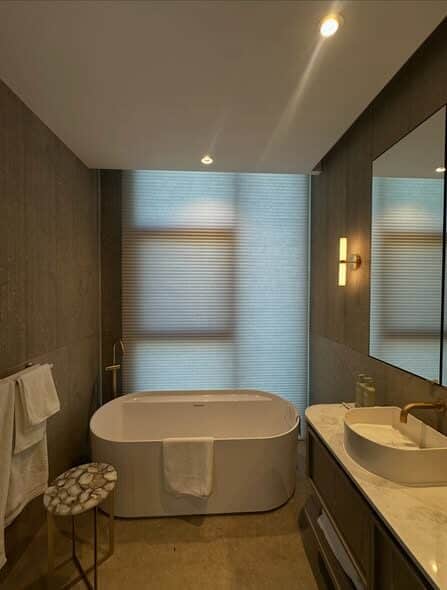

This needs saying straight, because it runs against what we would prefer to tell you.
Linen soft Romans in bathrooms are having a moment. They look wonderful, they photograph beautifully, and Annie has made a good many of them.
She does not expect them to last in an enclosed wet bathroom. Fabric sitting in moist air, day after day, is not a durable proposition, and we would be misleading you to suggest otherwise. What we do not yet have is a timeframe — these are a recent enough trend that nobody has watched one through ten years, and we have not been called back to any of them. So the honest position is not that they fail at a given point. It is that we would not expect them to go the distance, and we say so.
Clients are choosing them anyway, with that explained. That is a perfectly reasonable thing to do. A window treatment is allowed to be a decision about how a room feels rather than a fifteen-year purchase, as long as you are making it knowingly rather than discovering it later.
What Annie asks for in return is the ventilation. Use the exhaust fan. Open the window. Do not let moisture sit on the fabric. The difference between a linen Roman that lasts and one that does not is mostly in how the room gets used after it is hung.
If you want the look and not the risk, there is a middle path worth asking about: a linen blend behaves more predictably than a natural linen, and there are linen-look polyesters that read very close to the real thing while shrugging off everything a bathroom does. That is the same split the linen post sets out, and in a bathroom it matters more than anywhere else in the house.
It is the most photographed window in any bathroom and the most awkward one to operate.
The problem is reach. A blind over a bath is a blind you have to lean across water to adjust, and a cord in the wrong place is either unusable or something a child can get to. Annie’s approach at the consultation is physical rather than theoretical — she stands where you would stand and shows you where the cord would fall, so you can see whether you would actually reach it.
What follows from that is a preference for treatments you do not have to touch much.
Light filtering rollers sit in one position and do their job without being adjusted, which makes them the easiest thing to live with over a bath.
Anything with slats is easier again, because tilting is a smaller movement than lifting. You change the light without moving the blind.
Where the window is genuinely out of reach, motorisation stops being a luxury and becomes the practical answer — see motorised curtains and motorised blinds.
Everything above comes back to this.
Privacy in a bathroom is not constant — it changes with the time of day. During daylight, the glass is doing most of the work for you and the risk is lower than people assume. At night with the light on inside, the window becomes a lit stage and anything short of a closed treatment will show something.
What solves both is a treatment with two positions, or one that filters rather than blocks. A light filtering roller, a light filtering honeycomb, slats you can tilt, a double roller with two fabrics — any of these gives you daylight when you want it and cover when you need it.
What does not solve it is a blockout anything. A bathroom treated like a bedroom is a bathroom you will end up using with the light on at two in the afternoon.
Work out which bathroom you have first. If it is enclosed with a shower in it, go to shutters or a light filtering roller and do not fight it. If it is a WC, an open ensuite, or a window away from the water, fabric is genuinely available to you and the choice opens up considerably.
Then settle the light-and-privacy question before the look. Decide what you need at two in the afternoon and at nine at night, and choose something that does both rather than something that does one well.
And if the window is over the bath, stand where you would stand and work out whether you could reach it.
Annie will look at the room, ask how you actually use it, and tell you plainly where fabric is a risk — including when the answer is one you would rather not hear. We make curtains and Roman blinds in our Nedlands workroom and supply shutters, rollers and honeycombs across Perth.
It depends on the bathroom. In a separate WC with no shower, an ensuite that opens off a bedroom, or at a window well away from the water, fabric works perfectly well. In an enclosed bathroom with a shower and limited ventilation, we would not expect fabric to go the distance, and we will say so before making it.
For an enclosed wet bathroom, shutters — timber-look venetian or PVC — or a light filtering roller blind. Both wipe clean, both handle moisture, and both let you have daylight and privacy at the same time, which is what a bathroom actually needs. Cellular honeycomb blinds work in a well-ventilated bathroom but are less wipeable and less mould resistant than the alternatives.
Choose something that filters rather than blocks. A light filtering roller, a light filtering honeycomb, or any treatment with slats you can tilt will give you privacy and daylight together. A double roller gives you two fabrics on one bracket — filtering for the day, private for the evening. A blockout treatment solves privacy and creates a dark bathroom, which almost nobody wants.
In an enclosed, steamy bathroom we would not expect it to last, and we tell clients that before making one. Many choose it anyway for the look, which is a reasonable decision made knowingly. If you do, use the exhaust fan, open the window, and do not let moisture sit on the fabric. A linen blend or a linen-look fabric is more forgiving than natural linen.
Something you do not have to adjust often, because reaching across a bath is awkward and a cord in the wrong place is a hazard. Light filtering rollers and tilting slats are the easiest to live with. Where the window is genuinely out of reach, motorisation is the practical answer rather than a luxury.